Birds of Sverdlovsk Oblast
Sverdlovsk Oblast straddles the low, forested ridges of the Middle Urals on the boundary between Europe and Asia, its dense taiga and river valleys supporting a classic boreal forest bird community.
Taiga forest on the Europe-Asia border
Sverdlovsk Oblast occupies the eastern and western slopes of the Middle Urals, the stretch of the Ural range conventionally marking the boundary between Europe and Asia, though here the mountains themselves are low, rounded, and almost entirely forested rather than forming a dramatic high-altitude barrier. This gives the region's bird fauna a largely continuous character across the notional continental divide, dominated by the same boreal taiga species found across much of the wider West Siberian and East European forest belt.
Spruce, fir, and pine forest, with birch mixed through disturbed and transitional areas, covers most of the region's territory, interspersed with rivers, lakes, and a number of large reservoirs built to support the region's long industrial history centered on the city of Yekaterinburg. This combination of continuous forest and scattered open water gives the region a fairly classic taiga bird community alongside a smaller but locally important set of wetland species.
Typical species of the region
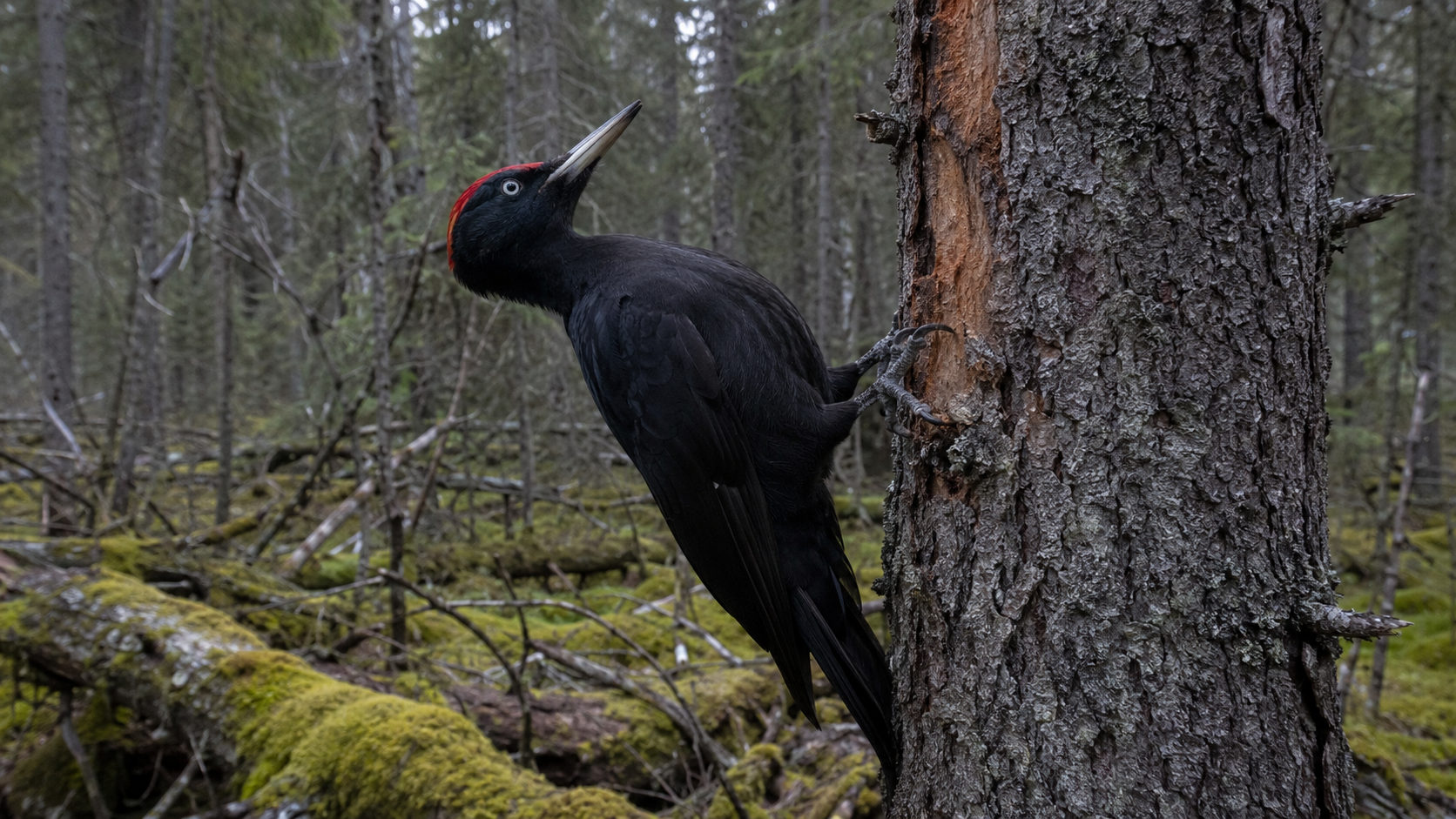
The region's dense conifer forest supports the black woodpecker, a crow-sized, all-black species whose loud calls and large rectangular excavations are among the most distinctive signs of mature taiga across Sverdlovsk Oblast, alongside the more widespread great spotted woodpecker. The coal tit is closely tied to spruce stands throughout the region, while the common crossbill, with its distinctive crossed mandibles adapted for extracting conifer seeds, tracks the irregular cone crops of the region's pine and spruce forest.
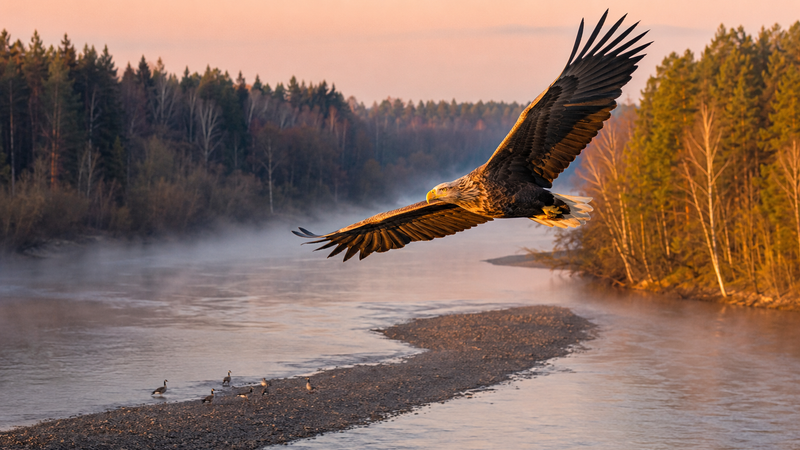
The common raven is a familiar sight over more remote forest tracts, and the white-tailed eagle hunts along the region's larger rivers and reservoirs, where fish and waterfowl are concentrated. The mallard is the most widespread duck on the region's open water, and the grey heron hunts the shallow margins of slower rivers and reservoir shorelines throughout the warmer months.
Seasonality
Spring migration reaches Sverdlovsk Oblast from April into May, later than regions further west and south owing to the Middle Urals' more continental climate, with breeding activity concentrated through late May and June. Autumn migration runs from August through September, as migratory species head south or southwest ahead of the region's long, cold winter. Winters are harsh, and bird activity outside sheltered forest is limited mainly to hardy resident taiga specialists such as tits, crossbills, woodpeckers, and corvids, which remain active through the coldest months by relying on cached food and conifer seed crops.
Conservation notes
Away from the industrial corridor around Yekaterinburg and other mining and metallurgical centers, Sverdlovsk Oblast retains extensive tracts of boreal forest, giving the region's taiga bird community a comparatively stable habitat base overall. Historical industrial pollution around some urban and mining areas has left localized habitat degradation, and continued logging pressure on older forest stands remains a concern for species that depend on mature trees for nesting and foraging, a pattern shared with much of the wider Russian taiga belt.