Common Raven
The common raven (Corvus corax) is the largest member of the crow family and the largest of all songbirds, an immensely intelligent, all-black aerial acrobat found across the Northern Hemisphere.
Key facts
- Latin name
- Corvus corax
- Wingspan
- 115–150 cm
- Season
- resident year-round
- Diet
- Carrion, often located by following predators or scavengers, Small mammals, birds, eggs, and nestlings, Insects and other invertebrates, Human food waste near settlements
- Conservation status
- LCLeast Concern
Appearance
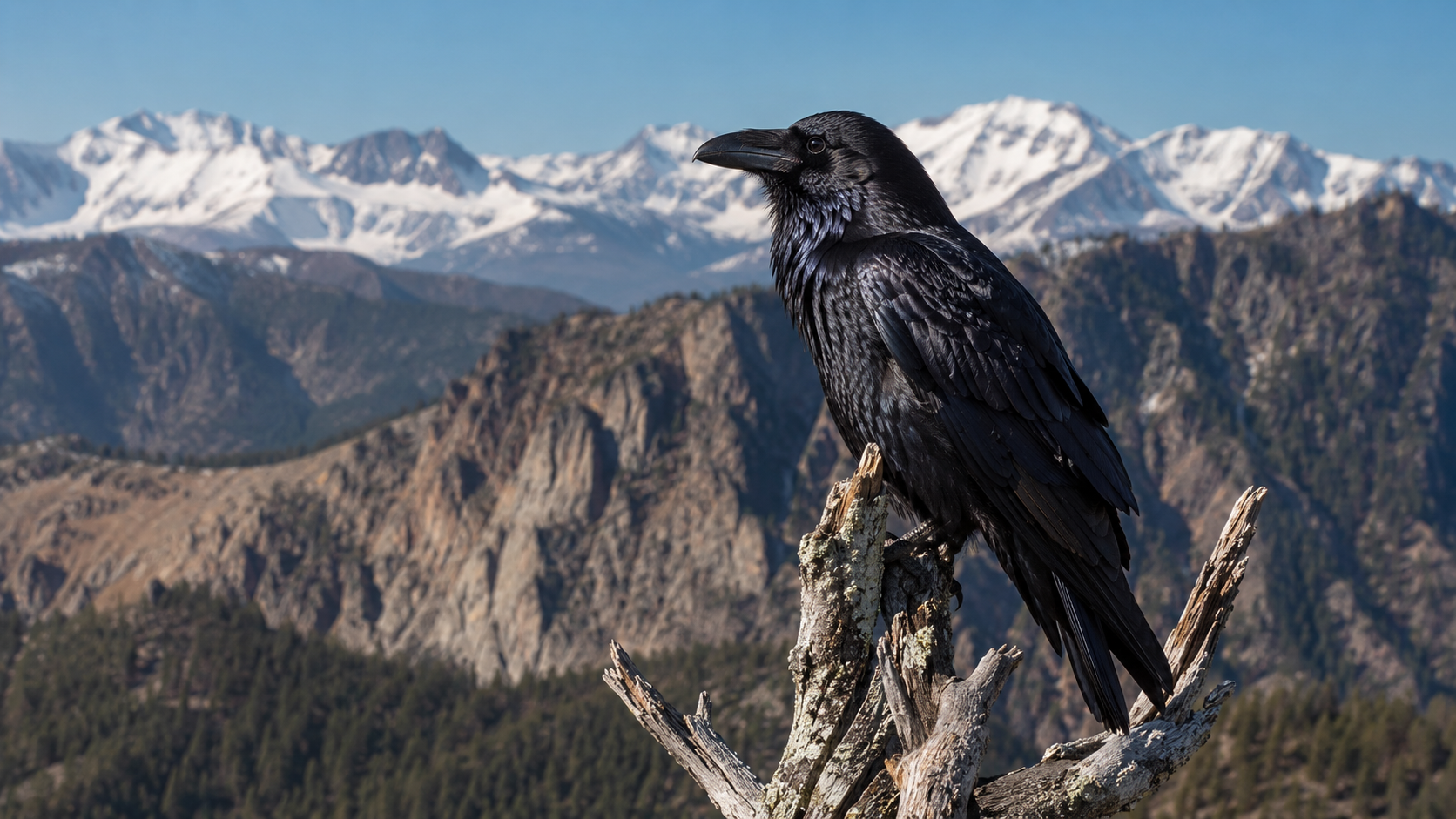
The common raven (Corvus corax) is the largest member of the crow family and, taken as a whole, the largest of all passerine (songbird) species, with a wingspan of 115 to 150 cm, a body length of 54 to 67 cm, and a weight ranging from roughly 0.7 to 2 kilograms. Its plumage is entirely glossy black with a strong purple-blue iridescent sheen visible in good light, and shaggy, elongated throat feathers — often called "hackles" — can be raised or fluffed during display, giving the bird a distinctive bearded appearance.
In flight, the raven's silhouette is unmistakable once learned: a wedge-shaped, rather than fan-shaped, tail, deep and powerful wingbeats, and a heavy, deep-based beak considerably larger and more robust than that of any crow. Its deep, resonant croaking call — often transcribed as a hollow "gronk" — carries much further than a crow's higher-pitched caw and is frequently the first clue to a raven's presence overhead.
Range and habitat
The common raven has one of the largest natural ranges of any land bird, found across almost the entire Northern Hemisphere, from the Arctic tundra through temperate Europe, Asia, and North America to parts of Central America and North Africa. Across most of this vast range it is strongly resident, with established pairs defending large territories year-round rather than migrating with the seasons.
It occupies an unusually wide range of habitats, from remote mountains, coastal cliffs, and tundra to forest, farmland, and — in many regions — towns and cities, reflecting a remarkable adaptability that has allowed the species to persist even in areas heavily altered by humans, provided a reliable food source and some undisturbed nesting sites remain available.
Behavior and lifestyle
Ravens are highly opportunistic omnivores and scavengers, feeding on carrion located by patrolling wide territories or by following predators and other scavengers to a kill, alongside small mammals, birds, eggs, nestlings, insects, and human food waste near settlements. Their intelligence is exceptional even by corvid standards, with documented behaviors including apparent future planning, sophisticated social deception around cached food, cooperative problem-solving, and simple tool use — placing the species among the most cognitively studied birds in the world.
Pairs are strongly monogamous, typically mating for life and defending large territories year-round, while non-breeding juveniles often gather in loose, highly social flocks that can include dozens of individuals, particularly around abundant food sources such as large carcasses or rubbish sites. Ravens are also remarkable aerial acrobats, performing rolls, tumbles, and even brief inverted flight, especially during pair-bonding displays and playful interactions between individuals.
Breeding
Ravens build a large stick nest, typically on a cliff ledge, in a tall tree, or increasingly on artificial structures such as pylons and buildings, often reused and enlarged across many breeding seasons. The typical clutch is 3 to 7 eggs, incubated mainly by the female for 18 to 21 days while the male provides food. Chicks fledge at around 35 to 42 days old and often remain associated with their parents' territory for several additional weeks before dispersing, sometimes joining a wider juvenile flock.
Interesting facts
- Ravens have been documented using cooperative signaling to recruit other ravens to a large carcass, apparently to overwhelm the resident dominant pair's ability to monopolize and defend the food alone — a striking example of tactical social behavior in a wild bird.
- The species holds deep cultural significance across numerous human traditions, from Norse mythology's ravens Huginn and Muninn to the ravens historically kept at the Tower of London, reflecting a long history of close observation and symbolic association between ravens and humans.
- Captive raven studies have demonstrated an understanding of cause-and-effect relationships and tool use rivaling that of great apes on comparable cognitive tasks, including solving multi-step puzzles requiring the sequential use of different tools to obtain food.