Red Crossbill
The red crossbill (Loxia curvirostra) is a specialist finch of coniferous forest with a uniquely crossed beak built for prying seeds from spruce and pine cones, and a breeding season that can start in the dead of winter.
Key facts
- Latin name
- Loxia curvirostra
- Family
- Fringillidae (Finches)
- Wingspan
- 27–30.5 cm
- Season
- resident, with irregular, food-driven irruptive movements at any time of year
- Diet
- Seeds of spruce, extracted directly from closed cones, Seeds of pine and other conifers, Occasionally buds, berries, and small insects
- Conservation status
- LCLeast Concern
Appearance
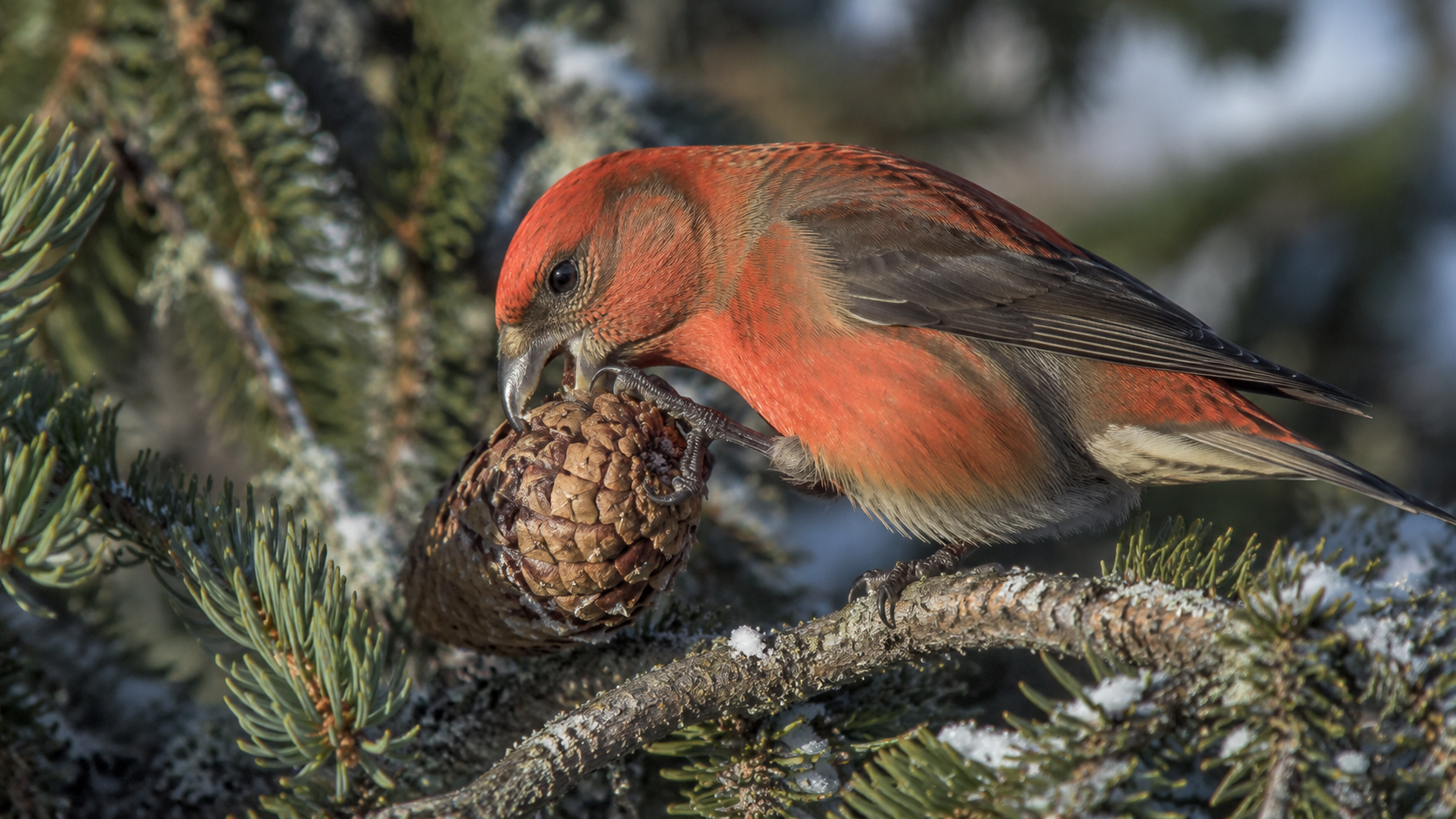
The red crossbill (Loxia curvirostra) is a stocky, large-headed finch with a wingspan of 27 to 30.5 cm and a body length of about 16 to 17 cm, weighing between roughly 34 and 53 grams. Its defining feature, unique among European finches, is a beak whose upper and lower mandible tips cross past one another rather than meeting neatly — an unusual structure that looks almost like a deformity at first glance but is in fact a precise tool for prying open the tightly packed scales of conifer cones.
Adult males are brick-red to orange overall, with darker, unmarked blackish-brown wings and tail, while females are a more muted olive-green to greyish-yellow, with a similarly dark, plain-winged pattern. Young birds are duller and more heavily streaked before acquiring adult coloring, and the exact shade of red or orange in males can vary considerably between individuals depending on age and diet.
Range and habitat
The red crossbill has an extensive range across the coniferous forests of the Northern Hemisphere, spanning most of forested Europe, Russia, and North America wherever suitable spruce and pine forest occurs. It is generally resident, but its movements are driven far more by food availability than by season: in years of widespread cone crop failure, crossbills undertake large-scale, unpredictable irruptive movements well beyond their typical range in search of better feeding conditions.
It is a strict coniferous forest specialist, found almost exclusively in stands of spruce, pine, and other cone-bearing trees, with its local abundance in any given area closely tracking the size of the current cone crop rather than remaining stable from year to year.
Behavior and lifestyle
Crossbills feed almost entirely on conifer seeds, particularly spruce, extracted directly from closed cones using the crossed beak to pry apart individual scales before removing the seed with the tongue — a technique that lets crossbills access food completely unavailable to most other seed-eating birds and largely explains their tight ecological dependence on conifer forest. Where different call types or regional populations favor different conifer species, subtle differences in beak size and shape have evolved to match the particular cone structure of the preferred tree.
Because cone crops vary dramatically between years and regions, crossbill populations are famously nomadic and unpredictable, with flocks capable of moving hundreds of kilometers between seasons in search of productive forest, and local abundance in any one area can shift dramatically from one year to the next depending entirely on food supply rather than typical migratory timing.
Breeding
Crossbills build a well-insulated cup nest, typically high in a conifer, and are unusual among European songbirds in their capacity to breed at almost any time of year, including the depths of winter, whenever a sufficiently large local cone crop supports it. The typical clutch is 3 to 4 eggs, incubated mainly by the female for 12 to 16 days, with the male feeding her regurgitated seeds throughout incubation. Chicks fledge at around 17 to 25 days old, a comparatively long nestling period reflecting the specialized, labor-intensive process of extracting and processing conifer seeds to feed them.
Interesting facts
- Because their entire life cycle is built around unpredictable conifer cone crops, crossbills can nest successfully in temperatures well below freezing, relying on thick insulating nest material and close parental attendance to keep eggs and chicks warm through midwinter cold snaps.
- Researchers have documented multiple distinct vocal "call types" of red crossbill, each with subtly different bill proportions matched to a particular conifer species, and ongoing research continues to investigate whether some of these types represent separate species rather than variants of one.
- A crossbill can extract and process conifer seeds so efficiently that a single bird may open several hundred cones in a single day during periods of active feeding, reflecting just how tightly its beak, behavior, and habitat are tied together.