Coal Tit
The coal tit (Periparus ater) is the smallest European tit, a conifer-forest specialist with a distinctive white nape patch and an intense drive to cache seeds against future shortages.
Key facts
- Latin name
- Periparus ater
- Family
- Paridae (Tits)
- Wingspan
- 17–21 cm
- Season
- resident year-round; occasional irruptive movements in poor cone-crop years
- Diet
- Small insects and spiders, especially in the breeding season, Seeds of spruce, pine, and other conifers, Cached seeds retrieved through autumn and winter, Garden feeder food, especially sunflower hearts
- Conservation status
- LCLeast Concern
Appearance
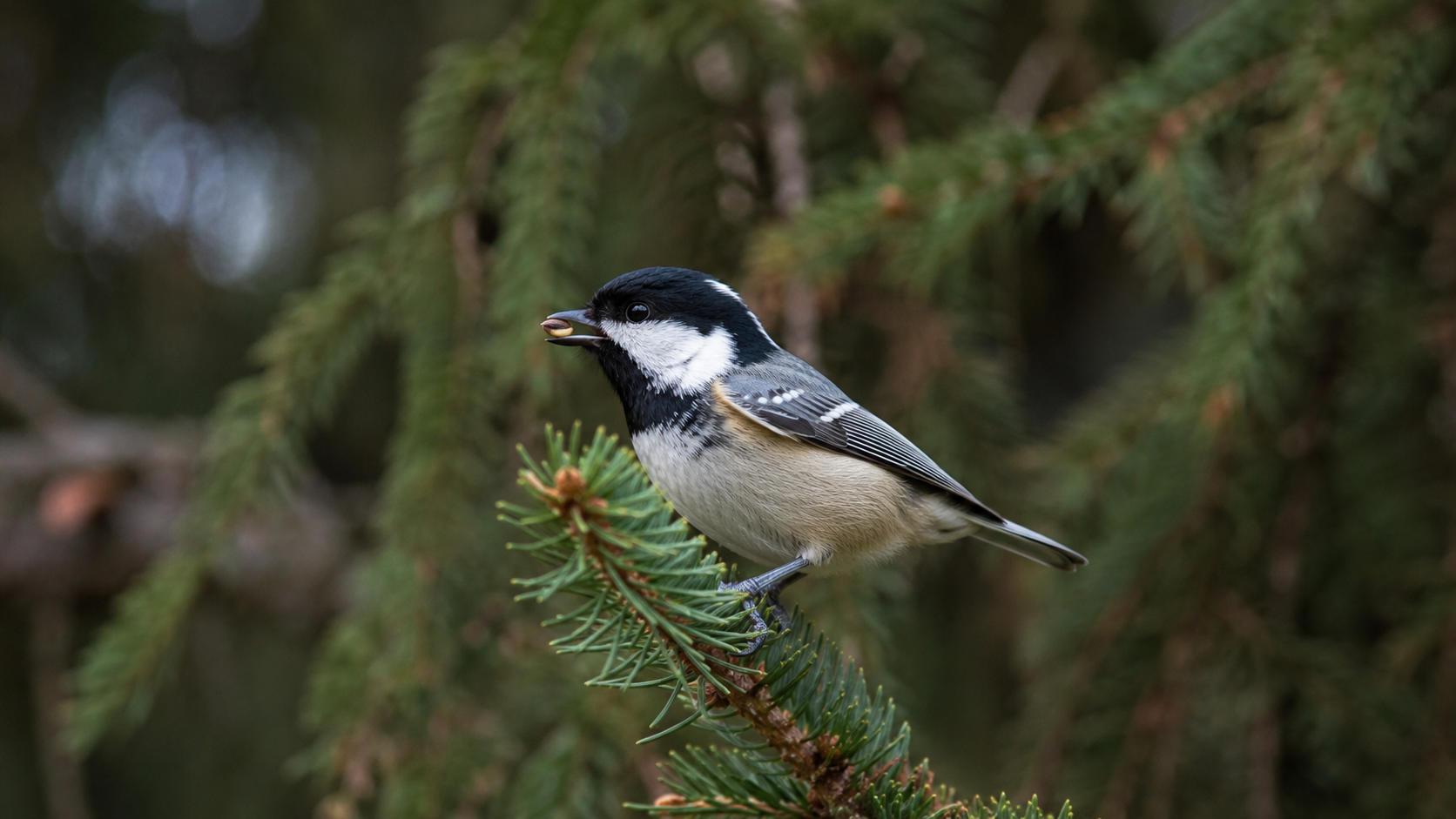
The coal tit (Periparus ater) is the smallest tit found in most of Europe, with a wingspan of 17 to 21 cm and a body length of about 10.5 to 11.5 cm, weighing only around 8 to 10 grams. Its head pattern shares the general black-and-white scheme of its larger relatives — a glossy black crown and bib with white cheek patches — but is uniquely marked by a distinct white patch on the nape, the back of the head, a feature absent in both the great tit and blue tit and one of the fastest ways to confirm identification.
The body is a fairly plain grey-buff above and paler buff below, lacking the bold blue or yellow tones of its close relatives, and the beak is notably fine and slightly elongated compared to other tits, an adaptation suited to extracting small seeds from tight conifer cones and probing among dense needle clusters.
Range and habitat
The coal tit is widespread across almost all of Europe and extends through the boreal forest belt of Russia into Siberia, occurring further into the coniferous taiga than either the great tit or blue tit. It is generally resident, though poor cone crop years in the northern part of the range can trigger irregular, food-driven movements southward, similar to the irruptive behavior seen in some conifer-specialist finches.
It shows a stronger preference for coniferous and mixed forest than its close relatives, favoring spruce, pine, and fir stands, though it also occurs in gardens and parks with conifer trees, particularly where feeders provide a reliable supplementary food source through the winter months.
Behavior and lifestyle
The coal tit's diet includes small insects and spiders, especially important during the breeding season, alongside the seeds of spruce, pine, and other conifers, which make up an increasingly large share of its food through autumn and winter. The species is a particularly intense food-cacher, hiding individual seeds in bark crevices, moss, and soil across its territory during periods of abundance and relying on strong spatial memory to relocate a significant proportion of these caches later, an adaptation that helps buffer against unpredictable cold spells and food shortages.
Despite its small size, the coal tit is a bold and agile forager, often visiting garden feeders alongside larger tits, though it typically takes a single seed and quickly retreats to a nearby perch to eat or cache it rather than lingering at the feeder itself — a behavioral difference from the more sedentary feeding style of the great tit.
Breeding
Coal tits nest in low cavities, including holes in tree stumps, banks, or rodent burrows close to ground level, somewhat lower than the typical nesting height favored by great tits and blue tits, and will also use nest boxes where available. The typical clutch is 7 to 11 eggs, incubated solely by the female for 14 to 16 days. Chicks fledge at around 16 to 19 days old and remain dependent on their parents for continued feeding for a short period after leaving the nest.
Interesting facts
- Coal tits have been shown in controlled studies to remember the locations of a substantial share of their own food caches for weeks at a time, relying on spatial memory abilities that rank among the most sophisticated documented in small songbirds.
- The species' strong association with coniferous forest means coal tit numbers and distribution can serve as a useful indicator of conifer forest health and extent within a given region.
- Despite weighing less than 10 grams, coal tits are capable of surviving harsh winter conditions in northern coniferous forest by combining intensive food caching with the same kind of controlled overnight energy-saving strategies used by other small tits.