Birds of Prey
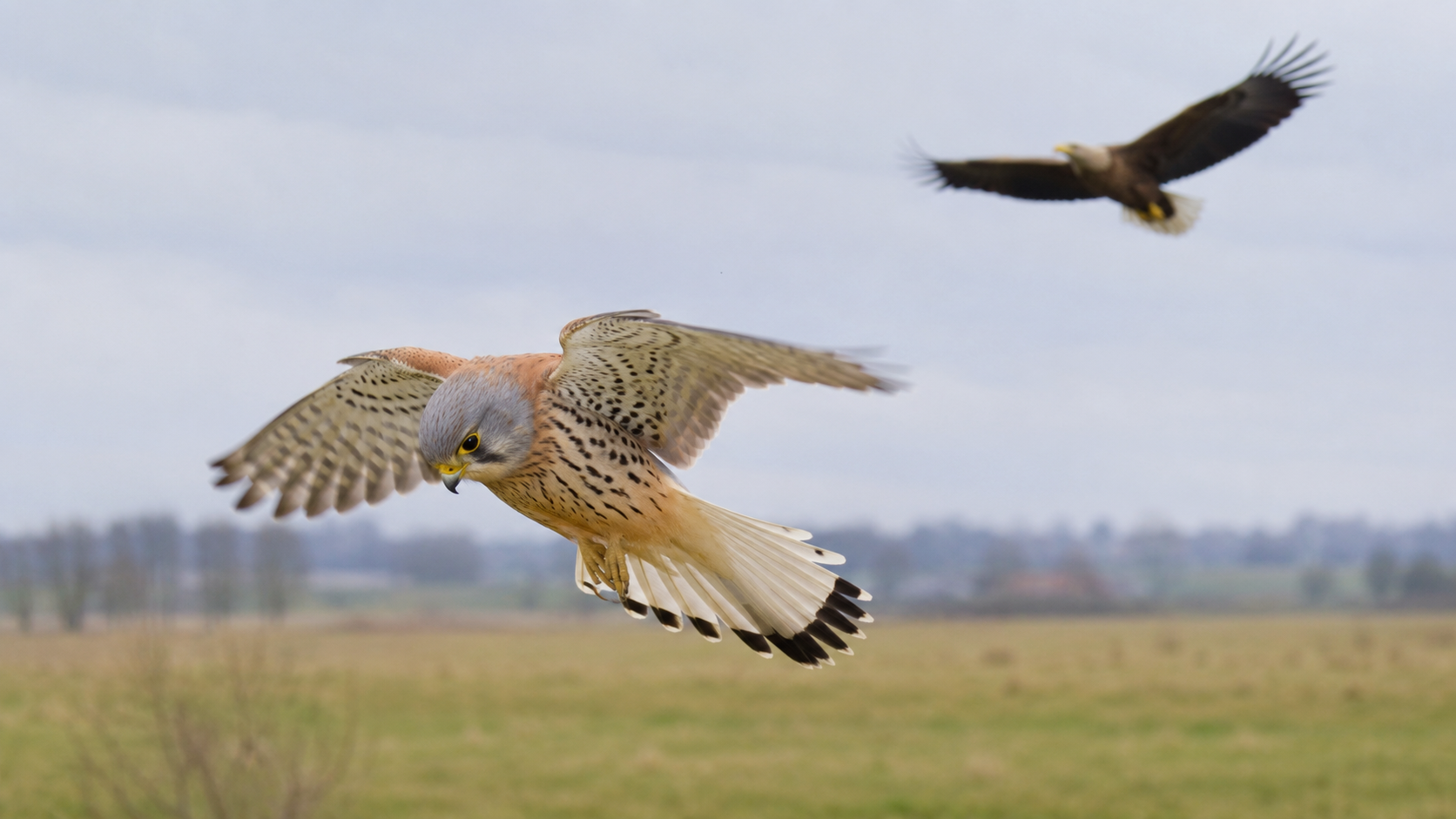
Birds of prey hunt live vertebrate prey with keen eyesight, sharp talons, and a hooked bill — from the hovering common kestrel to the massive, fish-hunting white-tailed eagle.
What unites birds of prey
Birds of prey, often called raptors, are defined less by close evolutionary relationship than by a shared set of specialized adaptations for hunting live vertebrate prey. Across several separate bird orders — falcons, hawks and eagles, and owls among them — the same core toolkit recurs: exceptionally sharp eyesight (or, in owls, exceptional hearing as well) for detecting prey at range, strong, deeply curved talons for seizing and dispatching prey, and a hooked bill suited to tearing flesh rather than the straighter, more generalized bills of most other bird groups.
This convergence reflects independent evolution toward the same demanding ecological role — killing and consuming other vertebrates — rather than a single shared ancestry, which is why modern classification places falcons, hawks and eagles, and owls in entirely separate taxonomic orders despite their broadly similar predatory toolkit and general silhouette.
Featured birds of prey in this atlas
The common kestrel (Falco tinnunculus) is Europe's most familiar falcon, instantly recognizable for its habit of hovering motionless over open ground while hunting voles. The common buzzard (Buteo buteo) is the most widespread broad-winged hawk relative across much of the atlas's covered range, frequently seen soaring in wide circles or watching from a roadside perch.
The white-tailed eagle (Haliaeetus albicilla) is one of the largest raptors in Europe, a powerful fish- and waterbird-hunter closely tied to large lakes, rivers, and coasts. The Eurasian eagle-owl (Bubo bubo) represents the nocturnal side of this group, one of the largest owl species in the world, hunting largely after dark using exceptional low-light vision and directional hearing.
Where and when to watch birds of prey
Open farmland, forest edges, large lakes and rivers, and areas with a mix of open hunting ground and elevated perches or nest sites tend to offer the best opportunities to see this group, with many species most active and visible during daylight hours in spring and summer while defending breeding territories and provisioning young. Nocturnal species such as the eagle-owl require a very different approach, best looked and listened for around dusk and after dark, when calls carry clearly through quiet woodland and territorial activity peaks.