Where Do Birds Live
Birds occupy virtually every habitat on Earth, from tropical rainforest to open ocean to Antarctic ice — with distribution shaped far more by climate and food than by any single continent.
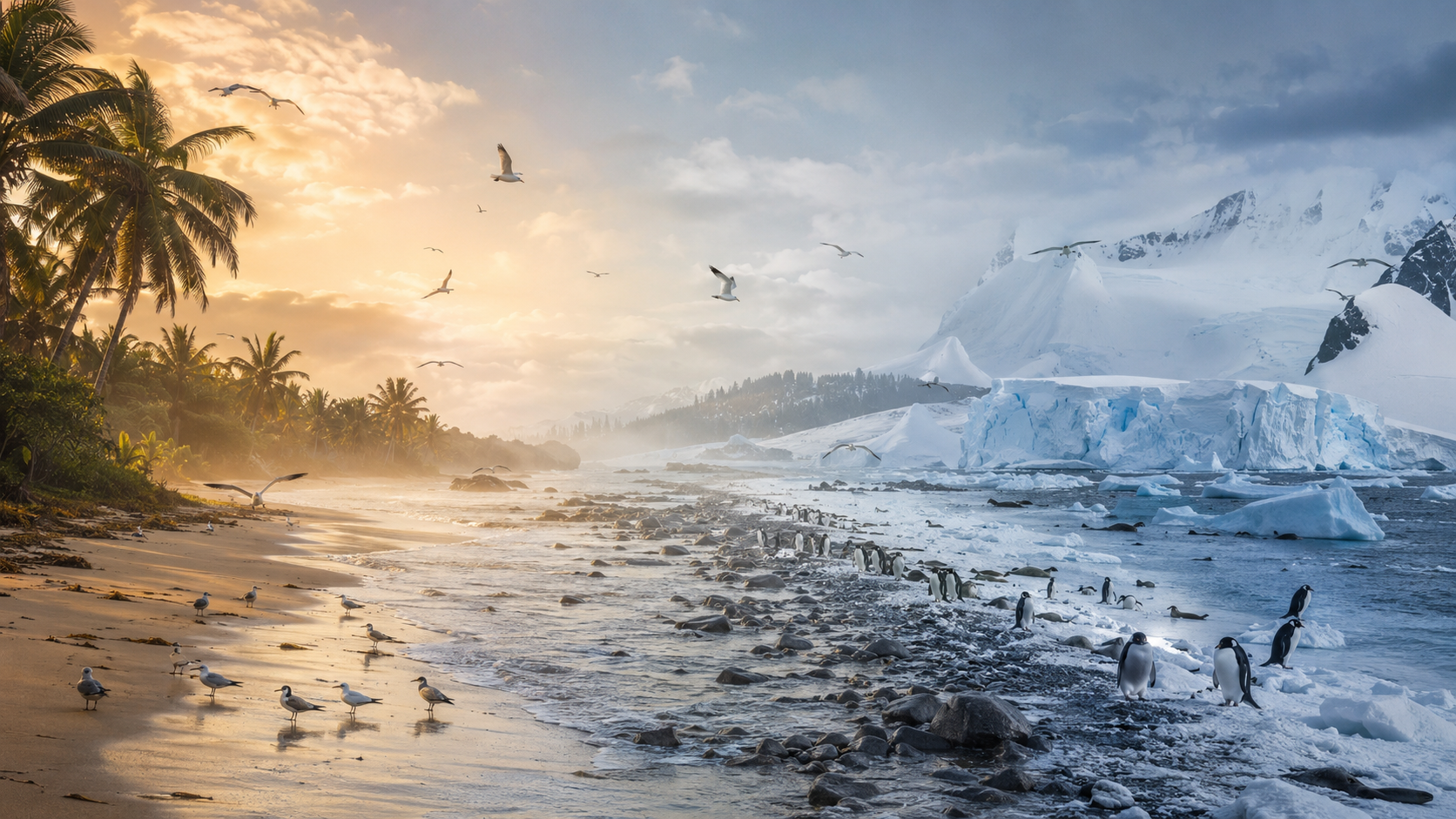
Birds occupy nearly every habitat on Earth
Few animal groups match birds for sheer breadth of habitat occupied. Birds breed in tropical rainforest, temperate forest and farmland, open grassland and steppe, desert, high mountains, freshwater wetlands, coastlines, and open ocean far from any land — and, in the case of several penguin species and a handful of seabirds, on the Antarctic continent itself, making birds one of the very few vertebrate groups with an established presence on every continent on Earth.
This breadth is possible because different bird lineages have evolved highly specialized adaptations for radically different environments: waterproof, densely packed feathers and efficient body heat retention for polar seabirds and penguins; the ability to extract water from food alone for many desert species; and, for high-altitude specialists, physiological adaptations to breathe efficiently in thin mountain air. No single body plan works everywhere, but across the roughly 10,000+ species that exist worldwide, essentially every viable habitat niche has been filled by some lineage.
Why some regions and habitats hold more species than others
Species diversity is distributed very unevenly. Tropical regions near the equator consistently support the highest number of species per unit area, driven by year-round warmth, abundant food, and structurally complex vegetation — a single hectare of tropical rainforest can support dramatically more bird species than an equivalent area of temperate forest or farmland further from the equator. This pattern, called the latitudinal diversity gradient, holds broadly across plants and animals generally, not birds alone, and it's reflected clearly across this atlas's regional pages, where tropical countries show markedly higher species counts than temperate ones of similar size.
Habitat structure matters alongside climate: wetlands and coastlines tend to concentrate unusually high species diversity relative to their area, since they offer abundant food and several distinct sub-habitats (open water, mudflat, reedbed, shoreline) in close proximity, while more extreme or uniform environments — deserts, open ocean far from coastlines, high-altitude tundra — support fewer species, each typically showing strong specialized adaptations to that specific environment's particular challenges.
Range versus local habitat
A species' presence in "the world" is really the sum of two separate things: its overall geographic range — the broad area across continents where it's found — and the specific local habitat type it needs within that range. A species can have a vast geographic range while still being absent from most of the landscape within it, simply because it depends on a specific habitat, such as reedbed or old-growth forest, that doesn't cover the entire range uniformly. Species restricted to one small area entirely, found nowhere else, are called endemics — a special case at the far end of the same range-and-habitat relationship that shapes where every bird species is actually found.