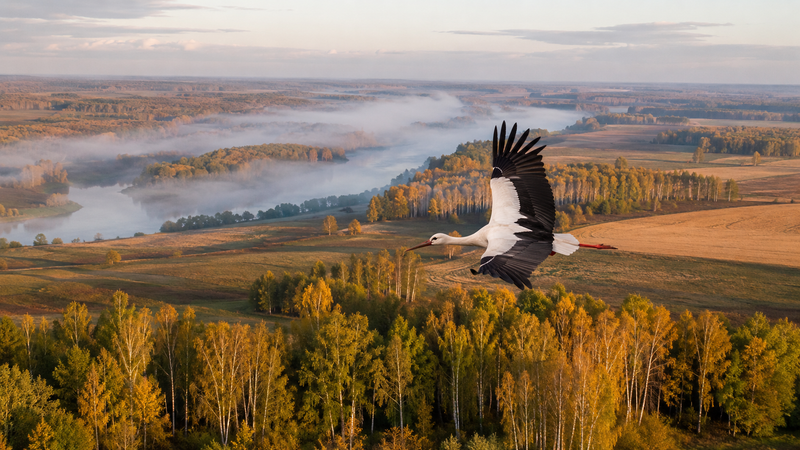
Bird Distribution Maps

What a distribution map actually shows
A bird distribution map is a compact summary of where a species occurs and when, condensing information that would otherwise take paragraphs of text into a single visual reference. At minimum, a useful map distinguishes between a breeding range — where a species nests and raises young — and a wintering range, the separate area, often much further south, where the same population spends the colder months when its breeding grounds become too cold or food-poor to support it.
For species that don't migrate at all, maps instead show a single resident range, one continuous zone occupied year-round rather than two separate areas connected by seasonal movement. Getting these categories right matters for identification: a sighting that falls squarely within a resident range at any time of year is unremarkable, while the same species turning up well outside its known range or season is worth a second look, and possibly a report to a local birdwatching network.
Reading migration routes between ranges
Between a breeding range and a wintering range, many maps also draw a migration route — the general corridor a population follows twice a year as it moves between the two. These routes are rarely a single straight line; they often follow coastlines, river valleys, or mountain passes that offer easier flying conditions, reliable stopover food, or shelter from prevailing winds, and different populations of the same species can follow entirely different routes depending on where within the breeding range they nest.
The greylag goose illustrates this well: populations breeding across Russia's steppe and forest-steppe zone are substantially migratory, present on their breeding grounds from March to October and wintering around the Mediterranean, Black Sea, and Caspian coasts, while feral and reintroduced populations in milder parts of Western Europe have become largely resident, staying on the same lakes and parks all year. A single species map, in other words, sometimes needs to show more than one range type at once.
Why some species show no clear pattern at all
Not every species fits neatly into resident, migratory, or partially migratory categories. The mallard is a good example of a species best described as resident across most of its enormous range, with only its northernmost populations shifting short distances south in the harshest winters, while the mute swan shows a similar pattern — resident through most of its temperate range, with only the coldest continental populations moving when home waters freeze solid. Maps for these species tend to show one large resident zone with a note about partial movement at the range edges rather than a clean two-region breeding-and-wintering pattern.
The grey heron sits somewhere in between: broadly resident in milder western and southern parts of its range, but genuinely migratory further east and north across colder, more continental parts of Russia, present there only from roughly March to October. This kind of within-species variation is exactly why regional pages in this atlas — organized by Russia, Europe, Asia, Africa, and the Americas — matter as much as species-level range maps: the same bird can behave quite differently depending on where in its range you're watching it.
Using range and season together with the identifier
Range and season are two of the five core criteria used throughout this atlas's bird identifier, alongside color, size, and beak shape. A distribution map answers a narrower but very practical question — is this species even plausible here, at this time of year — before the finer identification work of comparing plumage and structure begins. As more regional and country pages are added to the atlas, this page will continue to serve as the reference point for how to interpret the range and season information given on every species profile.