Black Woodpecker
The black woodpecker (Dryocopus martius) is Europe's largest woodpecker, an entirely black, crow-sized bird whose huge excavated cavities provide essential shelter for owls, martens, and many other forest animals.
Key facts
- Latin name
- Dryocopus martius
- Family
- Picidae (Woodpeckers)
- Wingspan
- 64–68 cm
- Season
- resident year-round
- Diet
- Carpenter ants and other wood-dwelling ants, a large share of the diet, Wood-boring beetle larvae extracted from dead trees, Other forest insects and larvae
- Conservation status
- LCLeast Concern
Appearance
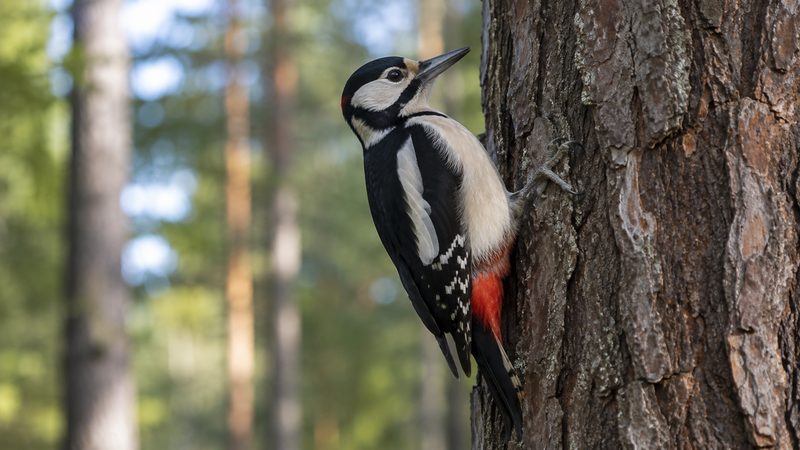
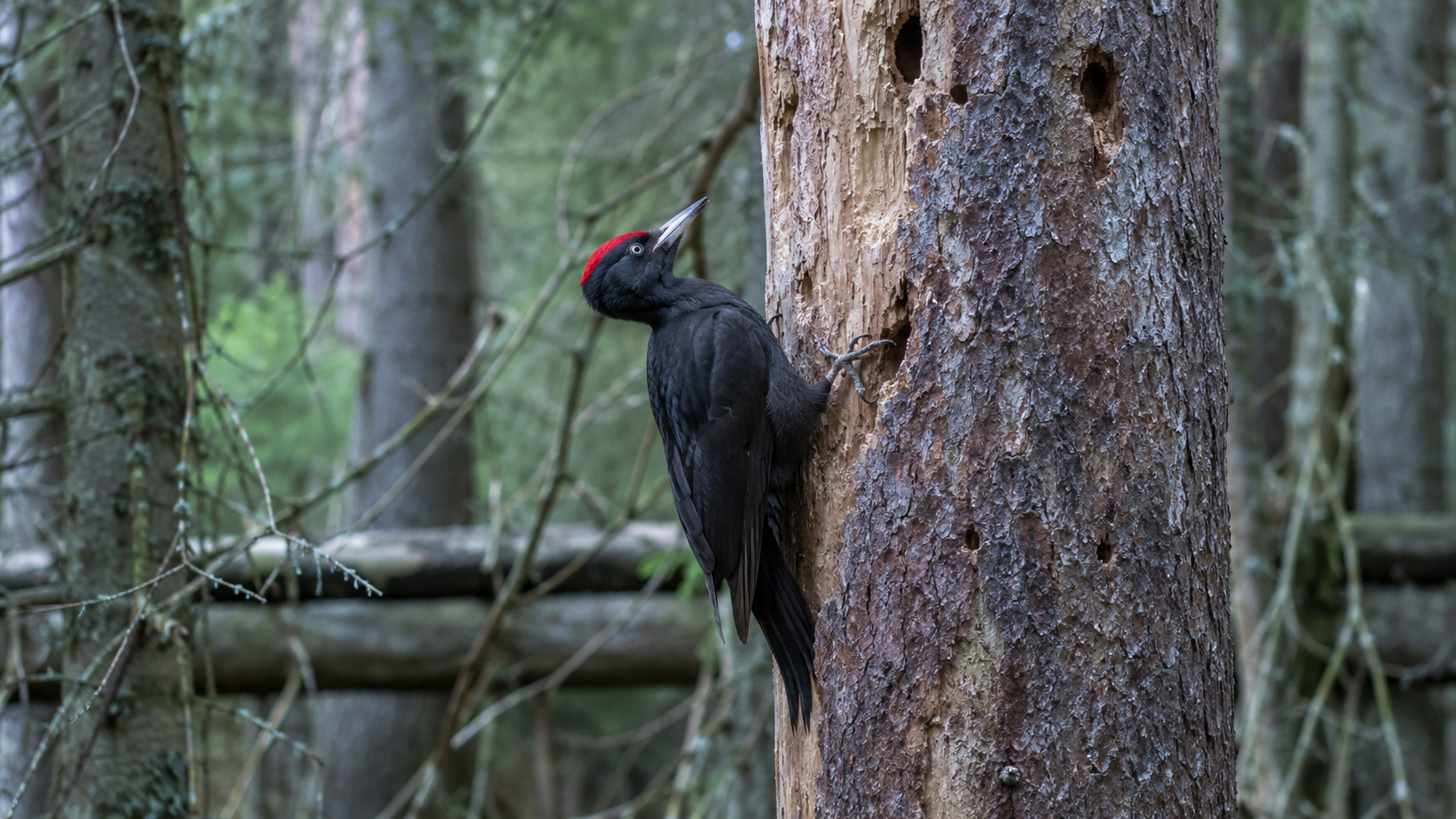
The black woodpecker (Dryocopus martius) is by far the largest woodpecker found in Europe, with a wingspan of 64 to 68 cm and a body length of about 45 to 57 cm, weighing between roughly 250 and 380 grams — a size close to that of a crow, quite different in scale from the much smaller great spotted woodpecker also covered in this atlas. Its plumage is a uniform, glossy black across the entire body, offset by a striking crimson-red crown patch and a pale, ivory-colored beak that stands out clearly against the dark head.
The extent of red on the crown provides the clearest way to distinguish the sexes: the male shows a solid red patch running the full length of the crown from the beak to the nape, while the female's red is confined to a smaller patch only at the back of the head. In flight, the species' large size, slow, deep, somewhat crow-like wingbeats, and loud, far-carrying calls usually make it easy to identify even at a distance.
Range and habitat
The black woodpecker has a broad range spanning most of forested Europe and extends across the boreal taiga belt of Russia into Siberia. It is strongly resident, with established pairs generally remaining within a large territory year-round rather than migrating.
It favors mature, structurally diverse forest, particularly stands with a good supply of large dead or decaying trees, since both its excavation of nest cavities and much of its foraging on wood-dwelling ants depend on the availability of substantial deadwood, a resource often scarcer in intensively managed, younger commercial forestry than in older, less disturbed woodland.
Behavior and lifestyle
Black woodpeckers feed heavily on carpenter ants and other wood-dwelling ant species, which can make up the majority of the diet, extracted by excavating deep into ant colonies within dead or decaying wood using powerful, forceful strikes considerably more extensive than the more precise, localized excavation typical of smaller woodpeckers. Wood-boring beetle larvae and other forest insects supplement this ant-heavy diet throughout the year.
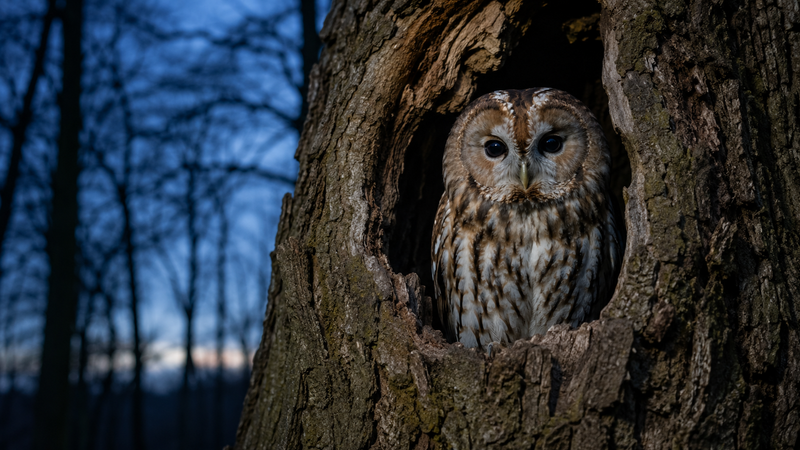
The species' large excavations, particularly the substantial nest cavities carved into mature trees, extend well beyond the bird's own needs: once vacated, these cavities are reused extensively by a range of other forest animals that cannot excavate cavities of their own, including tawny owls, stock doves, and pine martens, giving the black woodpecker significant standing as what ecologists describe as an ecosystem engineer within its forest habitat.
Breeding
Black woodpeckers excavate a large, deep nest cavity, typically higher and considerably more spacious than the cavities of smaller European woodpeckers, most often in a mature tree with heart rot or other internal decay that makes deep excavation more feasible. The typical clutch is 3 to 5 eggs, most often 4, incubated by both parents for 12 to 14 days. Chicks fledge at around 24 to 28 days old, a comparatively long nestling period reflecting both the large size of the species and the correspondingly extended development needed before independence.
Interesting facts
- A single black woodpecker excavation can be large and deep enough to later shelter species as different as a nesting tawny owl and a resting pine marten, illustrating just how far the ecological impact of this one species' activity extends beyond its own breeding needs.
- The black woodpecker's loud, ringing calls and distinctive, powerful drumming, produced on especially resonant deadwood, can carry over considerable distances through dense forest, making the species relatively easy to detect by ear even in habitat too thick for easy visual observation.
- Forest management practices that deliberately retain standing deadwood, rather than removing it entirely, have been shown in several European studies to directly benefit black woodpecker populations, illustrating a clear, practical link between forestry decisions and the conservation of this ecologically influential species.