Birds of Russia
Russia spans eleven time zones and habitats from Baltic wetlands to Far Eastern taiga, giving it one of the most varied bird faunas of any single country in this atlas.
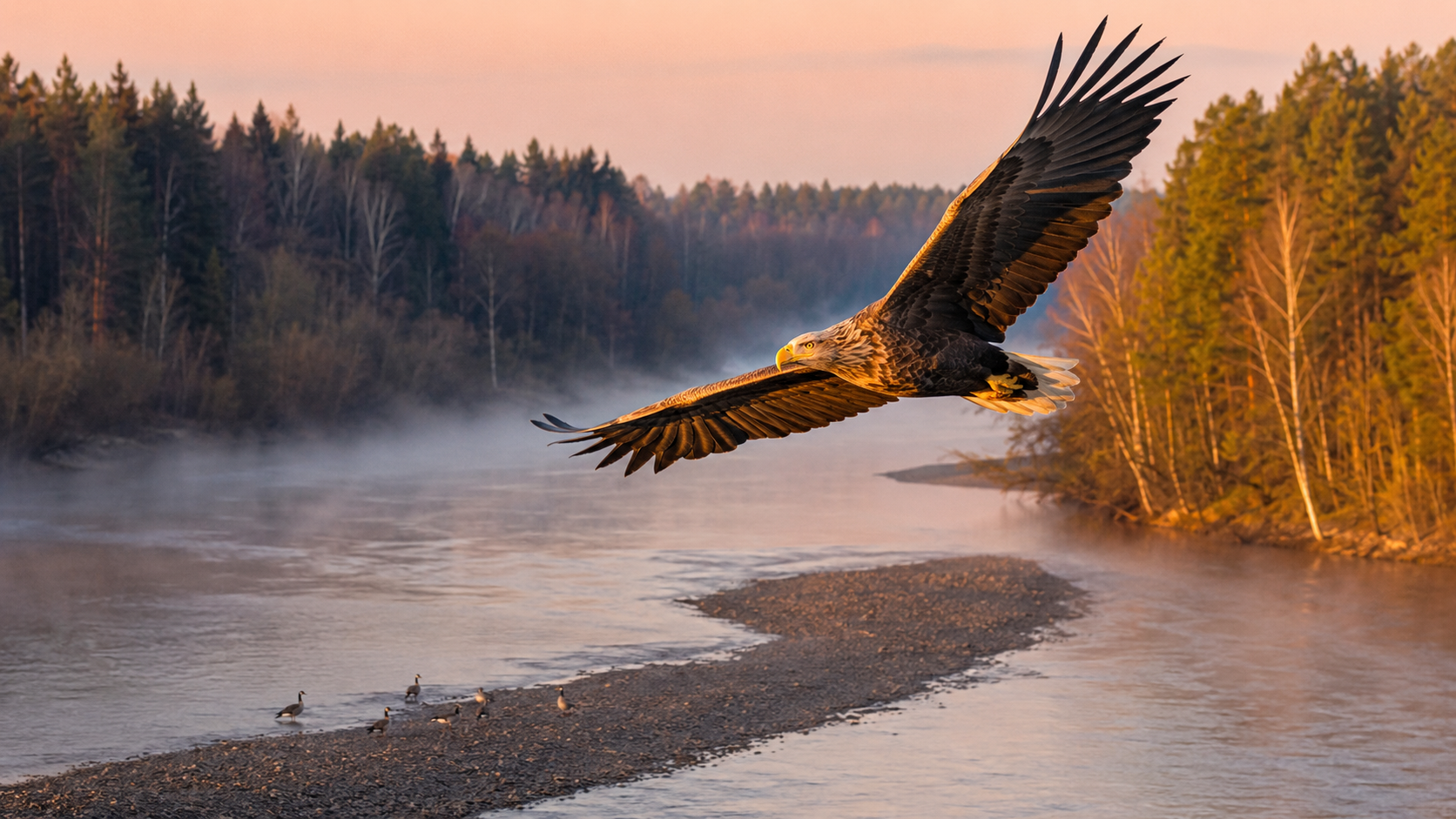
A country too large for one bird fauna
Russia is by far the largest country covered in this atlas, spanning eleven time zones and a correspondingly vast range of habitats — Baltic coastal wetlands and mixed forest in the west, endless taiga and steppe across Siberia, and temperate forest bordering the Sea of Japan in the Far East. No single list of "typical Russian birds" can do justice to that range, which is why this overview page sits above a growing set of subnational pages rather than trying to summarize the whole country in one sweep.
The regional pages published alongside this overview — covering Moscow Oblast, Leningrad Oblast, Krasnodar Krai, Primorsky Krai, and the Republic of Karelia — were chosen to represent that internal diversity from the start: central mixed forest and farmland, northwestern wetland and taiga near the Baltic, warm southern steppe and coast near the Black Sea, temperate Far Eastern forest with strong East Asian influence, and northern boreal forest and lake country near the Finnish border.
Species found widely across Russia
A core group of species covered in this atlas occurs across most of European and western Siberian Russia regardless of specific region, forming a useful baseline before looking at what makes each area distinct. Woodland and garden birds such as the great tit, common chaffinch, and Eurasian blackbird are familiar across nearly the entire western and central part of the country, while corvids like the hooded crow, rook, and Eurasian magpie are near-ubiquitous in both rural and urban settings.
Birds of prey such as the common buzzard and, in areas with large rivers and lakes, the white-tailed eagle, range widely across the country's forest and wetland zones, while waterfowl like the mallard and greylag goose turn up on almost any suitable lake, river, or wetland from the western border to well into Siberia.
Seasonality across the country
Russia's size means seasonal timing varies considerably by latitude and continentality, but a broad pattern holds across most of the country: spring migration brings returning breeders from roughly March through May, with the height of singing and territorial activity concentrated in May, when both migratory arrivals and resident species are most vocal and visible. Breeding continues through June and July, and autumn migration carries many species south again from August through October, after which the coldest, most continental parts of the country retain mainly hardy resident species such as tits, woodpeckers, and corvids through the winter months.
Milder western and southern regions, including parts covered by the Krasnodar Krai page, hold a noticeably larger share of resident and short-distance migrant species through winter than the colder continental interior, a distinction explored further on the individual regional pages.
Conservation context
Habitat pressures vary by region — wetland drainage and agricultural intensification affect farmland specialists like the northern lapwing in western Russia, while large raptors such as the white-tailed eagle face ongoing risks from power-line collisions and, in some areas, historical persecution, despite meaningful recovery in recent decades. As more regional pages are added to this section, each will cover conservation issues specific to its own habitats alongside the country-wide picture given here.