White-tailed Eagle
The white-tailed eagle (Haliaeetus albicilla) is Europe's largest eagle, a massive fish- and waterbird-hunting raptor of coasts, lakes, and river valleys, once nearly lost to persecution and pesticides.
Key facts
- Latin name
- Haliaeetus albicilla
- Wingspan
- 193–245 cm
- Season
- resident in most of the range; northernmost populations move south in severe winters
- Diet
- Fish, taken live from the water surface or scavenged, Waterbirds (ducks, geese, coots, grebes), Carrion, including large mammal carcasses, Occasionally small mammals and other birds
- Conservation status
- LCLeast Concern
Appearance
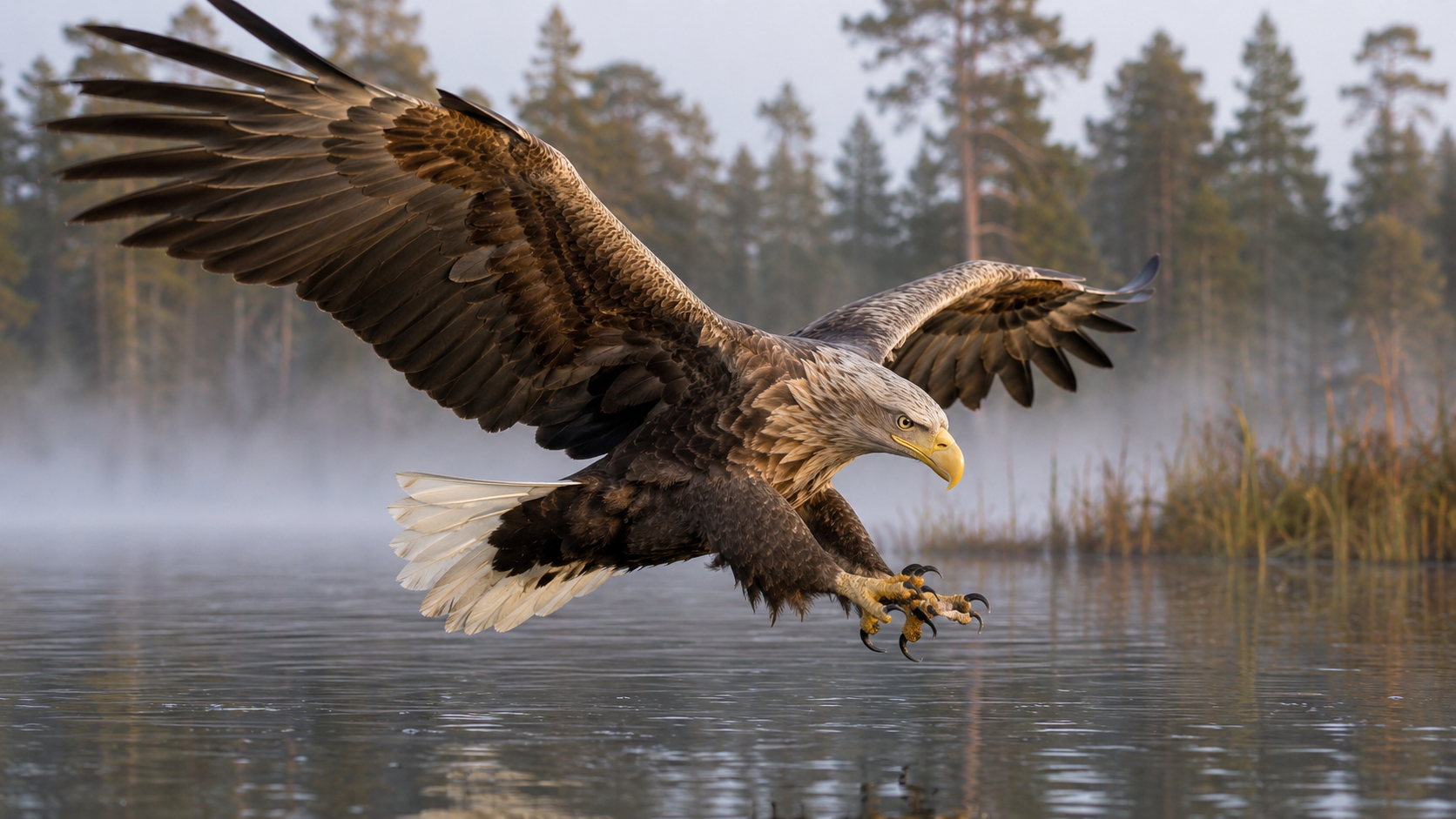
The white-tailed eagle (Haliaeetus albicilla) is an enormous raptor with a wingspan of 193 to 245 cm and a body length of up to 94 cm, weighing between roughly 3.1 and 6.9 kilograms depending on sex, with females again considerably larger than males. In flight its silhouette is often described as resembling a "flying barn door" — broad, rectangular wings held flat with visibly splayed primary feathers at the tips, quite unlike the narrower, more tapered wings of true eagles in the genus Aquila such as the golden eagle.
Adults are dark brown overall with a paler, almost creamy-yellow head and neck that lightens further with age, a massive yellow hooked beak, and — the feature that gives the species its name — a short, pure white, wedge-shaped tail that stands out clearly against the dark body even at a distance. Juveniles are more uniformly dark brown with a dark tail and beak, gradually acquiring the adult's pale head and white tail over four to five years before reaching full maturity.
Range and habitat
The white-tailed eagle breeds across a huge range spanning coastal and inland Eurasia, from Greenland and Iceland through Scandinavia and continental Europe to Russia and the Far East. In Russia it occurs widely, particularly along major river systems, large lakes, and coastlines from the Baltic to the Pacific. Most populations are largely resident, remaining near their breeding territory year-round, though birds from the far north of the range move south during the harshest winter months when water bodies freeze over and fish become inaccessible.
It is closely tied to large bodies of water — sea coasts, estuaries, big lakes, and slow, wide rivers — combined with tall trees or cliffs for nesting, since it relies heavily on fish and waterbirds for food and needs open water within its territory to hunt effectively.
Behavior and lifestyle
The white-tailed eagle is an opportunistic hunter and scavenger rather than a specialist pursuit predator. It typically takes fish from close to the water surface in a shallow swoop, feet extended and talons skimming the water, and preys on waterbirds such as ducks, geese, coots, and grebes, sometimes cooperating in pairs to flush and separate prey from a flock. Carrion makes up a substantial part of the diet in many areas, especially in winter, and the species readily gathers at large carcasses alongside other scavengers.
Flight is typically slow and heavy with deep wingbeats interspersed with long glides, and soaring birds are a familiar sight over favored lake and coastal territories, sometimes drawing the attention of smaller birds that mob them in flight. Pairs are highly territorial and will defend favored fishing and nesting areas from other eagles year-round.
Breeding
Pairs build one of the largest nests of any bird in the region — a massive stick structure in a tall tree or on a cliff ledge, added to and reused over many years until some nests reach well over a meter across and can weigh several hundred kilograms. The typical clutch is 1 to 3 eggs, most often 2, incubated mainly by the female for around 38 days. Chicks fledge at roughly 70 to 75 days old and remain dependent on their parents for food for several additional weeks. Pairs mate for life and typically return to the same nest site year after year unless disturbed.
Interesting facts
- The white-tailed eagle was driven to extinction in the United Kingdom by the early 20th century through relentless persecution, and was only reestablished decades later through a long-running reintroduction program using birds translocated from Norway.
- It is the largest bird of prey found in most of Europe, and one of the largest sea eagles in the world, rivaled in size mainly by its close relative the Steller's sea eagle of the Russian Far East.
- Because it readily scavenges carrion, the white-tailed eagle has historically been vulnerable to secondary poisoning from lead ammunition fragments in shot game carcasses, an issue that remains a focus of ongoing conservation efforts across its range.