Great Spotted Woodpecker
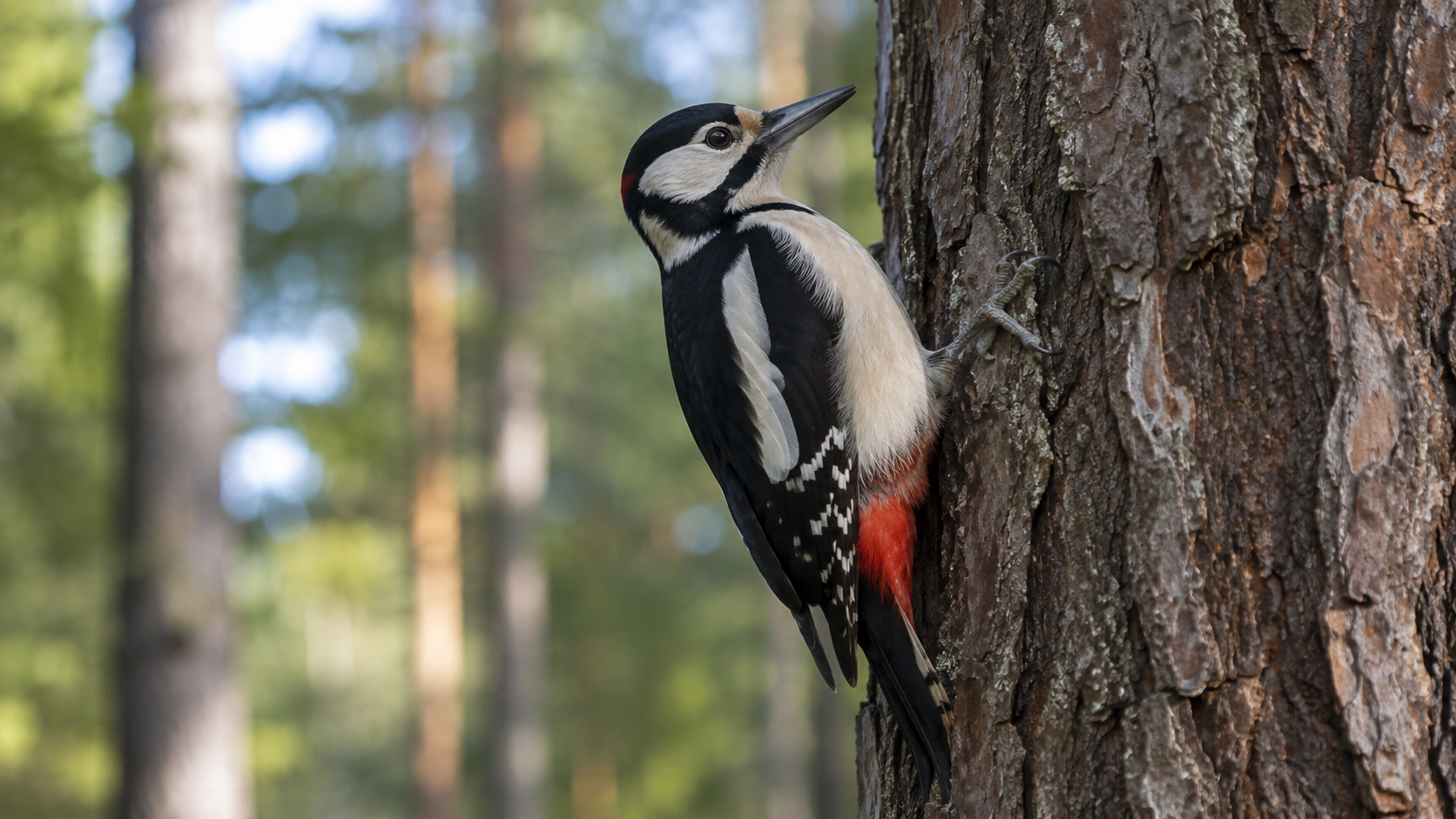
The great spotted woodpecker (Dendrocopos major) is the most widespread woodpecker in Europe, a bold black-and-white bird known for its rapid drumming and a bright red patch beneath the tail.
Key facts
- Latin name
- Dendrocopos major
- Family
- Picidae (Woodpeckers)
- Wingspan
- 34–39 cm
- Season
- resident year-round
- Diet
- Wood-boring beetle larvae and other insects extracted from bark and dead wood, Seeds and nuts, especially pine and spruce, wedged into bark crevices to open, Eggs and nestlings of other birds, Garden feeder food, especially peanuts and suet
- Conservation status
- LCLeast Concern
Appearance
The great spotted woodpecker (Dendrocopos major) is a medium-sized woodpecker with a wingspan of 34 to 39 cm and a body length of about 23 to 26 cm, weighing between roughly 70 and 100 grams. Its plumage is boldly patterned in black and white, with large white patches on the shoulders standing out clearly against an otherwise black back and wings, and a bright crimson-red patch on the lower belly beneath the tail, present in both sexes.
Adult males carry an additional small patch of red on the nape at the back of the head, which females lack entirely, making the two sexes otherwise identical in plumage. The beak is strong, straight, and chisel-shaped, well suited to excavating wood, and stiff, specially reinforced tail feathers act as a supporting brace against the trunk while the bird climbs and forages vertically.
Range and habitat
The great spotted woodpecker is the most widespread woodpecker species across Europe and extends through forested Russia into Siberia and parts of East Asia. It is strongly resident, with pairs generally remaining within the same territory year-round rather than migrating even in the coldest parts of its range.
It occupies a broad range of wooded habitats, including deciduous, coniferous, and mixed forest, parks, and large gardens with mature trees, and has adapted well enough to human-altered landscapes to become a fairly regular visitor to garden bird feeders across much of its range, particularly where peanuts or suet are offered.
Behavior and lifestyle
Great spotted woodpeckers feed extensively on wood-boring beetle larvae and other insects, extracted from bark and dead wood using a combination of powerful, chisel-like excavation and a long, barbed, sticky tongue capable of reaching deep into narrow tunnels within the wood. In autumn and winter, diet shifts substantially toward seeds and nuts, particularly pine and spruce cone seeds, which the bird wedges into a favored bark crevice or fork — sometimes called an "anvil" — to hold the cone steady while extracting individual seeds.
The species is also a notable, if opportunistic, nest predator of smaller songbirds, taking eggs and nestlings from cavity and open nests alike when the opportunity arises. Its rapid, mechanical drumming — produced by striking a resonant branch repeatedly at very high speed — serves the same territorial and mate-attraction role that song plays for most other birds, and is one of the most recognizable sounds of European woodland in early spring.
Breeding
Great spotted woodpeckers excavate a new nest cavity each year in a tree trunk or large branch, typically in dead or decaying wood that is easier to carve than solid, healthy timber, creating cavities that are frequently reused by other species, including tits and flycatchers, in subsequent years. The typical clutch is 4 to 7 eggs, incubated by both parents for 10 to 13 days. Chicks fledge at around 20 to 24 days old and remain dependent on their parents for continued feeding for a short period after leaving the nest.
Interesting facts
- A drumming great spotted woodpecker can produce individual strikes at a rate of roughly ten to sixteen per second, a burst so fast it appears almost as a continuous blur to the human eye and ear.
- Because great spotted woodpecker nest cavities are frequently reused by other cavity-nesting species once vacated, the bird plays an important supporting ecological role in local woodland communities, functioning as what ecologists sometimes describe as a keystone species for cavity availability.
- Great spotted woodpeckers have occasionally been documented drumming on artificial resonant surfaces, including metal chimney caps and street signs, apparently drawn by the particularly loud, far-carrying sound such materials can produce compared to natural wood.