Mallard
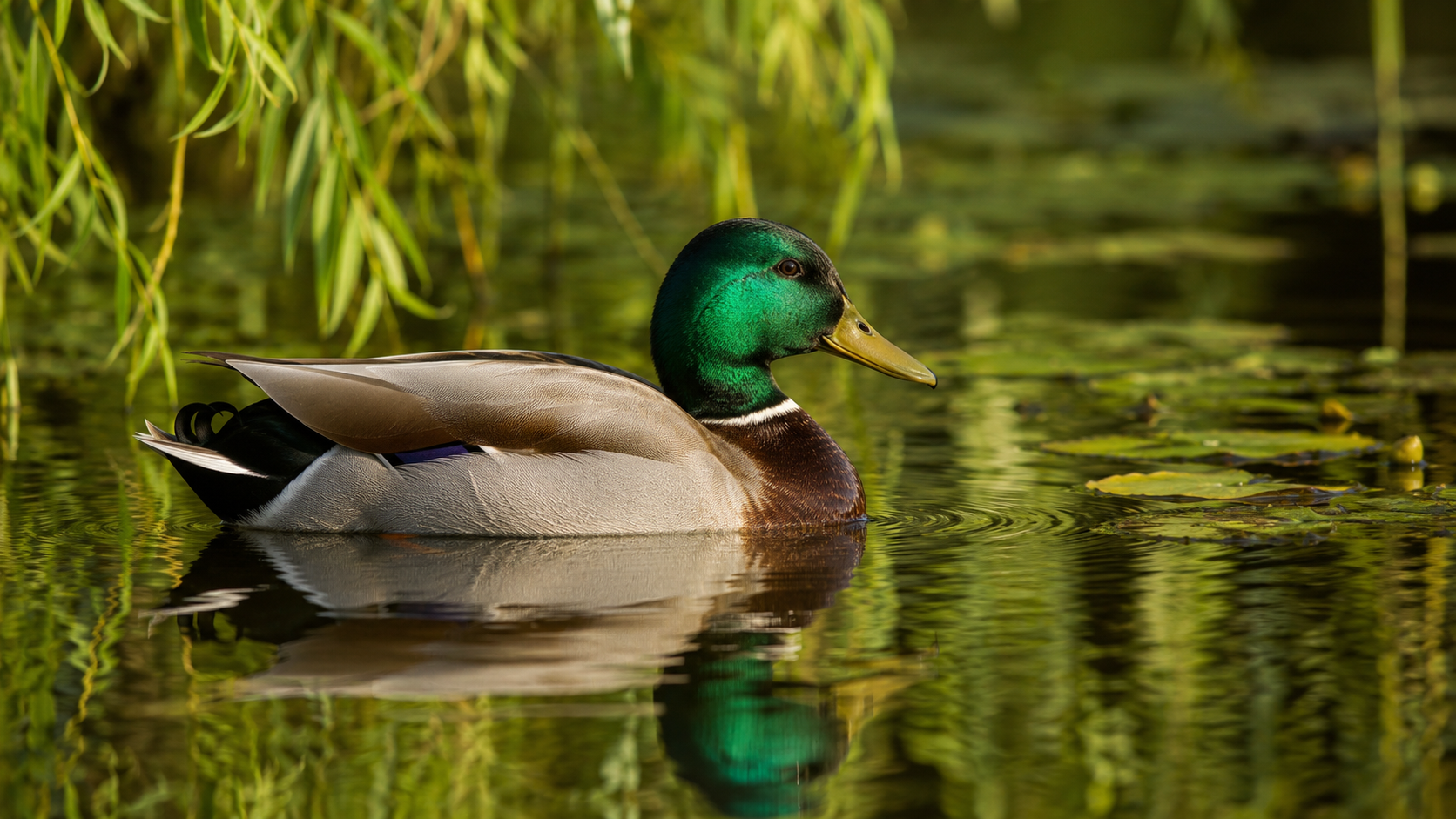
The mallard (Anas platyrhynchos) is the most familiar duck across the Northern Hemisphere, instantly recognized by the drake's glossy bottle-green head and found on almost any body of water year-round.
Key facts
- Latin name
- Anas platyrhynchos
- Family
- Anatidae (Waterfowl)
- Wingspan
- 81–98 cm
- Season
- resident year-round, with some northern populations moving short distances south in severe winters
- Diet
- Aquatic plants, seeds, and pondweed, Aquatic invertebrates: insect larvae, molluscs, and small crustaceans, Grain and waste food in agricultural and urban settings, Occasional small amphibians and fish fry
- Conservation status
- LCLeast Concern
Appearance
The mallard (Anas platyrhynchos) is a medium-to-large dabbling duck with a wingspan of 81–98 cm and a body length of 50–65 cm, weighing between roughly 0.7 and 1.6 kilograms. It shows one of the most pronounced examples of sexual dimorphism among ducks covered in this atlas, with males and females differing sharply in plumage for most of the year.
The drake carries a glossy, iridescent bottle-green head separated from a chestnut-brown breast by a narrow white neck ring, with grey flanks, a pale grey-brown back, and a distinctive small curled black feather above the tail found in no other common local duck. The female is mottled brown overall, closely resembling several other female dabbling ducks, but is reliably told apart by her orange-and-black bill and a blue-and-white speculum (wing patch) shared with the male, visible in flight or at rest with the wings folded.
Range and habitat
The mallard has one of the broadest distributions of any duck species in the world, breeding across nearly the whole of Europe, Asia, and North America and occurring on virtually every type of freshwater habitat within that range. In Russia and Europe it is found from lowland farmland ponds to city park lakes, slow rivers, reservoirs, and coastal estuaries, making it usually the easiest duck species to find for a beginning birdwatcher.
Most populations are effectively resident, remaining on the same waters throughout the year wherever open water and food persist through winter; only birds from the coldest northern parts of the range shift short distances south when their home waters freeze over completely. This adaptability to disturbed and urban habitats has made the mallard one of the most successful and widely recognized wild bird species on the planet.
Behavior and lifestyle
Mallards are classic dabbling ducks, feeding mainly by tipping forward to reach submerged vegetation with their tail in the air rather than diving fully underwater like diving ducks. Their diet is broadly omnivorous, shifting seasonally between aquatic plants, seeds, and pondweed, and a wide range of invertebrates including insect larvae, molluscs, and small crustaceans, supplemented opportunistically with grain and discarded food wherever they encounter it near people.
Outside the breeding season, mallards are highly social and often gather in large mixed-sex flocks on favored lakes and rivers, sometimes numbering in the hundreds where food and shelter are abundant. The species is also notably tolerant of humans, readily accepting bread and other food in parks, which has made it one of the most consistently visible wild birds in urban and suburban settings.
Breeding
Mallard pairs typically form during the autumn and winter, well before nesting begins in spring. The female builds a simple ground nest lined with down, usually well hidden in waterside vegetation but sometimes surprisingly far from water, and lays a clutch of 8 to 13 eggs, incubated by the female alone for 27 to 28 days. Ducklings are precocial, able to walk, swim, and feed themselves within hours of hatching, and follow the female closely for around 50 to 60 days until they can fly.
Male mallards take no part in raising the young and typically leave the female shortly after incubation begins, moving to separate gathering areas where they undergo a complete flightless eclipse moult, temporarily losing their bright breeding plumage for a duller, female-like appearance for several weeks.
Interesting facts
- During eclipse moult in mid-to-late summer, drakes lose their flight feathers all at once and become flightless for around three to four weeks, adopting drab, female-like plumage that offers better camouflage during this vulnerable period.
- The mallard is the wild ancestor of almost all domestic duck breeds, a domestication history stretching back thousands of years and one of the reasons the species interbreeds so readily with domestic and feral ducks today.
- Despite being classified as Least Concern and one of the most numerous ducks on Earth, mallard numbers in some regions have been affected by genetic swamping from domestic-derived feral birds, a conservation concern distinct from population decline.