Rare and Threatened Birds
Some birds in this atlas carry a conservation status above Least Concern — from the northern lapwing (NT) to the European turtle dove (VU). This is a reminder that even familiar species can face serious pressure.
What "threatened" means for these species
Every species page in this atlas lists a conservation status drawn from the IUCN Red List categories, running from Least Concern (LC) through Near Threatened (NT), Vulnerable (VU), Endangered (EN), and Critically Endangered (CR). Most species covered here sit at Least Concern, but a handful carry a higher status because of population decline, range fragmentation, or both.
This overview brings together species with elevated global status in the catalogue and briefly notes that the recovery of large predators does not remove the need to watch farmland species.
Featured rare and threatened birds in this atlas
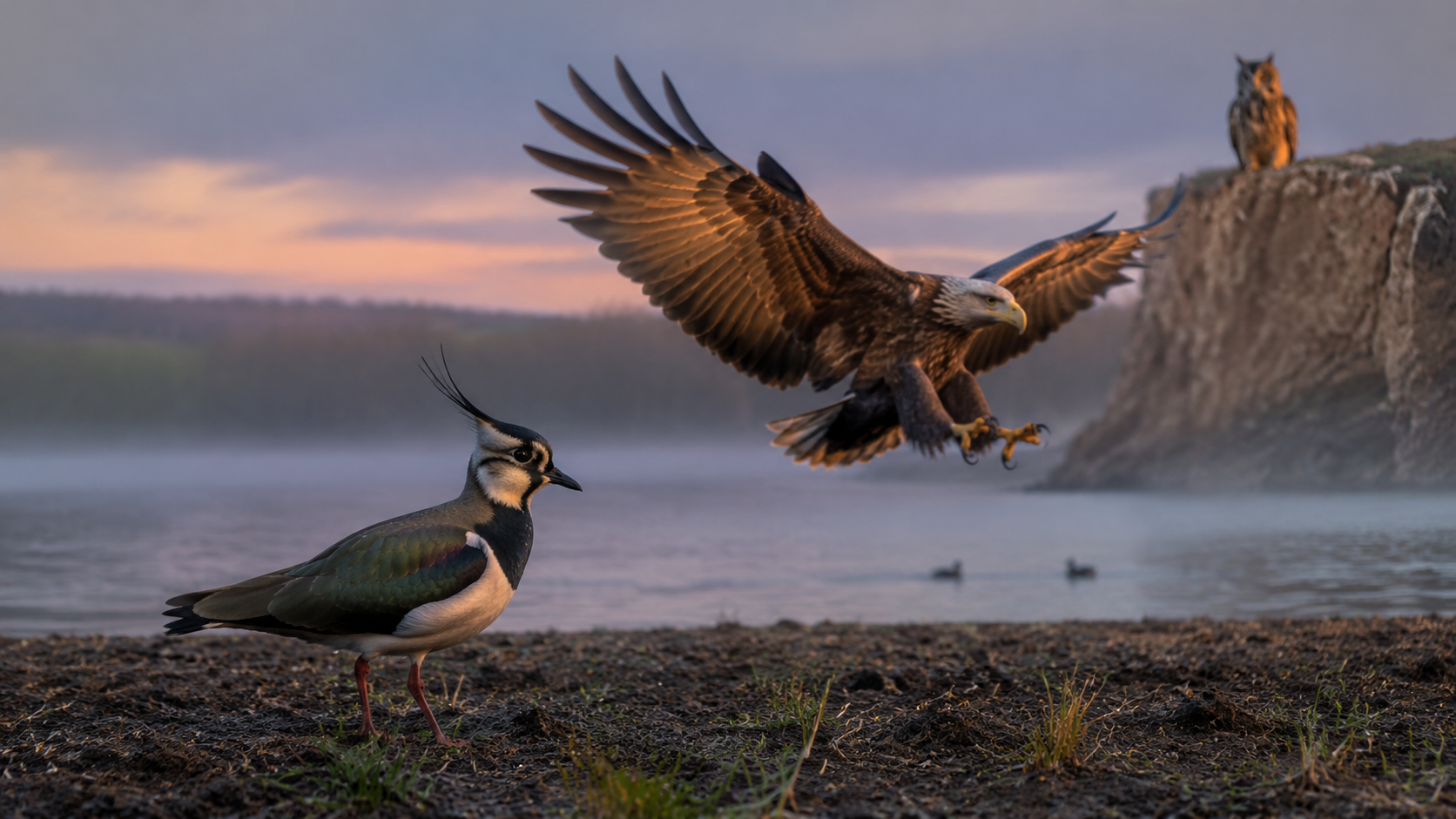
The northern lapwing (Vanellus vanellus) is classified as Near Threatened. Once one of the most abundant farmland birds in Europe, it has declined sharply because of autumn-sown cereals, drained wet pasture, and machinery disturbance.
The European turtle dove (Streptopelia turtur) is classified as Vulnerable — a higher category than NT. It faces hunting along migration routes, loss of mixed herbaceous habitat, and a shortage of seed food in modern agricultural landscapes.
The white-tailed eagle (Haliaeetus albicilla) and Eurasian eagle-owl (Bubo bubo) are now globally Least Concern after recovering from 20th-century population collapses. Their stories still matter: they show how strongly large predators depend on protection, and how regional threats — power lines, wind turbines, disturbance at nest sites — remain relevant.
Why conservation status matters for birdwatchers
Sightings of the lapwing, turtle dove, white-tailed eagle, or eagle-owl are often useful to regional monitoring schemes. Reporting observations through local birdwatching networks, avoiding disturbance near known nest sites — especially large predators during the breeding season — and supporting wetland and farmland habitat protection are among the most direct ways to help species with elevated or recently recovered status.