Hooded Crow
The hooded crow (Corvus cornix) is a highly intelligent, ash-grey and black corvid that replaces the all-black carrion crow across Eastern Europe, Russia, and Scandinavia.
Key facts
- Latin name
- Corvus cornix
- Wingspan
- 84–100 cm
- Season
- mostly resident; northernmost populations partially migratory October – March
- Diet
- Insects, earthworms, and other invertebrates, Small mammals, eggs, and nestlings of other birds, Carrion and human food waste, Grain, fruit, and other plant matter
- Conservation status
- LCLeast Concern
Appearance
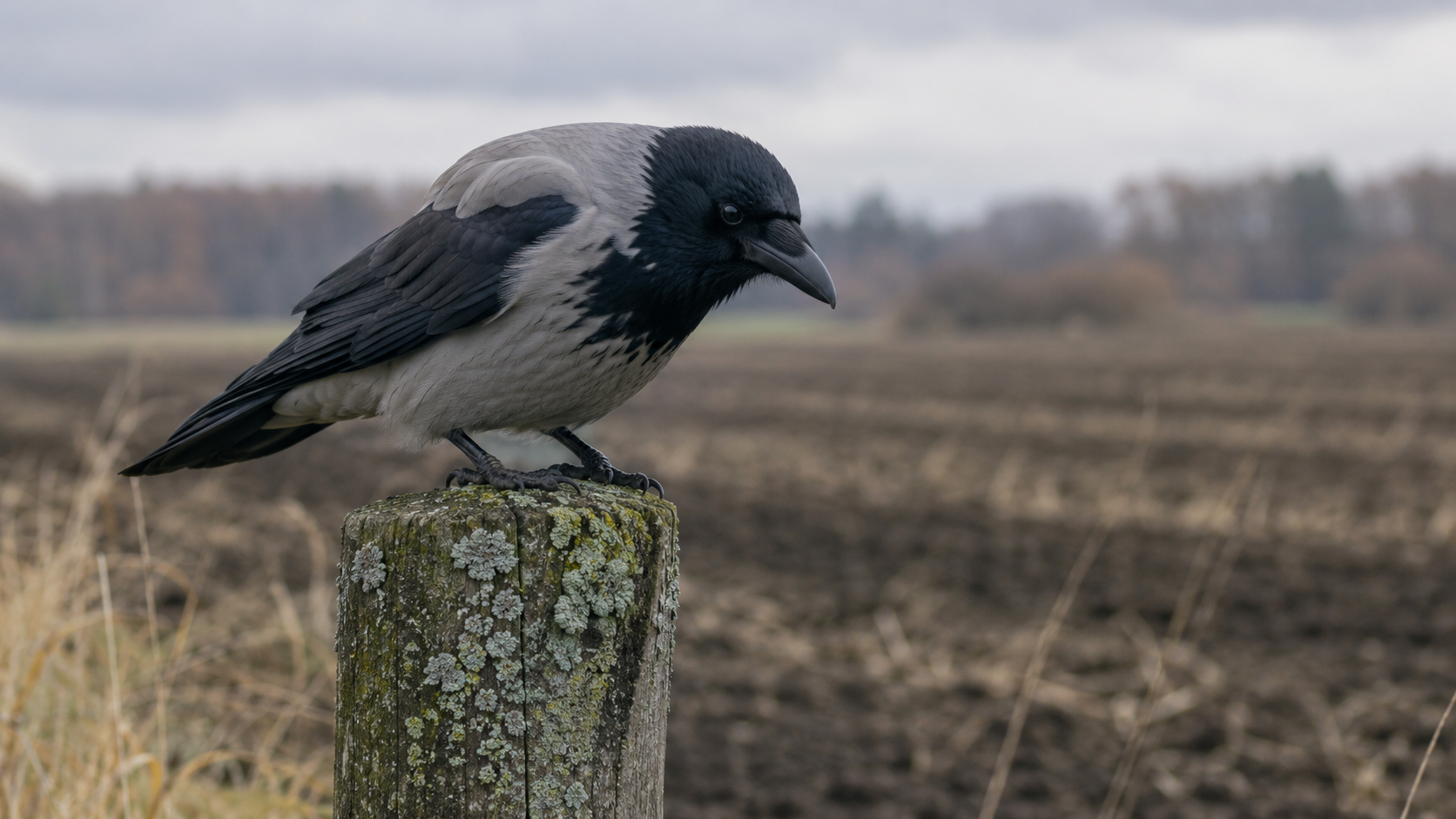
The hooded crow (Corvus cornix) is a medium-large corvid with a wingspan of 84 to 100 cm and a body length of 48 to 52 cm, weighing between roughly 400 and 600 grams. Its plumage is unmistakable among European corvids: an ash-grey body — mantle, breast, and belly — sharply contrasting with a glossy black head, throat, wings, and tail, giving the bird a distinctive two-tone appearance visible even at a considerable distance.
The beak is thick, black, and slightly downcurved at the tip, well suited to an omnivorous diet that ranges from probing soft ground for invertebrates to tearing at carrion. Sexes look alike, and juveniles resemble adults fairly closely from an early age, with only slightly duller, browner-toned grey plumage before their first full molt.
Range and habitat
The hooded crow occupies a broad range across Eastern and Northern Europe, Russia, and parts of the Middle East, replacing the closely related, all-black carrion crow across most of this area; the two meet and hybridize in a narrow contact zone running roughly through Scotland, northern Germany, and parts of Eastern Europe. Most populations are largely resident, though birds breeding in the far north and east of the range show partial migratory movement, moving south between October and March in the coldest years.
It is an exceptionally adaptable species, thriving in almost any open or semi-open habitat: farmland, coastlines, moorland, forest edges, and increasingly towns and cities, where it forages readily around parks, refuse sites, and human settlements alongside its more traditional rural range.
Behavior and lifestyle
Hooded crows are highly omnivorous and opportunistic, feeding on insects, earthworms, and other invertebrates, small mammals, the eggs and nestlings of other birds, carrion, human food waste, and a variety of plant matter including grain and fruit — a dietary flexibility that underlies much of the species' success across such a wide range of habitats. Like other corvids, they are notably intelligent, capable of using simple tools, solving multi-step problems to access food, and remembering the locations of dozens or even hundreds of cached food items over extended periods.
Outside the breeding season, hooded crows are often gregarious, forming loose foraging flocks and, in some areas, large communal roosts, though breeding pairs defend strict territories and can be notably aggressive toward intruders, including much larger birds of prey, which they will mob in coordinated groups.
Breeding
Hooded crows build a large stick nest, typically high in a tree but sometimes on a cliff ledge, pylon, or building in treeless areas, lined with softer material such as wool, moss, or fur. The typical clutch is 3 to 5 eggs, incubated mainly by the female for 18 to 20 days. Chicks fledge at around 32 to 36 days old and often remain associated with their parents for some weeks afterward, occasionally helping to defend the territory the following year before dispersing to breed independently.
Interesting facts
- Hooded crows have been observed dropping hard-shelled food items such as walnuts onto roads to be cracked by passing vehicles, then waiting for a safe gap in traffic before retrieving the exposed contents — a striking example of tool-like problem-solving in an urban setting.
- The narrow hybrid zone where hooded and carrion crows meet has become an important study system in evolutionary biology for understanding how closely related species with different plumage can maintain distinct identities despite ongoing interbreeding.
- Like many corvids, hooded crows can recognize individual human faces and reportedly hold long memories of people who have threatened or fed them, sometimes altering their behavior toward specific individuals for months or years afterward.