Greylag Goose
The greylag goose (Anser anser) is the wild ancestor of most domestic geese, a large grey-brown grazing bird best known for its loud honking calls and the strong lifelong pair bonds it forms.
Key facts
- Latin name
- Anser anser
- Family
- Anatidae (Waterfowl)
- Wingspan
- 147–180 cm
- Season
- March – October, with resident populations increasingly common in milder western areas
- Diet
- Grasses and cereal crops, grazed directly from the ground, Roots, rhizomes, and shoots of aquatic and waterside plants, Waste grain and stubble on agricultural fields, Occasional berries and seeds
- Conservation status
- LCLeast Concern
Appearance
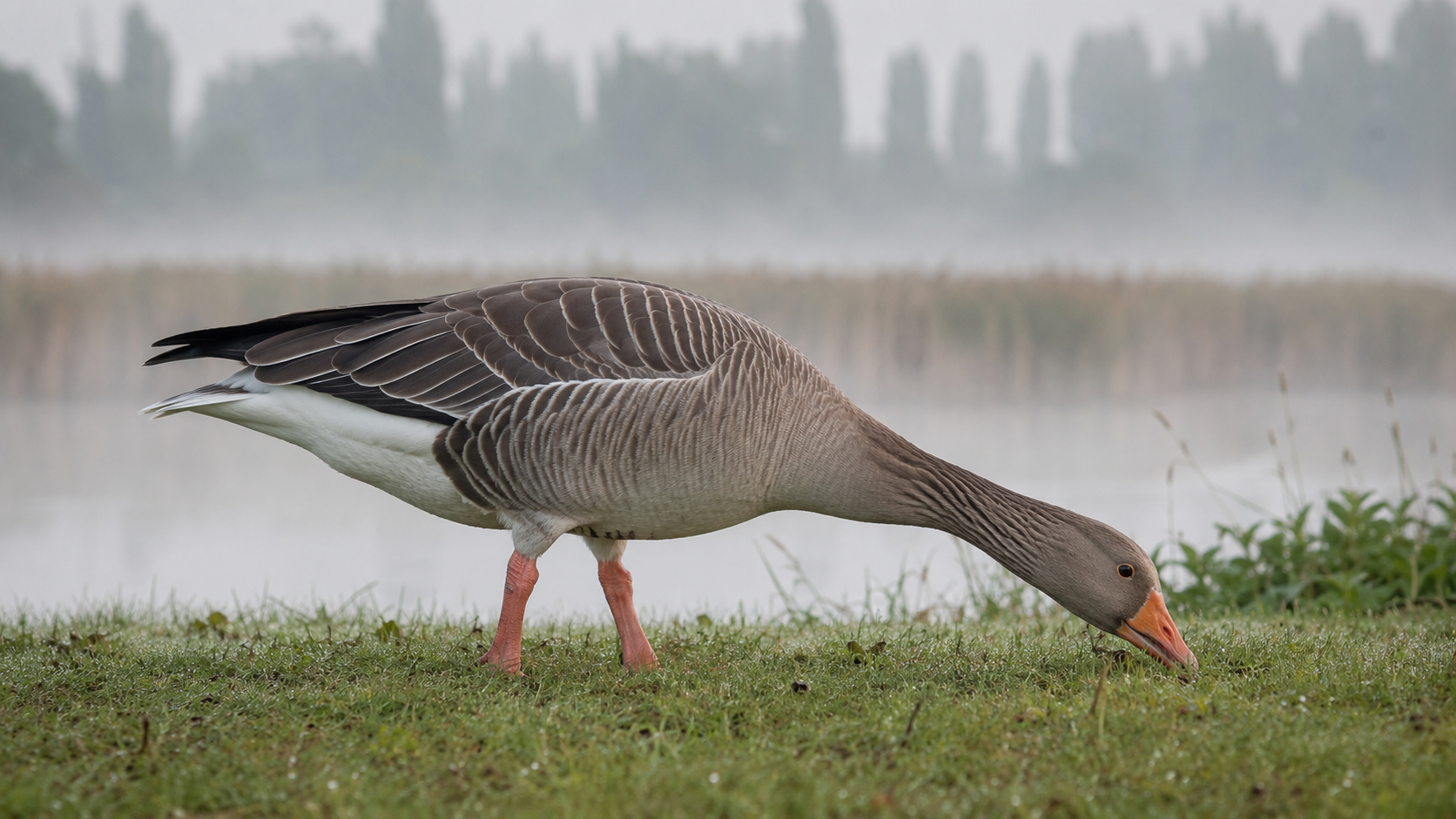
The greylag goose (Anser anser) is a large, bulky goose with a wingspan of 147–180 cm and a body length of 74–91 cm, weighing between roughly 2.5 and 4.5 kilograms, making it the largest and heaviest goose species covered in this atlas. It is mottled grey-brown overall, with pale fringing on the back and wing feathers that gives a subtly barred appearance, a paler head and neck, and a distinctive pale bluish-grey patch on the leading edge of the forewing, visible both at rest and clearly in flight.
Its bill is thick, conical, and orange to pink, and its legs are pale pinkish-orange — a combination that, together with its large size and pale forewing patch, separates it reliably from the smaller, darker-billed goose species that occasionally overlap with it outside the breeding season. In flight, greylag geese typically travel in loose lines or V-formations, calling frequently with the loud, resonant honking that gives the species much of its cultural familiarity.
Range and habitat
The greylag goose breeds across a broad swathe of Europe and Asia, from Iceland and the British Isles through Scandinavia and central Europe to Russia and beyond, and is the only goose species native to Great Britain still breeding there in significant numbers. Russian breeding populations are found from the west through much of the steppe and forest-steppe zone, favoring wetlands, lakes, and river deltas bordered by open grassland or farmland for grazing.
Most Russian and continental European populations are migratory, present from March to October and wintering further south around the Mediterranean, Black Sea, and Caspian Sea coasts, though feral and reintroduced populations in milder parts of western Europe have become substantially resident, remaining on the same lakes and parks year-round.
Behavior and lifestyle
Greylag geese are primarily grazers, feeding mainly on grasses, cereal shoots, and waste grain on agricultural stubble fields, supplemented with the roots, rhizomes, and shoots of aquatic and waterside plants pulled up with their strong bills. Feeding typically happens in flocks on open ground close to water, which the birds use for roosting overnight and retreating to when disturbed.
The species is highly social outside the breeding season, often gathering in large flocks that can number in the hundreds or thousands at favored wintering and staging sites. Greylag geese are also known for forming exceptionally strong, typically lifelong pair bonds, with paired birds staying close together throughout the year, not only during breeding, and showing visible distress if separated from or if they lose a long-term partner.
Breeding
Greylag geese nest on the ground, usually well hidden among waterside vegetation or on a small island offering some protection from ground predators, with the nest built and lined largely by the female. A typical clutch contains 4 to 6 eggs, incubated by the female alone for around 27 to 28 days while the male stands guard nearby, often aggressively defending the nest site against intruders.
Goslings are precocial, leaving the nest within a day of hatching to follow both parents to water and begin feeding themselves almost immediately, though they remain closely guarded by both adults for around 8 to 9 weeks until fledging. Family groups often stay together well beyond fledging, sometimes migrating and wintering as a unit before young birds disperse the following year.
Interesting facts
- Nearly all domestic goose breeds worldwide descend from the greylag goose, a domestication history stretching back several thousand years, longer than that of most other domesticated waterfowl.
- The greylag goose was a central subject of pioneering ethologist Konrad Lorenz's studies on imprinting, in which newly hatched goslings became attached to and followed the first moving object they encountered, even a human researcher, rather than their biological parent.
- Despite being widespread and classified as Least Concern, greylag goose populations in parts of their range have grown substantially in recent decades, in some areas leading to local management concerns over grazing pressure on agricultural land.