Common Chaffinch
The common chaffinch (Fringilla coelebs) is one of the most abundant and widespread songbirds in Europe, the brightly colored male known for his cheerful, cascading spring song.
Key facts
- Latin name
- Fringilla coelebs
- Family
- Fringillidae (Finches)
- Wingspan
- 24–28 cm
- Season
- resident in the west and south; migratory further north and east, present April – October
- Diet
- Seeds, especially in autumn and winter, Insects and spiders, especially during the breeding season, Buds and soft plant shoots in early spring, Caterpillars fed almost exclusively to nestlings
- Conservation status
- LCLeast Concern
Appearance
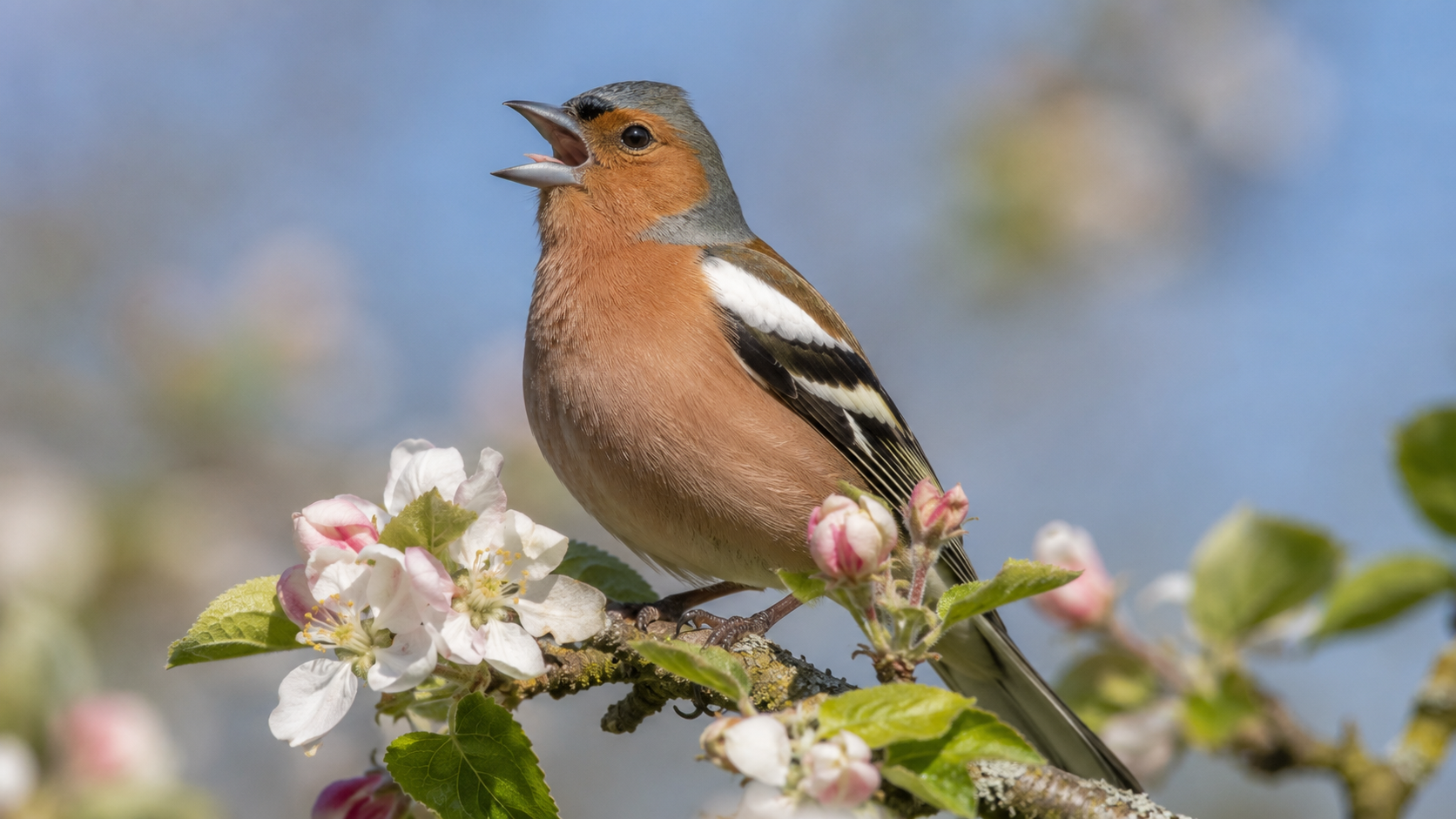
The common chaffinch (Fringilla coelebs) is a small, compact finch with a wingspan of 24 to 28 cm and a body length of about 14.5 cm, weighing between roughly 18 and 29 grams. The male is strikingly colored, with a blue-grey crown and nape, a warm pinkish-brown face and breast, a chestnut-brown back, and two bold white wing bars that flash clearly both at rest and in flight — a combination that makes him one of the most easily recognized songbirds in Europe once learned.
Females and juveniles are considerably duller, olive-brown above and pale buff-grey below, lacking the male's blue-grey head and pink tones but sharing the same white wing bars and white outer tail feathers, which flash conspicuously as the bird flies away — often the clearest identification clue for a duller individual glimpsed only briefly.
Range and habitat
The common chaffinch is one of the most widespread and numerous songbirds across the whole of Europe and extends through temperate Russia well into western Siberia. Populations in the milder west and south of the range are largely resident, while birds breeding in colder parts of central, northern, and eastern Russia are migratory, present from roughly April to October and wintering further south and west.
It occupies an unusually broad range of habitats, including deciduous and mixed woodland, farmland with hedgerows, parks, and gardens, and is one of the most familiar garden birds across much of its range, readily coming to bird feeders and foraging on lawns and open ground alongside woodland edges.
Behavior and lifestyle
Chaffinches feed mainly on seeds for most of the year, foraging both in trees and, distinctively among many finches, directly on the ground, where they hop and pick through leaf litter and open soil. During the breeding season the diet shifts heavily toward insects and spiders, and parents feed nestlings an almost exclusively caterpillar-based diet to meet the high protein demands of rapid chick growth.
The male's loud, cheerful song — a rapid, descending cascade of notes ending in an emphatic flourish, often rendered as "chip-chip-chip-cherry-erry-tissie-cheweeoo" — is one of the most familiar and earliest signs of spring across much of Europe, typically beginning in late winter well before most other songbirds have started singing. Outside the breeding season, chaffinches often form loose mixed flocks with other seed-eating songbirds, particularly around abundant winter food sources.
Breeding
The female builds a neat, compact cup nest of moss, grass, and lichen bound together with spider silk, camouflaged on the outside to closely match the bark of the supporting branch, usually sited in a fork of a tree or shrub. The typical clutch is 4 to 5 eggs, incubated solely by the female for 11 to 13 days. Chicks fledge at around 12 to 15 days old and remain dependent on their parents for continued feeding for a further couple of weeks after leaving the nest.
Interesting facts
- Chaffinch song shows clear regional "dialects," with young males partly learning their song by listening to and imitating adult males nearby, producing subtle variations that can differ between populations separated by only a few kilometers.
- The species' scientific name, Fringilla coelebs — meaning roughly "bachelor finch" — references an observed difference in migratory behavior between the sexes in parts of northern Europe, where females tend to migrate further south than males in winter.
- Despite being one of the most common birds across most of its range, chaffinch numbers can fluctuate noticeably from year to year depending on beech mast and other seed crop abundance, which strongly influences winter survival.