Common Buzzard
The common buzzard (Buteo buteo) is the most widespread bird of prey in Europe, a broad-winged soarer often seen circling over fields or perched on roadside posts.
Key facts
- Latin name
- Buteo buteo
- Wingspan
- 110–130 cm
- Season
- resident in the west and south; March – October further north and east
- Diet
- Voles and other small mammals, Rabbits and young hares, Earthworms, especially after rain, Carrion and roadkill, Reptiles, amphibians, and large insects
- Conservation status
- LCLeast Concern
Appearance
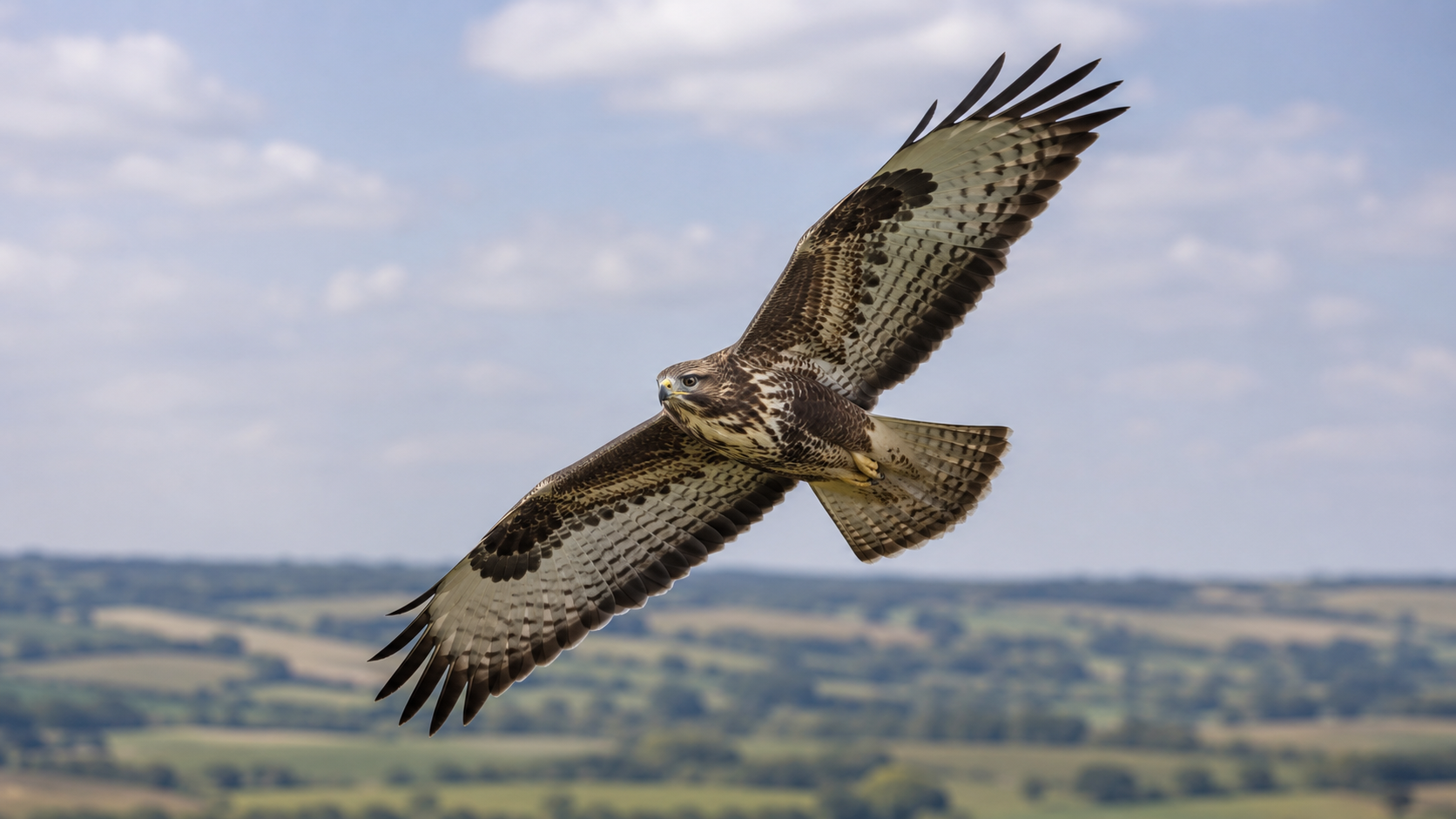
The common buzzard (Buteo buteo) is a medium-sized bird of prey with broad, rounded wings and a short, fanned tail, giving it a heavy, compact silhouette quite different from the slender build of falcons. Wingspan ranges from 110 to 130 cm, with a body length of 40–58 cm and weight varying widely from about 425 grams to over 1.4 kilograms, females noticeably larger than males as in most birds of prey.
Plumage is highly variable, ranging from almost uniform dark chocolate-brown birds to pale, cream-colored individuals with only light streaking, though most fall somewhere in between: mottled brown upperparts, a pale breast band, and barred underparts. In flight, the wings show a dark trailing edge and dark carpal patches at the wrist, while the fanned tail displays fine, even barring. This plumage variability can make individual buzzards tricky to identify with confidence, but the combination of broad wings held in a shallow V while soaring, a stocky body, and a short tail remains consistent across the whole range of color forms.
Range and habitat
The common buzzard is the most widespread and numerous diurnal raptor across most of Europe, found from the British Isles and Iberia east through central Russia to the Ural Mountains, with related buzzard forms continuing further into Siberia. Western and southern populations are largely resident year-round, while birds breeding in colder parts of central and northern Russia are migratory, present from March to October and wintering in milder parts of Europe, the Mediterranean basin, or the Middle East.
It occupies an unusually broad range of habitats: farmland interspersed with woodland, forest edges, hedgerow country, moorland, and increasingly suburban parks and motorway verges, wherever open hunting ground is combined with trees or poles for perching. This adaptability, more than any single habitat preference, explains why it has become the default "bird of prey on a roadside post" across so much of its range.
Behavior and lifestyle
Common buzzards hunt mainly by watching from a perch — a fence post, pylon, or tree branch — before dropping onto prey on the ground, though they also hunt on the wing and will walk on open ground searching for earthworms after rain, a habit that surprises many first-time observers of a bird of prey. Their diet is broad and opportunistic, dominated by voles and other small mammals but extending to rabbits, young hares, reptiles, amphibians, large insects, and carrion, which can make up a significant part of the diet in winter or in years when small mammal numbers are low.
Buzzards are frequently seen soaring in wide circles on thermal updrafts, wings held in a shallow V and the characteristic "fingered" primary feathers spread at the wingtips. Their loud, plaintive mewing call — often rendered as a cat-like "pee-yow" — is one of the most familiar sounds of European farmland skies and is frequently heard before the bird itself is spotted.
Breeding
Common buzzards build a large stick nest in a tree, sometimes reusing and adding to the same nest over several years, occasionally with the addition of fresh green sprigs throughout the breeding season. The typical clutch is 2 to 4 eggs, most often 2 or 3, incubated mainly by the female for 33 to 38 days. Chicks fledge at around 50 to 55 days old but continue to depend on their parents for food for several weeks afterward. Pairs are generally monogamous and often reuse the same territory, and sometimes the same nest, year after year.
Interesting facts
- Buzzards perform a striking "roller-coaster" display flight during the breeding season, climbing steeply, tumbling, and diving in a series of dramatic loops, often accompanied by loud calling.
- Populations of the common buzzard collapsed across much of Western Europe in the mid-20th century due to organochlorine pesticides and direct persecution, but the species has recovered strongly since the 1970s and 1980s and is now classified as Least Concern.
- Because it will readily eat earthworms and carrion alongside live prey, the common buzzard is one of the most opportunistic feeders among European raptors, a flexibility that has helped it thrive in landscapes heavily altered by farming.