Rook
The rook (Corvus frugilegus) is a highly social, glossy-black corvid of farmland, known for its bare greyish face patch and its habit of nesting in large, noisy tree-top colonies called rookeries.
Key facts
- Latin name
- Corvus frugilegus
- Wingspan
- 81–99 cm
- Season
- mostly resident; northern and eastern populations migratory October – March
- Diet
- Earthworms and soil-dwelling insect larvae, Grain and other cultivated crops, Small invertebrates and occasionally small vertebrates, Carrion and food scavenged near human activity
- Conservation status
- LCLeast Concern
Appearance
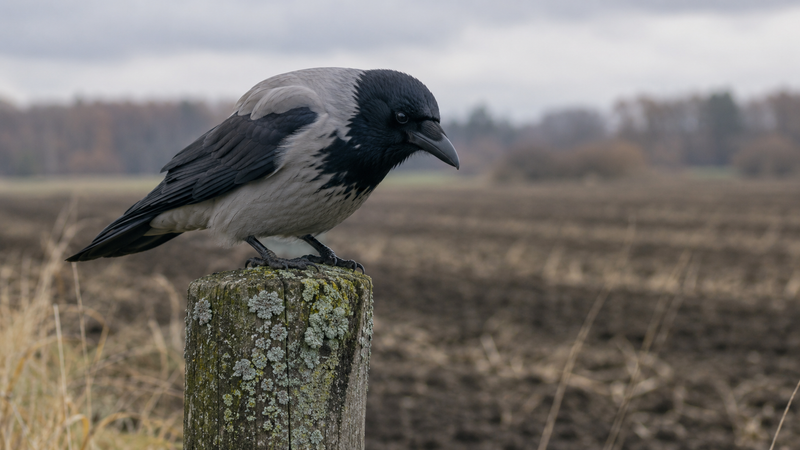
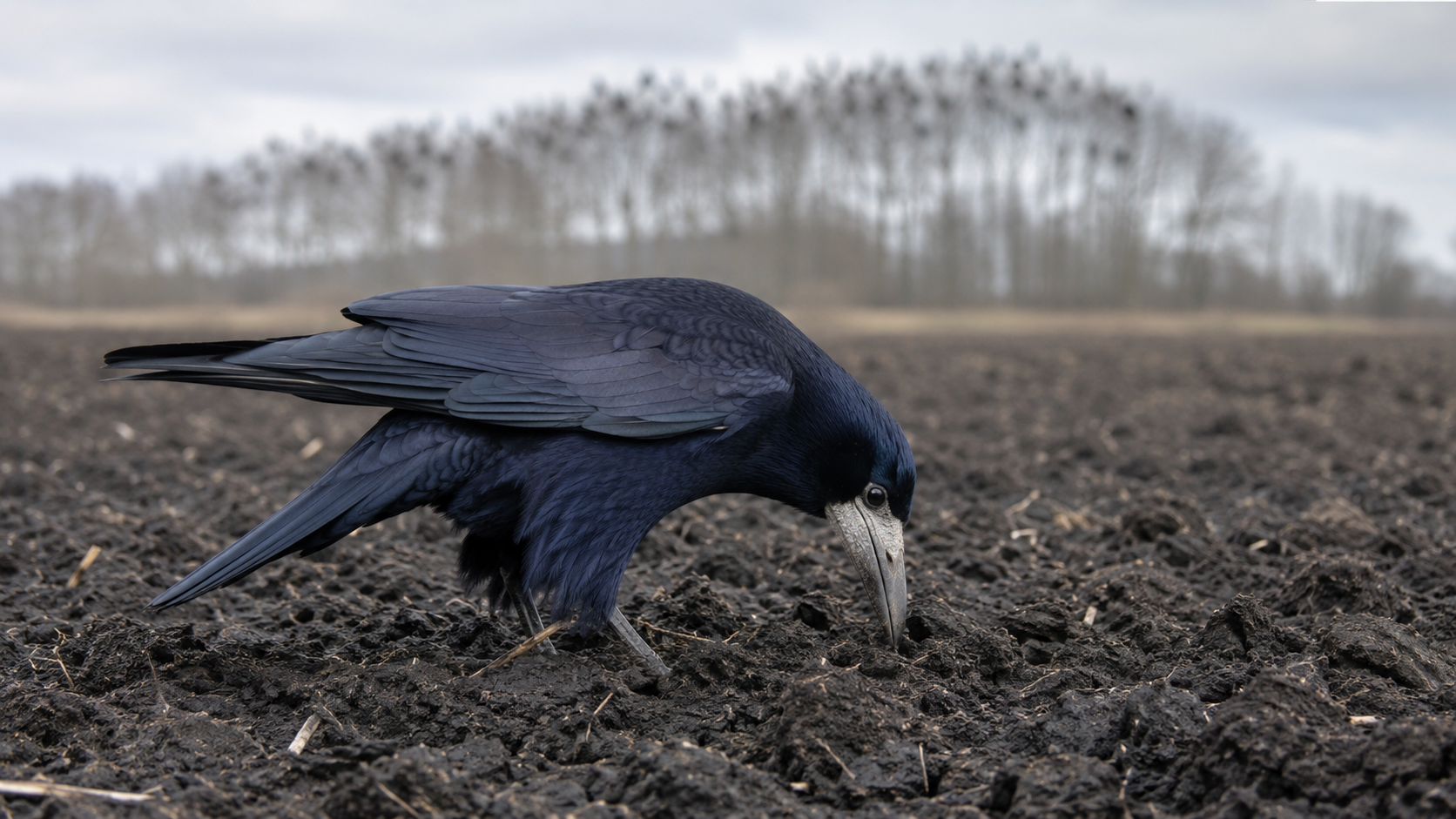
The rook (Corvus frugilegus) is a medium-large corvid with a wingspan of 81 to 99 cm and a body length of 44 to 46 cm, weighing between roughly 340 and 590 grams. Its plumage is a glossy purplish-black overall, similar in color to the carrion crow, but adults are readily distinguished by the bare, greyish-white patch of skin at the base of the long, pointed beak — a feature absent in juveniles, which have a fully feathered black face until their first molt.
Beyond the bare face patch, the rook has a distinctly peaked, steep forehead rather than the more rounded crown of a crow, and loose, shaggy feathering on the upper legs that gives the impression of baggy trousers, visible clearly when the bird is walking or standing. Its gait on the ground is also more purposeful and strutting than the carrion crow's, a subtle but useful field clue at a distance.
Range and habitat
The rook breeds across a wide swathe of temperate Europe and Asia, from the British Isles through central and eastern Europe into Russia and parts of Siberia. Populations in the milder west and south of the range are largely resident, while birds breeding in the coldest parts of northern and eastern Russia are migratory, moving south between October and March and sometimes forming large mixed winter flocks with hooded crows and jackdaws.
It is strongly associated with open farmland, particularly arable land with pasture, hedgerows, and stands of tall trees nearby for nesting and roosting, and is generally scarce or absent from dense unbroken forest, high mountains, and the most intensively urbanized city centers, though it readily forages in parks and open ground at the edge of towns.
Behavior and lifestyle
Rooks are among the most highly social of all corvids, feeding, roosting, and breeding in large, noisy groups rather than the more solitary or pair-based habits typical of crows. Diet centers on earthworms and soil-dwelling insect larvae, extracted by probing recently turned or open soil with the long, pointed beak, supplemented by grain and other crops, small invertebrates, and, opportunistically, carrion and food scavenged near human activity.
Foraging flocks can number in the hundreds outside the breeding season, and rooks frequently associate with jackdaws in mixed feeding and roosting groups. Like other corvids, rooks show marked intelligence, including cooperative problem-solving and the ability to use simple tools in captive studies, though this has been documented less extensively in wild populations than in some related species.
Breeding
Rooks nest colonially in structures called rookeries, large stick nests built close together high in a stand of tall trees, sometimes numbering from a handful up to several hundred nests at a single site, often reused and repaired across many years. The typical clutch is 3 to 5 eggs, incubated mainly by the female for 16 to 18 days while the male feeds her at the nest. Chicks fledge at around 32 to 33 days old, and young rooks typically remain associated with the colony, gradually integrating into the wider social flock as they mature.
Interesting facts
- Rookeries have been used by naturalists for centuries as a simple, visible index of local rook population trends, since colony sites tend to be traditional and long-lived, sometimes occupied for well over a hundred years at the same location.
- Experimental studies on captive rooks have demonstrated sophisticated tool use and problem-solving, including bending wire into hooks to retrieve out-of-reach food, placing them among the more cognitively studied corvids alongside crows and ravens.
- Despite their strong association with farmland, rooks were historically persecuted in parts of their range over concerns about crop damage, even though much of their diet consists of soil pests that would otherwise damage the same crops.