Great Tit
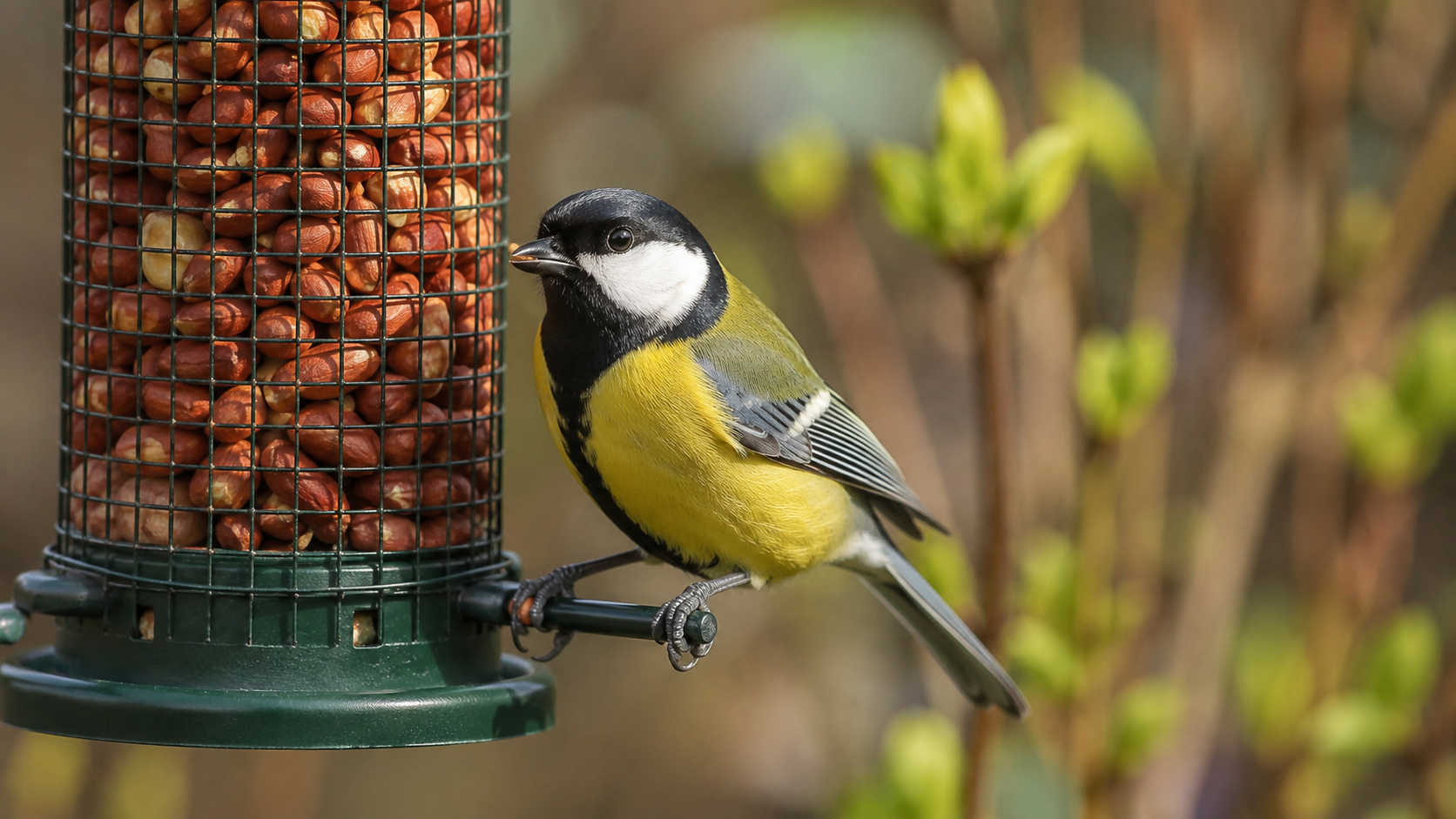
The great tit (Parus major) is the largest and most familiar European tit, a bold, adaptable garden bird known for its bright yellow underparts, black head, and endlessly varied calls.
Key facts
- Latin name
- Parus major
- Family
- Paridae (Tits)
- Wingspan
- 22.5–25.5 cm
- Season
- resident year-round
- Diet
- Insects and spiders, especially caterpillars in spring, Seeds and nuts, especially in autumn and winter, Garden feeder food, including sunflower seeds and suet, Occasionally larger prey, including other small birds in hard winters
- Conservation status
- LCLeast Concern
Appearance
The great tit (Parus major) is the largest member of the tit family found in Europe, with a wingspan of 22.5 to 25.5 cm and a body length of about 14 cm, weighing between roughly 16 and 21 grams. Its head is glossy black with bold white cheek patches, and a black stripe runs from the throat down the center of the bright yellow underparts to the legs — broader and more continuous in males, narrower and more prone to breaking up in females, providing one of the more reliable sex-based field marks among common European songbirds.
The back is olive-green, the wings blue-grey with a single white wing bar, and the tail blue-grey with white outer edges, together giving the species a strikingly clean, high-contrast appearance that makes it easy to identify even for beginning birdwatchers, particularly once its bold, confident behavior around bird feeders is added to the picture.
Range and habitat
The great tit is one of the most widespread songbirds in Europe and extends across virtually all of Russia south of the Arctic tundra, into parts of Central and East Asia. It is strongly resident, with established pairs typically remaining within the same territory year-round rather than migrating even in the coldest parts of its range.
It occupies an exceptionally broad range of wooded and semi-wooded habitats, including deciduous and mixed forest, farmland with hedgerows, and — perhaps most conspicuously — parks and gardens, where it is one of the most familiar and confident visitors to bird feeders across nearly the entire range, readily approaching close to human activity.
Behavior and lifestyle
Diet shifts markedly with the seasons: insects and spiders, especially caterpillars, dominate during spring and early summer, when great tits time their breeding to coincide closely with the seasonal peak in caterpillar abundance on nearby trees, while seeds and nuts become increasingly important through autumn and winter, supplemented heavily by garden feeder food including sunflower seeds and suet where available.
Great tits are known for an unusually large and flexible vocal repertoire, with the classic, ringing "teacher-teacher" song being just one of dozens of distinct call types documented in the species, used across a wide range of social contexts from territory defense to alarm signaling. Outside the breeding season they often join mixed foraging flocks with other tits and small songbirds, and the species is notably bold and assertive at feeding sites, frequently dominating smaller or more timid birds.
Breeding
Great tits nest in tree cavities, walls, or readily in artificial nest boxes, which the species accepts more consistently than almost any other common European bird — a trait that has made it a favorite subject of long-term ecological research. The typical clutch is unusually large among songbirds, ranging from 5 to 12 eggs, incubated solely by the female for 12 to 15 days. Chicks fledge at around 16 to 22 days old and remain dependent on their parents for continued feeding for a further period after leaving the nest.
Interesting facts
- Decades of long-term nest box studies on great tit populations, particularly in parts of Western Europe, have produced some of the most detailed and widely cited long-term datasets in all of ornithology, informing broader understanding of how climate change is shifting breeding timing across many bird species.
- Great tits have been documented using simple tools in captivity, including using a small stick to extract food from a narrow crevice, a behavior more commonly associated with larger-brained birds such as corvids.
- Urban great tits in some cities have been shown to sing at a higher pitch than their rural counterparts, a documented adaptation that helps their song stand out above low-frequency traffic noise.