Eurasian Magpie
The Eurasian magpie (Pica pica) is a strikingly patterned black-and-white corvid with a long wedge-shaped tail and iridescent wings, famous among birds for passing the mirror self-recognition test.
Key facts
- Latin name
- Pica pica
- Wingspan
- 52–62 cm
- Season
- resident year-round
- Diet
- Insects and other invertebrates, Eggs and nestlings of other birds, Small mammals and carrion, Seeds, fruit, and grain
- Conservation status
- LCLeast Concern
Appearance
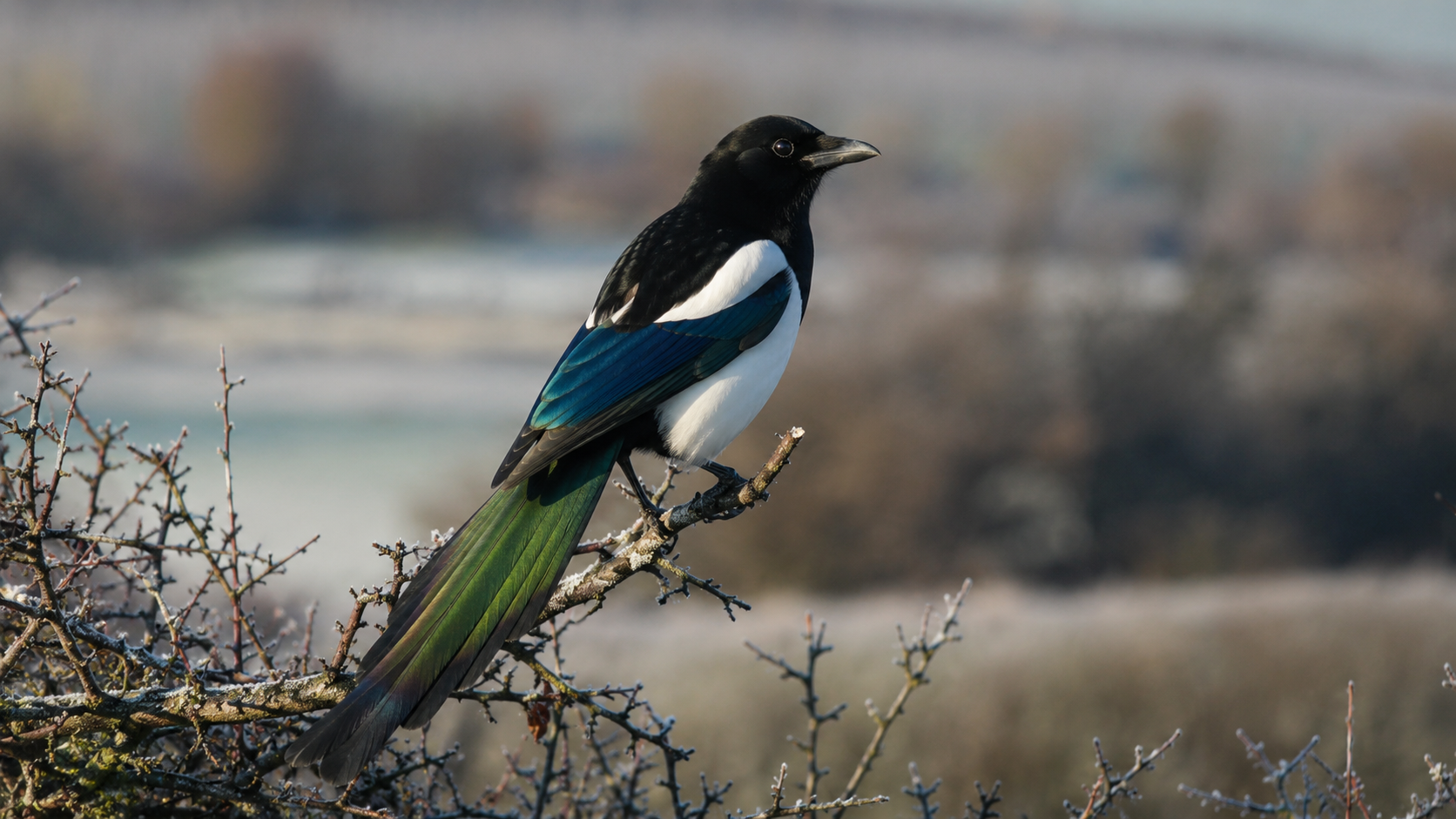
The Eurasian magpie (Pica pica) is a medium-sized corvid, smaller than a crow, with a wingspan of 52 to 62 cm and a body length of 44 to 46 cm — over half of which is its exceptionally long, wedge-shaped tail. Weight ranges from roughly 180 to 270 grams. Plumage is boldly patterned in black and white: a black head, breast, and back contrast sharply with pure white shoulder patches and belly, while the wings and long tail show a striking iridescent blue-green sheen produced by the microscopic structure of the feathers rather than pigment.
The unmistakable silhouette — compact body, long tail, and strongly rounded wings — combined with a distinctive, somewhat clumsy, bounding flight low over the ground makes the magpie one of the easiest corvids to identify at a glance, even at a considerable distance.
Range and habitat
The Eurasian magpie has an enormous range spanning most of Europe, much of Asia, and parts of northwestern Africa, occurring across nearly all of Russia except the high Arctic and the most densely forested taiga interior. It is strongly resident, with pairs typically remaining on the same territory year-round and showing little tendency to migrate even in the coldest parts of its range.
It thrives in a wide variety of semi-open habitats — farmland with scattered trees and hedgerows, woodland edges, parks, and gardens — and has adapted with particular success to towns and cities, where it is now one of the most familiar and conspicuous birds in many urban and suburban settings across its range.
Behavior and lifestyle
Magpies are omnivorous and highly opportunistic, feeding on insects and other invertebrates, the eggs and nestlings of smaller birds, small mammals, carrion, and a range of plant material including seeds, fruit, and grain. Like other corvids, they show marked intelligence, including sophisticated problem-solving, long-term memory for cached food, and — most famously — self-recognition in mirror tests, a level of cognitive sophistication that places them among the most intellectually capable birds studied.
Breeding pairs are territorial and largely monogamous, often remaining paired for multiple years, while non-breeding birds — typically younger individuals not yet holding a territory — form loose, gregarious flocks that roost and forage together until they establish territories of their own.
Breeding
Magpies build a large, distinctive domed stick nest with a roofed structure and a side entrance, offering protection from both weather and predators, typically placed high in a tree or tall shrub. The typical clutch is 5 to 8 eggs, incubated solely by the female for 21 to 22 days while the male provisions her with food. Chicks fledge at around 27 to 31 days old and remain dependent on their parents for several weeks afterward, often joining the local non-breeding flock once fully independent.
Interesting facts
- The magpie's 2008 confirmation as a mirror self-recognition-passing species was a landmark finding in animal cognition research, since it demonstrated a form of self-awareness in a bird whose brain architecture is very different from that of mammals previously known to pass the same test.
- Despite widespread folklore linking magpies to theft of shiny objects, controlled experiments have generally found the opposite pattern — magpies tend to approach unfamiliar shiny items cautiously rather than being drawn to them.
- Magpie numbers rose sharply across many European towns and cities during the 20th century as the species adapted to urban parks and gardens, making it one of the more visible examples of a wild bird thriving alongside expanding human settlement.