Northern Lapwing
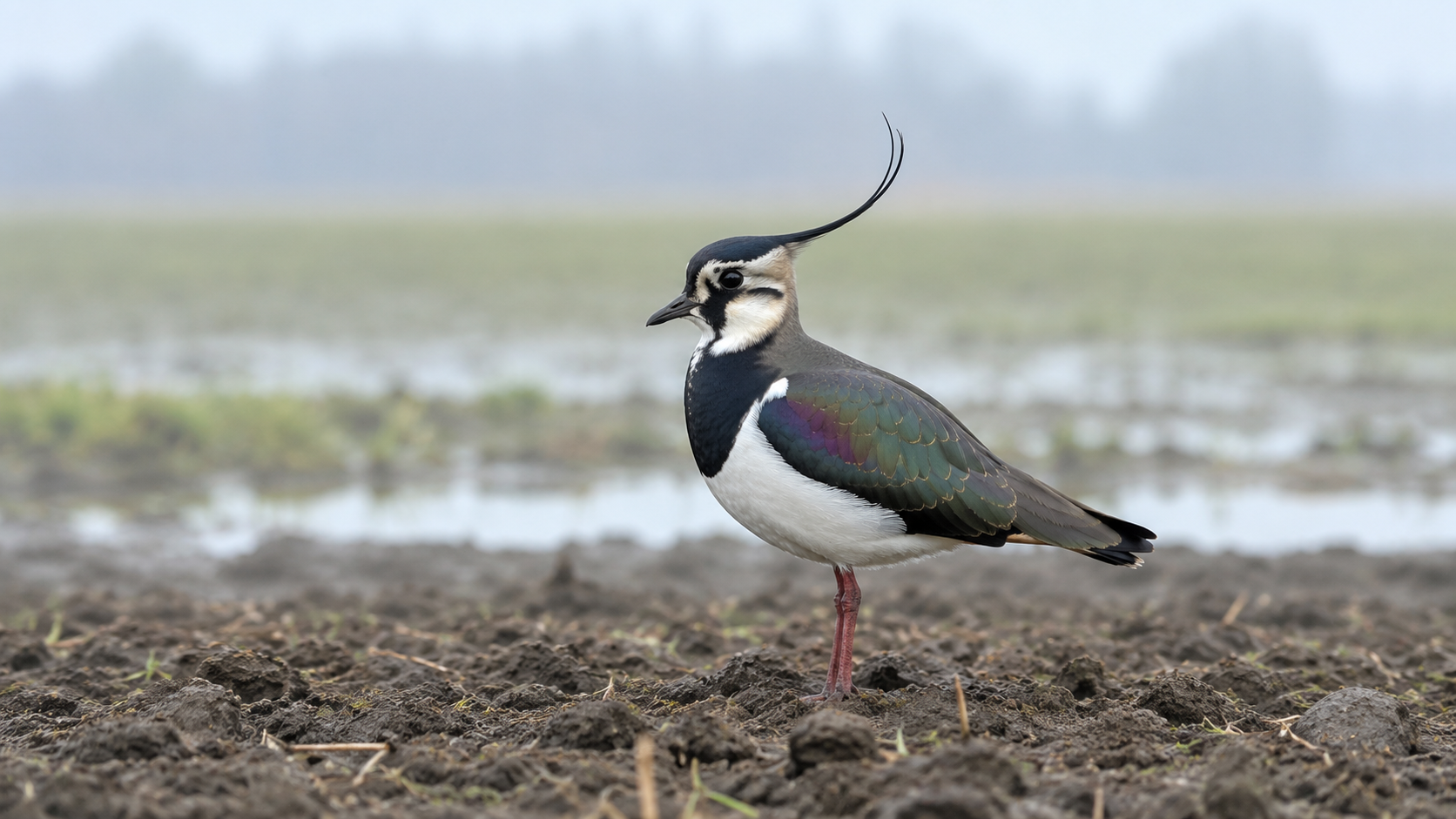
The northern lapwing (Vanellus vanellus) is a striking farmland wader known for its wispy head crest, iridescent green-black upperparts, and spectacular tumbling display flight.
Key facts
- Latin name
- Vanellus vanellus
- Wingspan
- 82–87 cm
- Season
- March – August, with early arrivals possible from late February
- Diet
- Earthworms, pulled from soft ground and pasture, Soil-dwelling insect larvae and beetles, Small invertebrates picked from ploughed fields and mudflats
- Conservation status
- NTNear Threatened
Appearance
The northern lapwing (Vanellus vanellus) is a medium-sized wader with a wingspan of 82–87 cm and a body length of 28–31 cm, weighing between roughly 150 and 300 grams. Its most distinctive feature is a thin, wispy black crest curling upward from the back of the head, longer and more prominent in males, giving the species an unmistakable silhouette even in poor light or at a distance.
At close range the upperparts show a glossy, iridescent dark green-black sheen with hints of purple, contrasting sharply with clean white underparts and a broad black breast band. In flight, the lapwing's rounded, broad-tipped wings, slow, floppy wingbeats, and bold black-and-white pattern make it one of the most easily recognized waders of open farmland, quite different from the narrower, more pointed-winged silhouette typical of most shorebirds.
Range and habitat
The northern lapwing breeds across most of temperate Europe and Asia, including a broad range through European Russia and westward into western Siberia, favoring open, damp lowland habitats: wet pasture, water meadows, and increasingly, arable farmland with bare or sparsely vegetated ground in early spring. Its adaptability to farmed landscapes made it, historically, one of the most numerous and familiar birds of European countryside.
Most Russian and continental European populations are migratory, arriving on the breeding grounds from March with occasional early arrivals in late February, and departing again by August to winter across milder parts of western and southern Europe, North Africa, and the Middle East, where damp fields and coastal mudflats remain unfrozen and accessible through the winter months.
Behavior and lifestyle
Lapwings feed mainly on earthworms and soil-dwelling invertebrates, using a characteristic run-stop-peck technique across open ground, pausing to look and listen before pecking at prey detected at or near the surface. Ploughed fields, short pasture, and damp mudflats all provide productive feeding grounds, and the species is often seen foraging in loose flocks, particularly outside the breeding season.
The male's tumbling, acrobatic display flight, involving steep climbs, rolls, and dives accompanied by a distinctive wheezing call, is a central part of both territory advertisement and courtship, performed repeatedly over the breeding territory in the early weeks of spring. Outside the breeding season, lapwings become considerably more gregarious, often gathering in large mixed flocks alongside golden plovers and other waders on open fields and coastal areas.
Breeding
The lapwing nests on the ground in a shallow scrape, often in a relatively open, sparsely vegetated field where the sitting bird retains a clear view of approaching danger. A typical clutch contains 3 to 4 eggs, camouflaged with dark blotching that makes them difficult to spot against bare earth, incubated mainly by the female for 26 to 29 days.
Chicks are precocial, leaving the nest within hours of hatching to feed themselves under the close guard of both parents, who defend the brood vigorously against predators and intruders with loud alarm calls and, if necessary, direct aggressive dive-bombing. Fledging takes around 35 to 40 days, after which family groups often join wider post-breeding flocks.
Interesting facts
- The lapwing's old country name, "peewit," directly imitates its distinctive wheezing call, and the name remains in common use across parts of its European range alongside "lapwing."
- Sharp, sustained population declines across much of Western Europe over recent decades led to the species' reclassification from Least Concern to Near Threatened, making it a focus species for several farmland bird conservation programs.
- Lapwings are known for a distraction display in which an adult feigns injury, dragging a wing as if unable to fly, to lure predators away from a nest or chicks before flying off once the threat has been drawn a safe distance away.