Common Blackbird
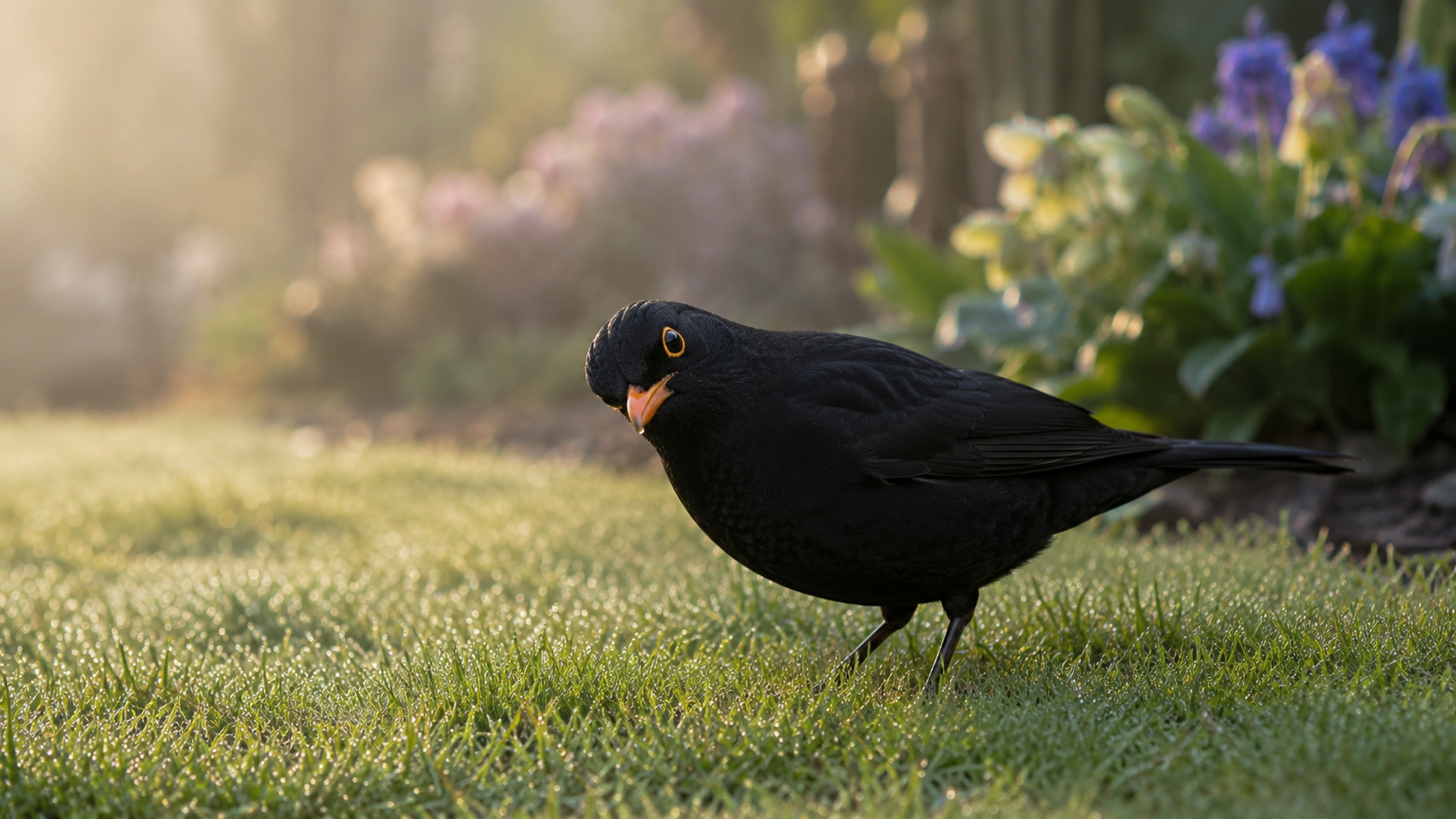
The common blackbird (Turdus merula) is one of Europe's most familiar garden birds, the glossy black male with his bright orange bill instantly recognizable, and his fluting dawn song among the most beautiful in Europe.
Key facts
- Latin name
- Turdus merula
- Family
- Turdidae (Thrushes)
- Wingspan
- 34–38.5 cm
- Season
- mostly resident; northern and eastern populations partially migratory October – March
- Diet
- Earthworms, especially on open lawns after rain, Insects and other invertebrates, Berries and soft fruit, especially in autumn and winter, Windfall fruit and garden scraps
- Conservation status
- LCLeast Concern
Appearance
The common blackbird (Turdus merula) is a medium-sized thrush with a wingspan of 34 to 38.5 cm and a body length of about 23.5 to 29 cm, weighing between roughly 80 and 125 grams. The adult male is entirely glossy black, with a bright orange-yellow beak and a matching narrow eye-ring that stand out sharply against the dark plumage — one of the most immediately recognizable combinations among common European garden birds.
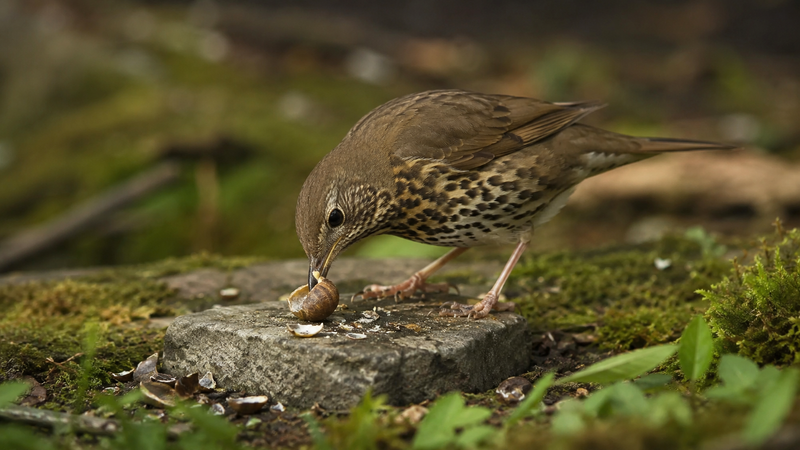
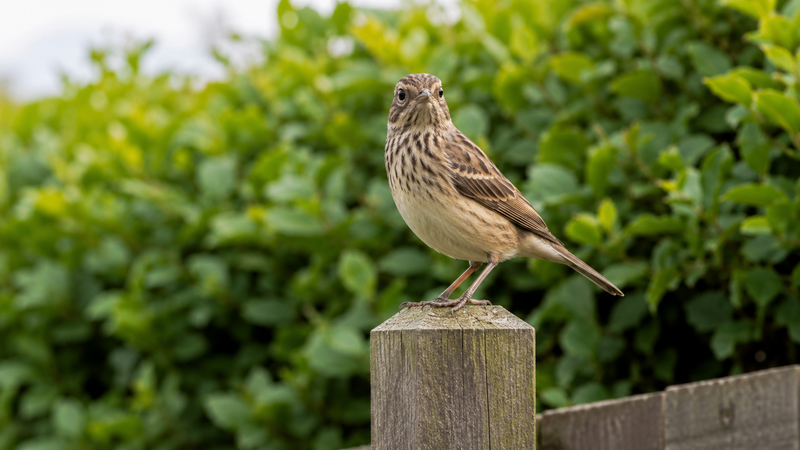
Females and juveniles look markedly different from the male, being dark brown overall, sometimes with faint mottling or streaking on the breast, and a duller, brownish beak rather than the male's vivid orange — different enough in appearance that beginning birdwatchers sometimes assume they belong to an entirely different species from the familiar black male.
Range and habitat
The common blackbird is one of the most widespread and familiar songbirds across almost the whole of Europe and extends through temperate Russia into western Siberia. Populations in the milder west and south of the range are largely resident, while birds breeding in colder parts of northern and eastern Russia show partial migratory movement, present further south between roughly October and March.
It is exceptionally adaptable, found across woodland, farmland with hedgerows, and — perhaps more conspicuously than almost any other thrush — parks and gardens, where it is often one of the first birds to become active at dawn and one of the last to stop singing at dusk, foraging confidently on open lawns close to human activity.
Behavior and lifestyle
Blackbirds forage mainly on the ground, taking earthworms and other invertebrates from open lawns and soil, characteristically pausing with head cocked to one side to spot subtle movement before a quick, precise strike. Diet shifts toward berries and soft fruit in autumn and winter, and blackbirds readily take windfall fruit and garden scraps, making them one of the more opportunistic feeders among common thrushes.
The male's song — a rich, slow, fluting series of phrases delivered from a prominent perch, typically at dawn and dusk — is widely regarded as one of the most beautiful songs among common European birds, and its unhurried, almost whistled quality makes it one of the easier bird songs for beginners to learn. Blackbirds are also notably vocal in alarm, producing a loud, chattering call when disturbed by a predator or other threat that frequently alerts other birds nearby.
Breeding
The female builds a sturdy cup nest of grass and twigs, lined with mud and finer material, typically placed in dense shrub or hedge cover, sometimes surprisingly close to human activity in gardens. The typical clutch is 3 to 5 eggs, incubated solely by the female for 12 to 14 days. Chicks fledge at around 13 to 14 days old, and pairs frequently raise two or three broods across an extended breeding season from early spring into summer.
Interesting facts
- Male blackbirds are famous for opportunistically singing from elevated perches such as chimney pots, television aerials, and rooftops in urban and suburban areas, exploiting the added height to project their song further across gardens and streets.
- Partial albinism, producing blackbirds with irregular white feather patches, is documented more frequently in this species than in most other common European birds, though the underlying cause remains only partially understood.
- Blackbird populations were successfully introduced to Australia and New Zealand in the 19th century, and the species has since become well established and widespread in both countries, far outside its native Eurasian range.