Bird Orders
Bird orders are the major taxonomic groupings above family — Passeriformes (perching birds) alone contains over half of all known species, with the rest split across raptors, waterfowl, waders, and more.

What an order is
An order is a taxonomic rank sitting above family and below class — it groups multiple related families that share a deeper common ancestry, even where the families within an order can look and behave quite differently from each other. Every bird species belongs to exactly one order, one level up from the more specific family groupings covered in this atlas's families section.
Passeriformes: the dominant order
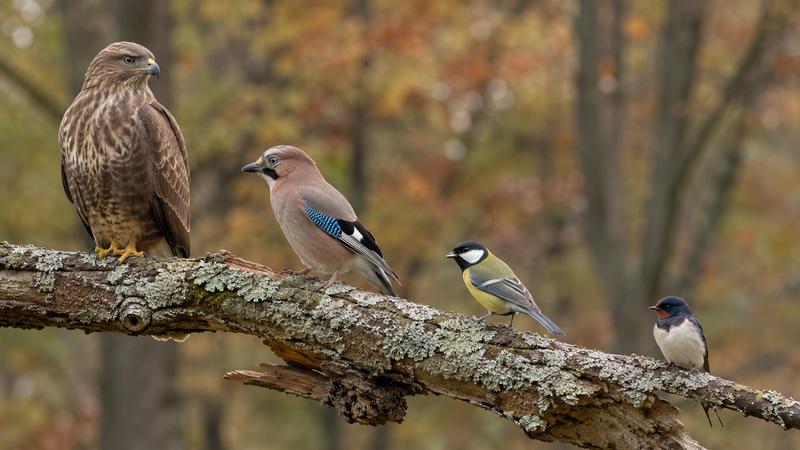
Passeriformes, the perching birds (also called passerines), is by far the largest bird order, containing well over half of all known bird species worldwide. Passerines share a distinctive foot arrangement — three toes pointing forward and one pointing back, meeting the leg at the same point — that gives a firm, largely automatic grip on branches, wires, and other thin perches without conscious muscular effort. Nearly all the small, familiar songbirds covered in this atlas belong here: tits, finches, thrushes, crows, swallows, and dozens of other families all sit within this single, enormously diversified order.
The major non-passerine orders
Outside Passeriformes, several other orders account for most of the remaining species diversity. Accipitriformes and Falconiformes cover diurnal birds of prey — hawks, eagles, and falcons — sharing hooked beaks and strong grasping talons, represented in this atlas by families like the Accipitridae and Falconidae. Strigiformes covers owls, the nocturnal counterpart to daytime raptors, represented by the Strigidae. Anseriformes covers waterfowl — ducks, geese, and swans — represented by the Anatidae. Charadriiformes is a large and varied order covering waders, gulls, and terns, represented here by families like Charadriidae and Laridae. Piciformes covers woodpeckers, represented by the Picidae, while Columbiformes covers pigeons and doves, represented by the Columbidae.
Why order-level grouping matters
Order-level classification captures deep evolutionary relationships that aren't always obvious from appearance alone — an owl and a falcon both hunt with hooked beaks and sharp talons, filling a similar ecological role, but belong to entirely separate, only distantly related orders, a case of convergent evolution rather than shared recent ancestry. Understanding this distinction helps explain why some superficially similar-looking or similarly-behaving birds turn out to be far less closely related than their day-to-day resemblance might suggest, while species that look quite different — a tiny finch and a large crow, both passerines — actually share a much closer common ancestor than their appearance alone would indicate.