Hawks, Eagles, and Kites (Accipitridae)
The largest family of diurnal birds of prey, spanning soaring buzzards, forest-hunting goshawks, massive fish eagles, and scavenging kites united by a hooked beak and taloned feet.
What makes Accipitridae a family
Accipitridae is the largest family of diurnal birds of prey in the world, with well over 200 species spanning buzzards, hawks, eagles, kites, harriers, and Old World vultures. What unites such a visually and behaviorally diverse group is shared ancestry rather than a single body plan: every member has a strongly hooked beak for tearing flesh, powerful feet armed with sharp curved talons for seizing and killing prey, and broadly similar skeletal proportions, even though wing shape, size, and hunting style vary enormously between genera.
Unlike falcons, which typically kill with a precise bite to the neck using a notched beak, Accipitridae species generally kill by crushing or piercing prey with their talons, using the beak mainly to tear food apart once it is subdued. This difference in hunting mechanics reflects a deeper evolutionary split: genetic studies confirm that hawks and eagles are not close relatives of falcons at all, despite a long history of both being lumped together informally as "birds of prey."
Distinctive traits across a diverse group
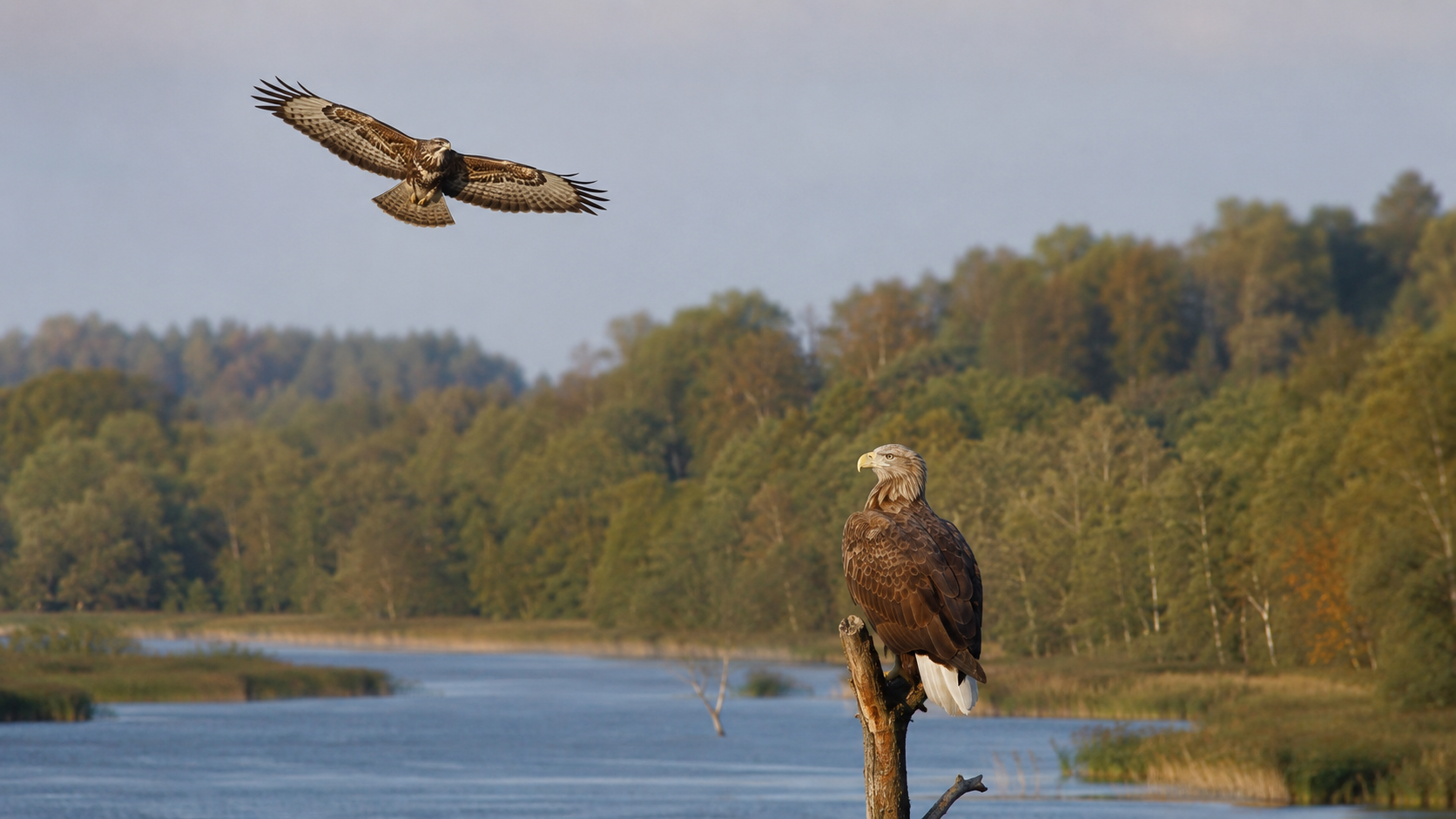
Within Accipitridae, wing shape closely tracks hunting habitat and strategy. Open-country soarers like the common buzzard have broad, rounded wings suited to riding thermal updrafts with minimal effort. Forest specialists like the northern goshawk have short, rounded wings and long tails built for tight, explosive maneuvering between trees. Large fish- and carrion-eating species like the white-tailed eagle have some of the broadest wingspans of any bird, built for slow, powerful flight while carrying heavy prey or scanning wide territories. Kites, such as the black kite, combine long, angled wings with a distinctive forked or notched tail for exceptional in-flight agility while scavenging.
Nesting habits also vary: most Accipitridae species build large stick nests in trees or on cliffs, often reused and enlarged across many years, in clear contrast to the falcon family's habit of using existing cavities without building anything at all.
Species in this family
This atlas currently covers four members of Accipitridae in detail: the common buzzard (Buteo buteo), the most widespread bird of prey across Europe and western Russia; the northern goshawk (Accipiter gentilis), a powerful and secretive forest hunter; the white-tailed eagle (Haliaeetus albicilla), Europe's largest eagle and a specialist of coasts and large lakes; and the black kite (Milvus migrans), one of the most abundant and adaptable raptors on Earth. Further Accipitridae species, including harriers and additional eagles native to the atlas's covered regions, will be added to the catalogue over time.
Where and when to watch this family
Because Accipitridae spans so many habitats — open farmland, dense forest, wetlands, and coastlines — members of this family can turn up almost anywhere across the atlas's covered regions. Broad-winged soaring species like the buzzard and eagle are easiest to spot on clear, sunny days when rising thermals allow prolonged effortless flight, while forest specialists like the goshawk are far more often heard or glimpsed briefly than seen at length. Spring and autumn migration periods bring an added chance to see resident and passage species together, particularly at natural migration corridors such as river valleys, coastlines, and mountain passes.