Crows, Ravens, and Allies (Corvidae)
The crow family: some of the most intelligent birds on Earth, from the tiny, sociable jackdaw to the giant common raven, united by cognitive sophistication and remarkable behavioral flexibility.
What makes Corvidae a family
Corvidae, the crow family, comprises around 120 species worldwide, including crows, ravens, magpies, jays, jackdaws, and rooks. What defines the family is less a single distinctive body shape — members range from the compact jackdaw to the massive raven — than a shared package of behavioral and cognitive traits: corvids are consistently among the most intelligent birds known, capable of tool use, multi-step problem-solving, long-term spatial memory, and complex social behavior including apparent deception and cooperation.
Physically, corvids share a sturdy build, strong perching and walking legs, and a robust, all-purpose beak suited to an unusually broad omnivorous diet spanning insects, small vertebrates, eggs, carrion, grain, and fruit. This dietary flexibility, combined with high intelligence, underlies much of the family's remarkable success across an enormous range of habitats, from Arctic tundra to city centers.
Distinctive traits across the family
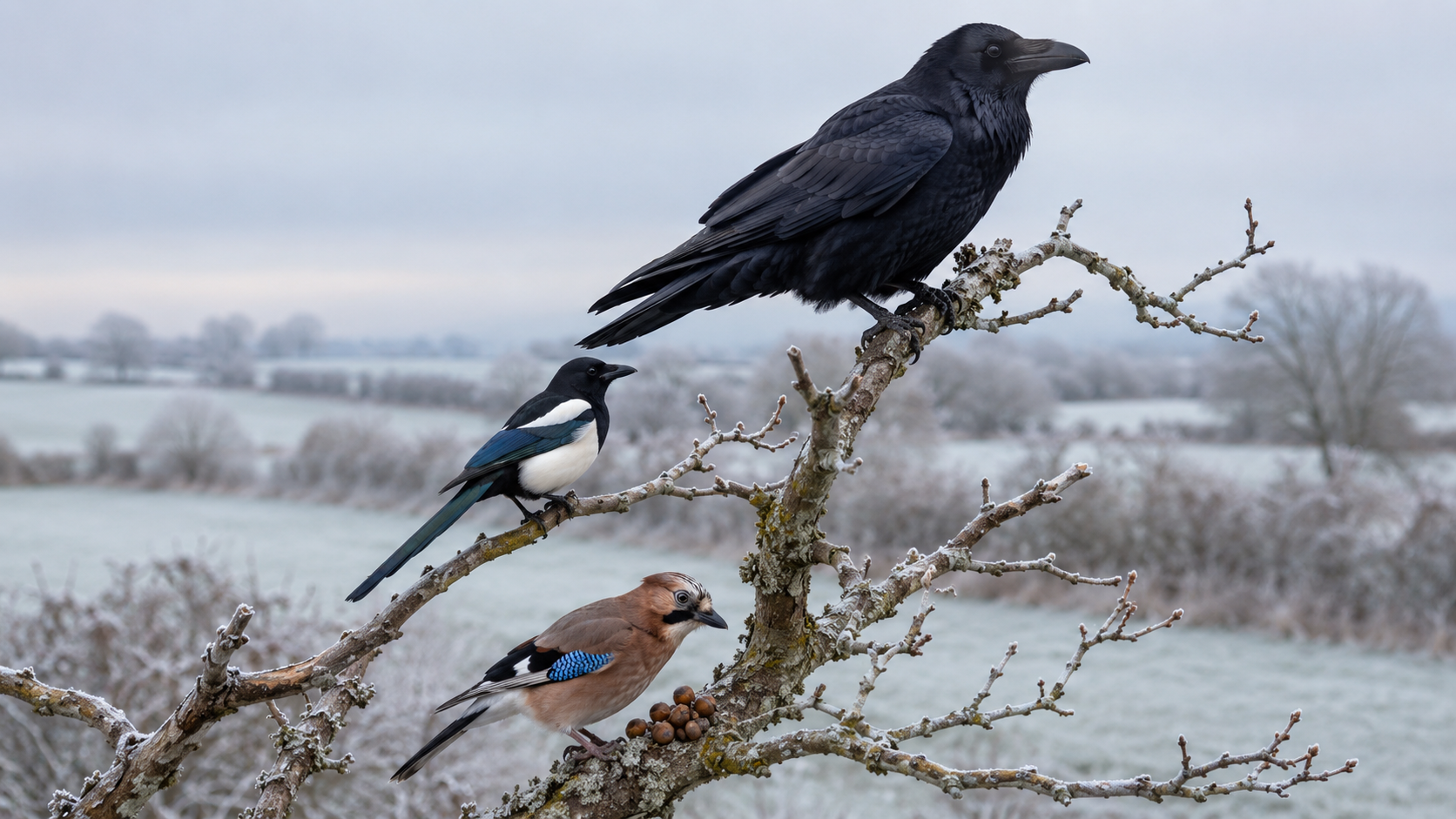
Social structure varies considerably within Corvidae, from the near-solitary, strictly territorial pairs of the raven to the large, noisy colonial nesting of the rook and the tightly pair-bonded but flock-living jackdaw. Plumage is similarly varied: species like the raven, rook, and hooded crow are dominated by black or grey-and-black patterns, while the magpie and jay display bold white patches and iridescent structural coloration entirely different from typical corvid coloring.
Nesting habits split the family into two broad groups: open stick-nest builders, such as the raven, hooded crow, rook, and magpie, which construct their own nest from scratch (the magpie uniquely adding a domed roof), and obligate cavity nesters like the jackdaw, which depend entirely on finding an existing hole or hollow rather than building an open structure.
Species in this family
This atlas currently covers five members of Corvidae: the hooded crow (Corvus cornix), a grey-and-black farmland generalist; the rook (Corvus frugilegus), a highly colonial farmland specialist recognized by its bare grey face; the Eurasian magpie (Pica pica), famous for passing the mirror self-recognition test; the Eurasian jay (Garrulus glandarius), a shy woodland specialist and prolific acorn-planter; and the western jackdaw (Coloeus monedula), the smallest common European corvid and an obligate cavity nester. Further Corvidae species native to the atlas's covered regions will be added to the catalogue over time.
Where and when to watch this family
Corvids are among the most reliably visible birds across nearly every habitat covered by this atlas, from open farmland and woodland to city centers, and are active and conspicuous year-round rather than showing strong seasonal patterns like many other bird families. Autumn and winter often bring the most dramatic viewing opportunities, when species such as the rook and jackdaw form large mixed foraging flocks and communal roosts, and when jays become unusually visible while actively caching acorns ahead of the leaner winter months.