Swallows and Martins (Hirundinidae)
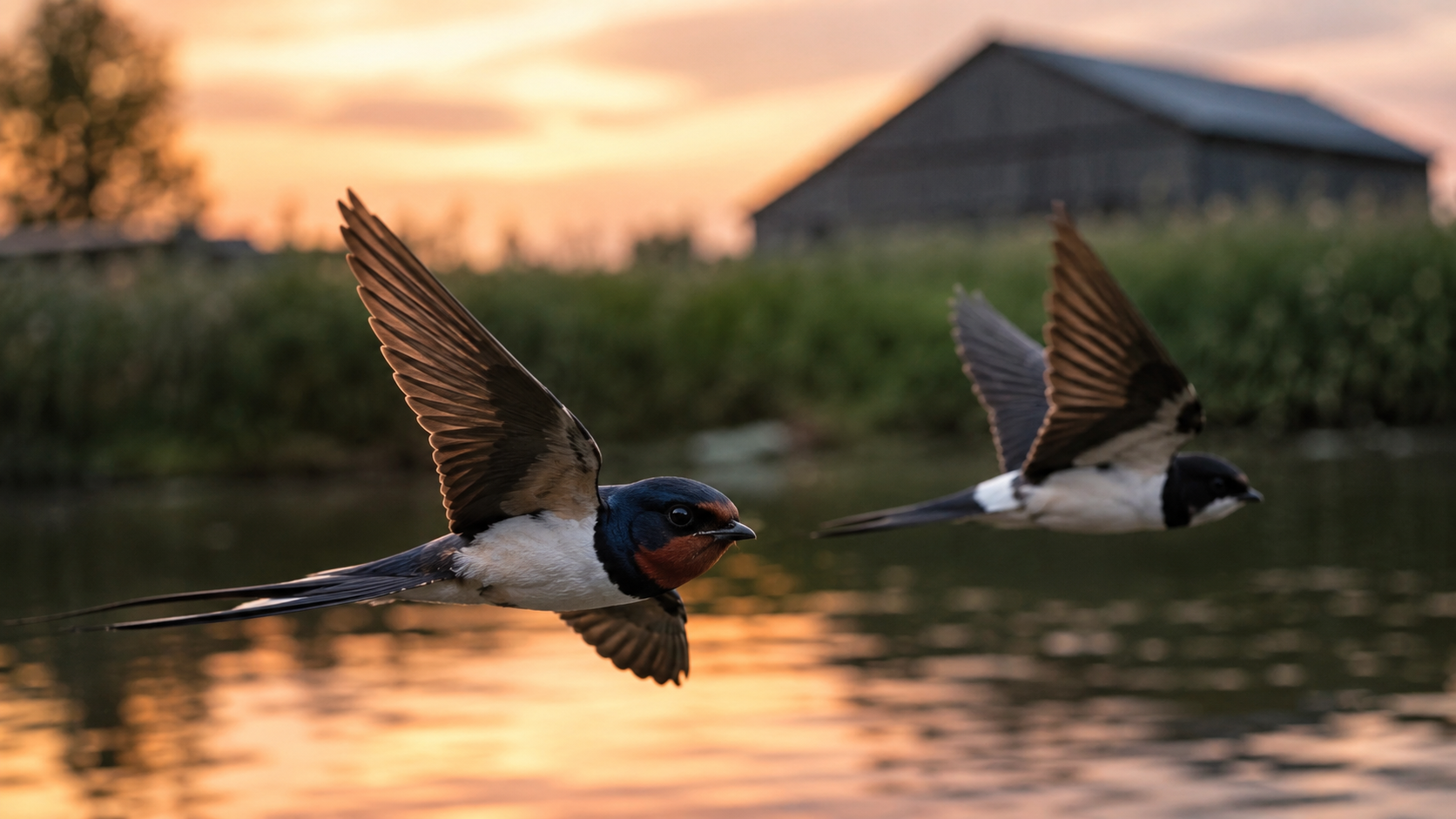
The swallow family: sleek, long-winged aerial insect-hunters that spend most of their waking lives on the wing, from the red-throated barn swallow to the white-rumped house martin.
What makes Hirundinidae a family
Hirundinidae, the swallow family, comprises around 90 species of highly aerial songbirds found on every continent except Antarctica, unified by long, pointed wings, a streamlined body built for fast, sustained, and remarkably agile flight, and a wide, short beak adapted for snatching insects directly out of the air. Unlike many songbird families that forage mainly on the ground or among foliage, Hirundinidae species spend the great majority of their waking hours airborne, feeding, and often even socializing on the wing.
Both species covered in this atlas build nests entirely from mud, collected one small pellet at a time and shaped into a cup or dome using the bird's own beak and saliva, a distinctive construction method shared broadly across the family, even as the exact resulting nest shape varies depending on the specific nesting site each species favors.
Distinctive traits across the family
The two species covered here illustrate a meaningful architectural divide within the family: the barn swallow builds an open cup nest, typically sited on a sheltered indoor beam or ledge protected from rain by a roof overhead, while the house martin constructs a mostly enclosed, dome-shaped nest with only a small entrance hole, usually fixed to an exposed outdoor wall beneath an eave — a structure that compensates for its more exposed outdoor location with a more fully protective shape.
Social structure also varies meaningfully within the family: barn swallows tend to nest more individually or in loosely associated small groups, while house martins are markedly more colonial, often building dense clusters of nests side by side under the eaves of a single favored building.
Species in this family
This atlas currently covers two members of Hirundinidae: the barn swallow (Hirundo rustica), famous for its deeply forked tail streamers and one of the longest migrations of any small songbird; and the common house martin (Delichon urbicum), easily told apart by its clean white rump and colonial nesting habits. Further Hirundinidae species native to the atlas's covered regions will be added to the catalogue over time.
Where and when to watch this family
Open farmland, water bodies, and villages or towns with traditional buildings offering suitable nest sites are the most reliable places to encounter this family, and because both species covered here are long-distance migrants, they are present only from spring through early autumn across nearly their entire Eurasian breeding range. Warm, calm days with abundant flying insects typically bring the most active and visible foraging behavior, while cold or wet spells can temporarily reduce activity dramatically as insect prey becomes scarce.