Finches (Fringillidae)
The true finch family: small, seed-eating songbirds with conical beaks ranging from the everyday chaffinch to the specialized, cone-prying red crossbill.
What makes Fringillidae a family
Fringillidae, the true finch family, comprises over 200 small to medium-sized songbird species worldwide, unified by a short, strong, typically conical beak adapted for handling seeds — the family's dominant, though not exclusive, food source. A notched or shallow-forked tail and a distinctive undulating, bounding flight, produced by alternating short bursts of flapping with brief closed-wing glides, are shared across nearly every member of the family, making silhouette and flight style useful identification clues even before plumage details are visible.
Beak shape within the family varies substantially according to diet, offering one of the clearest examples in European birds of how a single anatomical feature can diversify to exploit different food sources: from the goldfinch's fine, needle-like bill suited to extracting seeds from tight flower heads, to the greenfinch's heavy conical bill built for cracking large, hard seeds, to the red crossbill's remarkable crossed mandibles, uniquely adapted for prying open unopened conifer cones.
Distinctive traits across the family
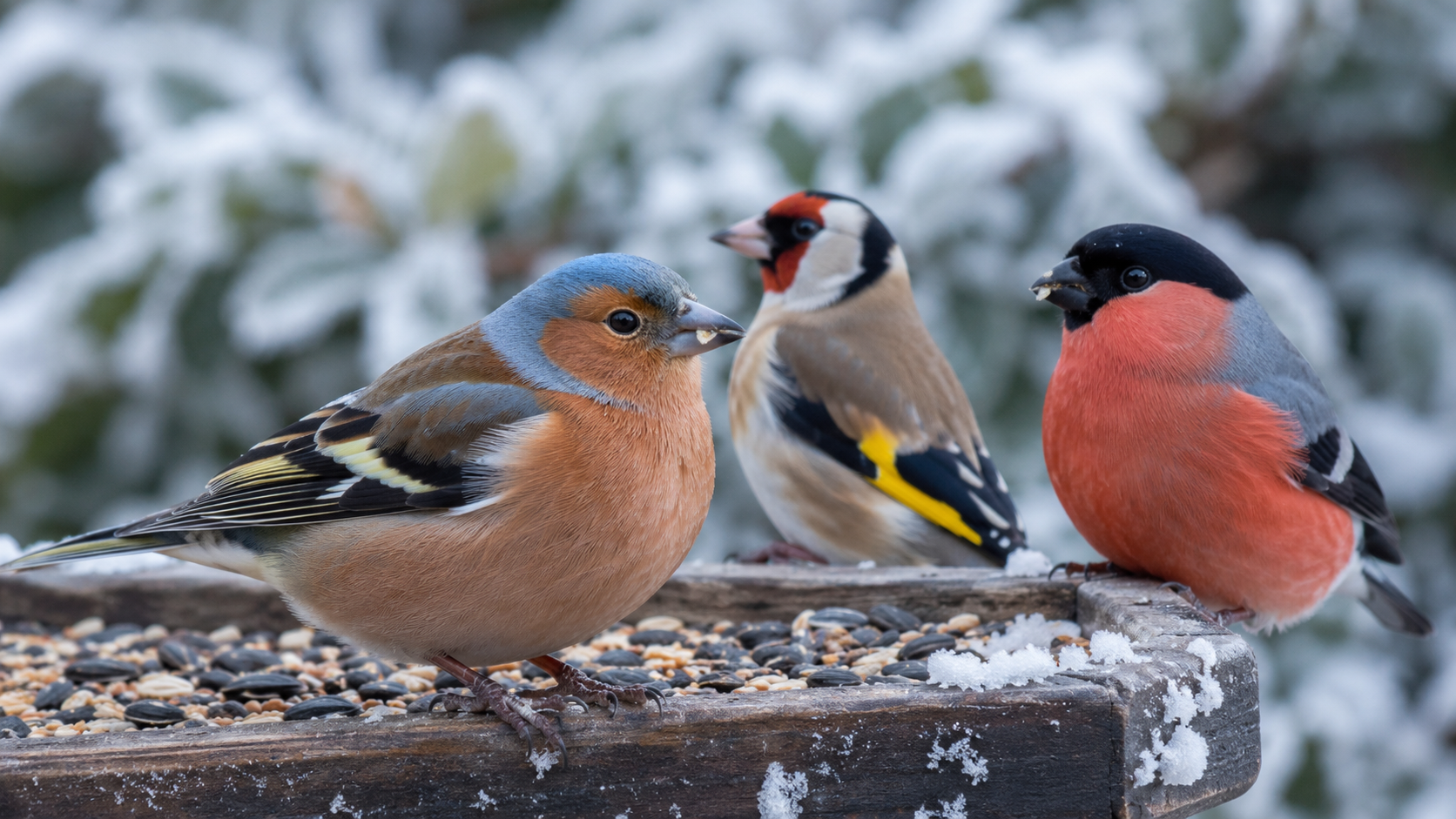
Plumage across Fringillidae ranges from the muted, understated coloring of species like the siskin to some of the most vividly patterned songbirds in Europe, including the bullfinch's vivid rose-pink and the goldfinch's bold red, black, and gold face pattern. Social behavior also varies: some species, like the chaffinch, forage individually or in loose association for much of the year, while others, including the siskin and greenfinch, are strongly gregarious, forming large, cohesive flocks outside the breeding season.
Migratory strategy within the family spans the full range from largely sedentary populations to fully migratory ones, and several conifer-specialist finches — the siskin and red crossbill in particular — follow food-driven nomadic movements rather than a fixed seasonal pattern, appearing unpredictably in large numbers wherever a good local seed crop draws them.
Species in this family
This atlas currently covers six members of Fringillidae: the common chaffinch (Fringilla coelebs), one of Europe's most abundant songbirds; the European goldfinch (Carduelis carduelis), a vividly colored thistle-seed specialist; the Eurasian bullfinch (Pyrrhula pyrrhula), a shy, stocky finch known for its rose-pink males; the Eurasian siskin (Spinus spinus), a small acrobatic conifer specialist; the European greenfinch (Chloris chloris), a heavy-billed generalist with a distinctive buzzing song; and the red crossbill (Loxia curvirostra), famous for its uniquely crossed beak. Further Fringillidae species native to the atlas's covered regions will be added to the catalogue over time.
Where and when to watch this family
Finches can be found across nearly every habitat covered by this atlas, from farmland and hedgerows to coniferous forest and gardens, and most species are present year-round somewhere within their range, though local abundance can shift noticeably with the seasons and with food availability. Winter is often the easiest time to see several species together, as mixed finch flocks gather at rich seed sources — weedy field margins, alder stands, or garden feeders — bringing species that might otherwise rarely overlap into close, easily comparable view.