Woodpeckers (Picidae)
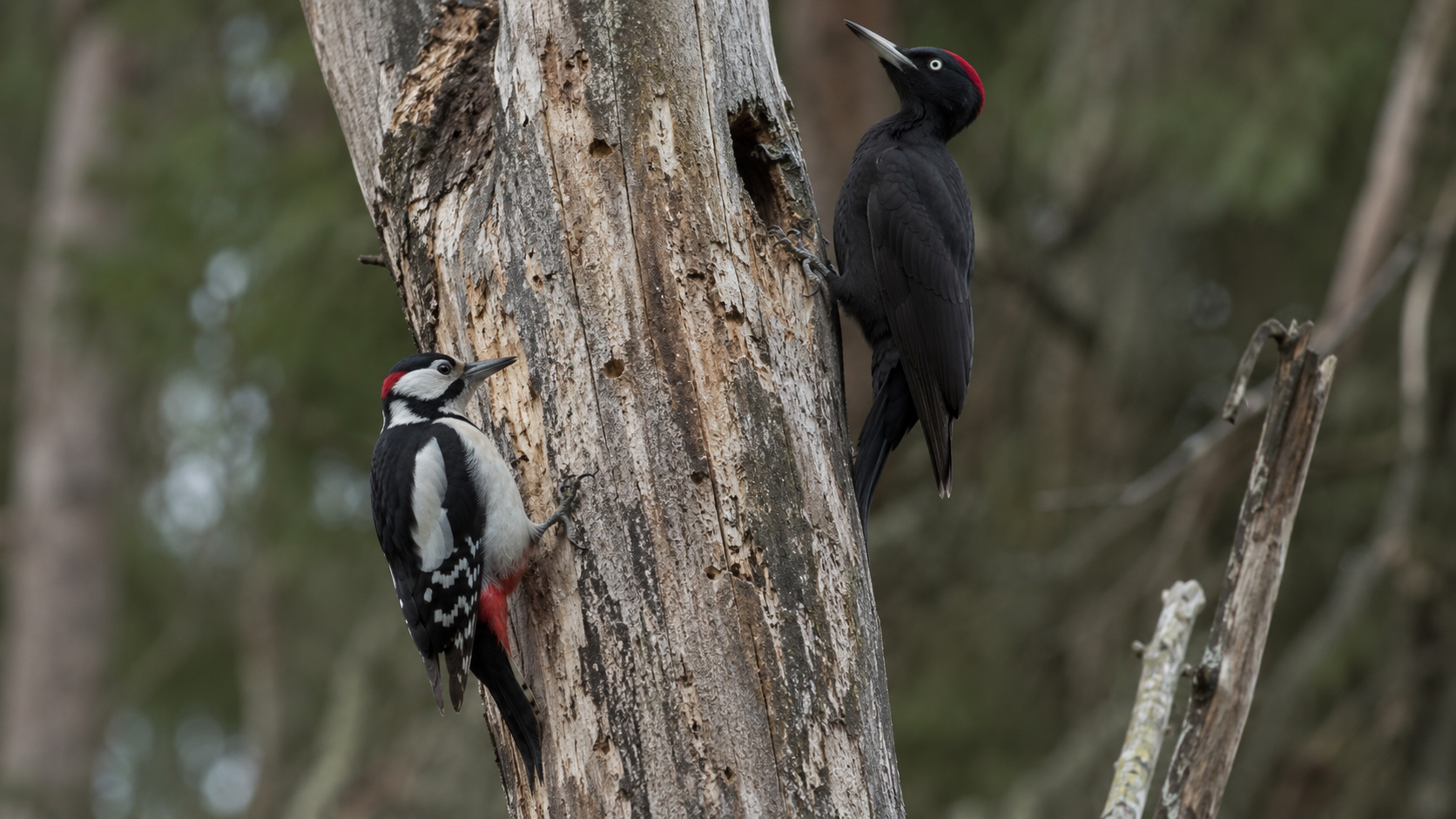
The woodpecker family: powerful, tree-climbing excavators built to hammer into wood, from the widespread black-and-white great spotted woodpecker to the crow-sized black woodpecker.
What makes Picidae a family
Picidae, the woodpecker family, comprises over 200 species found across most of the world's forested regions, unified by a remarkable set of anatomical adaptations built around the demands of striking and excavating wood at high speed and force. A strong, chisel-shaped beak does the actual work of excavation, while a shock-absorbing skull structure, incorporating spongy bone and strong supporting neck muscles, protects the brain from the repeated impact, and stiff, specially reinforced tail feathers act as a supporting brace against the trunk while the bird climbs and works vertically.
Feet across the family are typically zygodactyl, with two toes pointing forward and two backward, providing an unusually secure grip on vertical bark surfaces compared to the more typical three-forward, one-back foot arrangement found in most other perching birds — an adaptation directly suited to a life spent climbing and clinging to tree trunks rather than perching on horizontal branches.
Distinctive traits across the family
Drumming, a rapid mechanical burst of beak strikes against a particularly resonant piece of wood, is one of the family's most distinctive shared behaviors, functioning as the woodpecker equivalent of song for territorial advertisement and mate attraction — a striking example of an existing physical capability, evolved originally for feeding and nest excavation, being repurposed for communication.
Body size within the family correlates closely with the scale of excavation a species can undertake and the specific food resources it targets: smaller woodpeckers like the great spotted woodpecker excavate more modest cavities and extract insect larvae with more localized, precise strikes, while considerably larger species like the black woodpecker can carve deep into substantial deadwood, accessing food resources and creating nest cavities entirely out of reach for smaller relatives.
Species in this family
This atlas currently covers two members of Picidae: the great spotted woodpecker (Dendrocopos major), the most widespread woodpecker in Europe, known for its bold black-and-white pattern and rapid drumming; and the black woodpecker (Dryocopus martius), Europe's largest woodpecker and an important ecosystem engineer whose large cavities shelter many other forest species. Further Picidae species native to the atlas's covered regions will be added to the catalogue over time.
Where and when to watch this family
Mature woodland with a good supply of dead or decaying trees offers the best chance of encountering this family, and early spring, before leaves fully emerge and while territorial drumming activity peaks, is typically the easiest time to both hear and see woodpeckers, since drumming carries well through relatively open, still-bare forest canopy and often reveals a bird's location before it comes into clear view.