Typical Owls (Strigidae)
The largest owl family, spanning the familiar tawny owl, tufted long-eared owl, and the giant Eurasian eagle-owl, united by forward-facing eyes, silent flight, and mostly nocturnal habits.
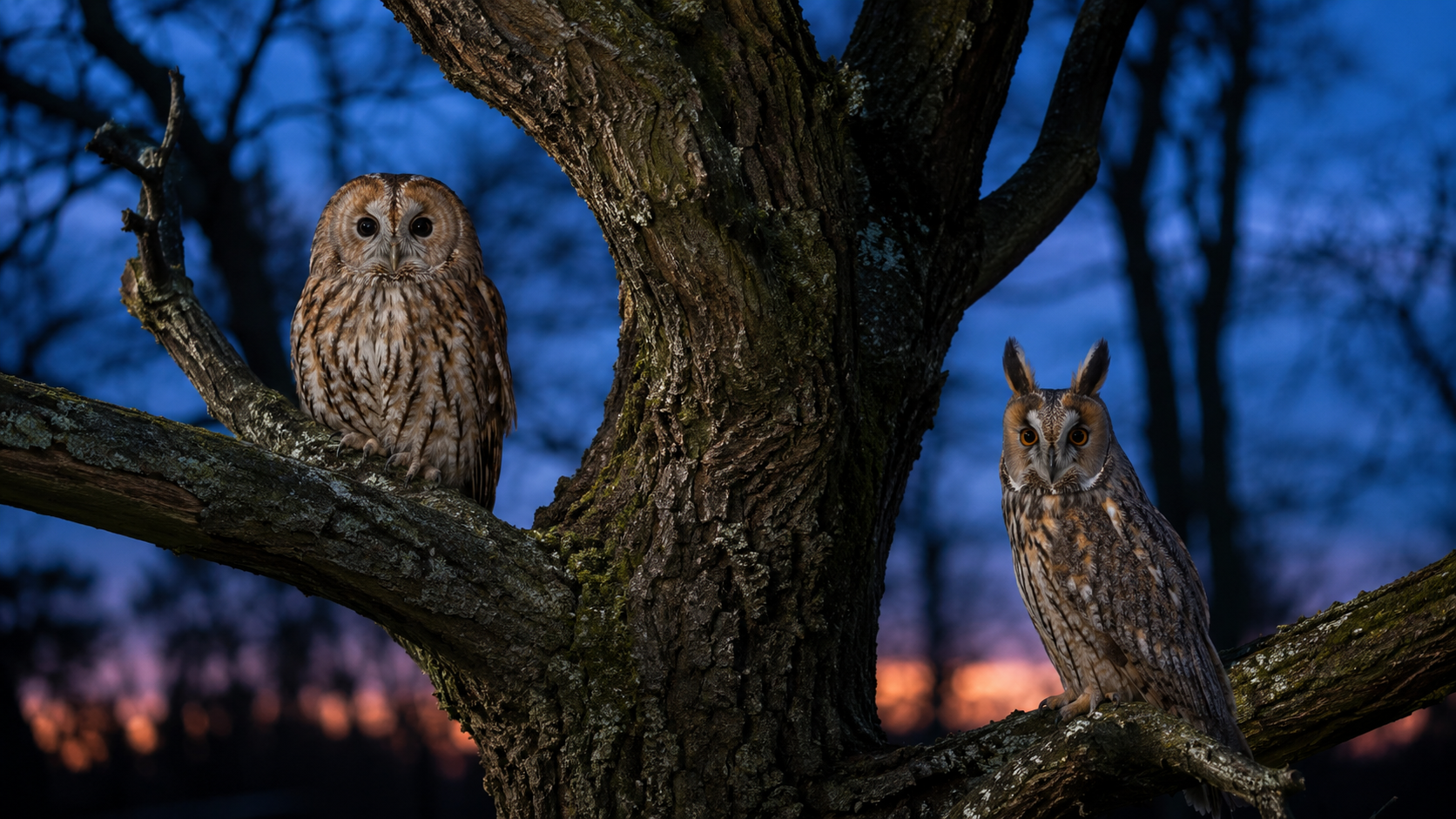
What makes Strigidae a family
Strigidae, often called the "typical owls," is by far the largest of the two living owl families, containing well over 200 species worldwide and including the great majority of owls familiar to most people — from the diminutive little owl to the massive Eurasian eagle-owl. It is distinguished from the smaller barn owl family, Tytonidae, primarily by the shape of the facial disc, which is rounder rather than heart-shaped, along with differences in the skull, breastbone, and middle toe claw.
Members of this family share the traits most people associate with owls generally: large, forward-facing eyes that provide excellent binocular vision and depth perception in low light, an extremely flexible neck capable of rotating roughly 270 degrees to compensate for eyes that barely move within their sockets, and specially structured flight feathers with soft, comb-like leading edges that break up turbulent airflow and allow near-silent flight — a crucial advantage for a predator that relies on stealth and hearing as much as sight.
Distinctive traits across the family
Size within Strigidae varies more dramatically than in almost any other bird family, from species weighing barely 100 grams to the Eurasian eagle-owl at over 4 kilograms — a more than fortyfold range in body mass among close relatives. Ear tufts, another visible variation within the family, are not true ears at all but tufts of feathers used for camouflage and signaling; some genera, like Strix (the tawny owl's genus), lack them entirely, while others, like Asio (the long-eared owl's genus) and Bubo (the eagle-owl's genus), display them prominently.
Hunting strategy also varies with size and habitat: smaller species tend to specialize more narrowly on insects and small rodents, while the largest, like the eagle-owl, are capable of taking prey as large as other birds of prey. What unites the family despite this range is the underlying toolkit — acute night vision, precise directional hearing from asymmetrically placed ear openings hidden beneath the facial disc, and silent flight.
Species in this family
This atlas currently covers three members of Strigidae: the tawny owl (Strix aluco), the most familiar owl across much of Europe and western Russia; the long-eared owl (Asio otus), a slender conifer specialist known for its winter roosting groups; and the Eurasian eagle-owl (Bubo bubo), one of the largest owls in the world and a formidable apex predator. Further Strigidae species native to the atlas's covered regions will be added to the catalogue over time.
Where and when to watch this family
Because nearly all Strigidae species are nocturnal or crepuscular, encountering one usually means listening rather than watching: hooting and calling activity peaks around dusk and again before dawn, and is most vocal in late winter and early spring as pairs establish or reaffirm territories ahead of the breeding season. Daytime sightings typically come from disturbing a roosting bird by chance or, in winter, locating a communal roost site — most reliably for species like the long-eared owl that gather socially outside the breeding season.