Falcons (Falconidae)
The falcon family: fast, direct-flying birds of prey with a distinctive hooked, tomial-toothed beak, found on every continent except Antarctica.
What makes a falcon a falcon
The family Falconidae comprises around 65 species of small to medium-sized birds of prey found on every continent except Antarctica, from the arctic tundra to tropical savanna. Despite superficial similarities to hawks and eagles, falcons are not close relatives of them — modern genetic studies place the falcon family closer to parrots and songbirds on the bird family tree, a striking result of convergent evolution toward a similar predatory lifestyle.
Falcons are built for speed and precision rather than raw power or soaring endurance. Their wings are long, narrow, and pointed, giving them fast, direct flight and, in species like the peregrine falcon, the fastest recorded diving speed of any animal on Earth. Their beak carries a distinctive notch on the upper mandible — often called a "tomial tooth" — used to sever the spinal cord of prey at the neck, a hunting method distinct from the crushing grip favored by hawks and eagles.
Distinctive traits
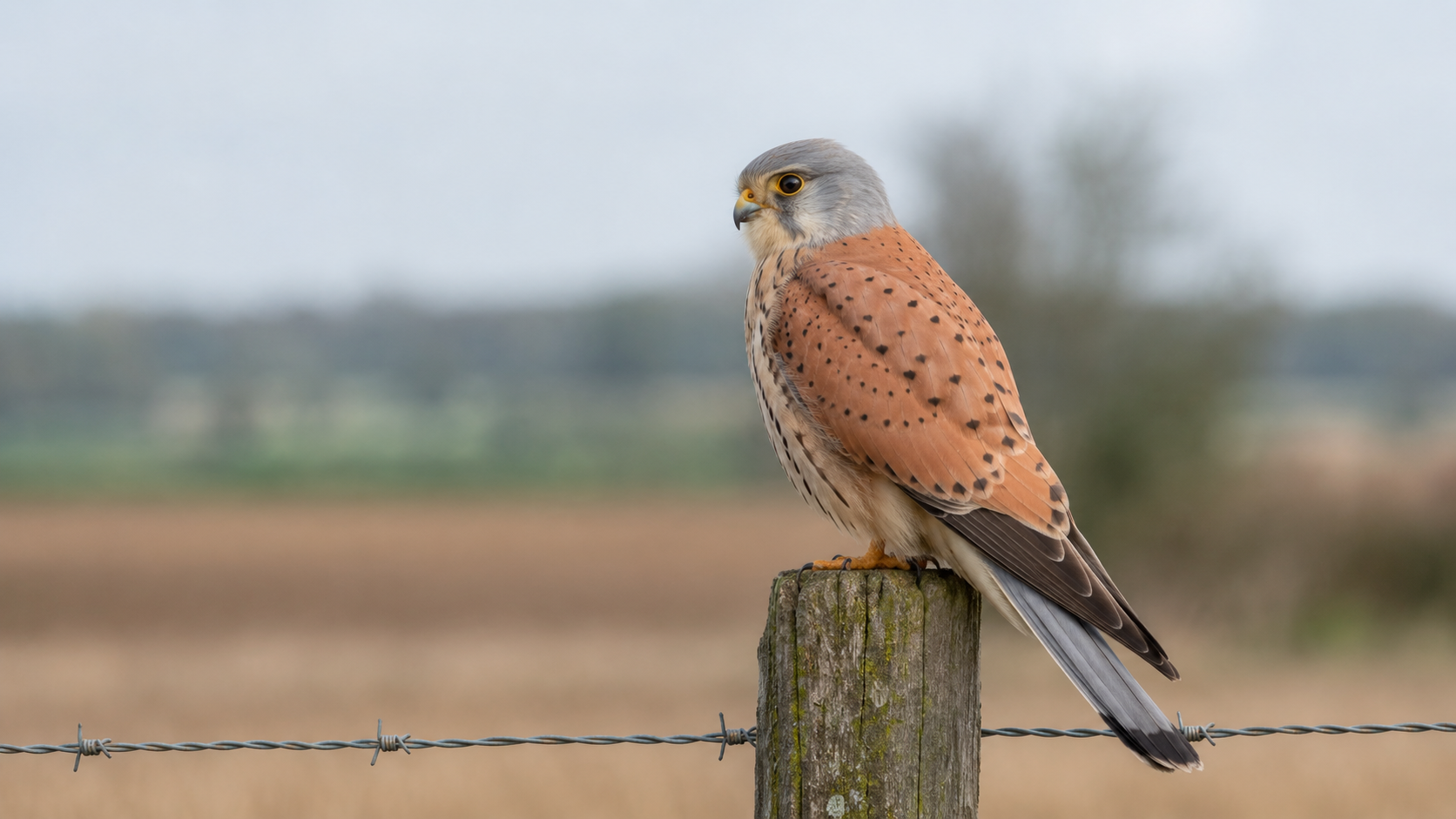
Beyond flight style and beak shape, falcons share a set of behavioral traits that set them apart within the birds of prey. None build a nest of their own: every falcon species lays its eggs directly into an existing cavity, ledge, or a nest abandoned by another bird, from tree hollows to cliff faces to city ledges. Most falcons also show some degree of sexual size dimorphism, with females typically larger than males, and several species — including the common kestrel — display distinct plumage differences between the sexes as well.
Hunting technique varies across the family: some falcons, like the kestrel, hover in place while scanning open ground below; others, like the peregrine, hunt on the wing with high-speed stoops on flying prey; smaller species such as the merlin favor low, fast pursuit flight close to the ground.
Species in this family
So far, this atlas covers one member of the falcon family in detail: the common kestrel (Falco tinnunculus), Europe's most familiar hovering falcon, found across open farmland, grassland, and increasingly in urban areas throughout its huge range from Western Europe to the Russian Far East. Other falcons native to the atlas's covered regions — including the peregrine falcon, merlin, and saker falcon — will be added to the catalogue over time, each linked back to this page.
Where and when to watch falcons
Falcons favor open habitats where they can spot prey at a distance: farmland, grassland, steppe, coastal cliffs, and increasingly cities, where tall buildings substitute for natural cliff ledges. In Russia and much of Europe, resident falcon populations are joined seasonally by migratory individuals, making spring and autumn passage periods especially good times to see multiple falcon species in the same area. A hovering silhouette over an open field, motionless against the wind, is one of the most reliable field signs of a falcon at any time of year.