European Greenfinch
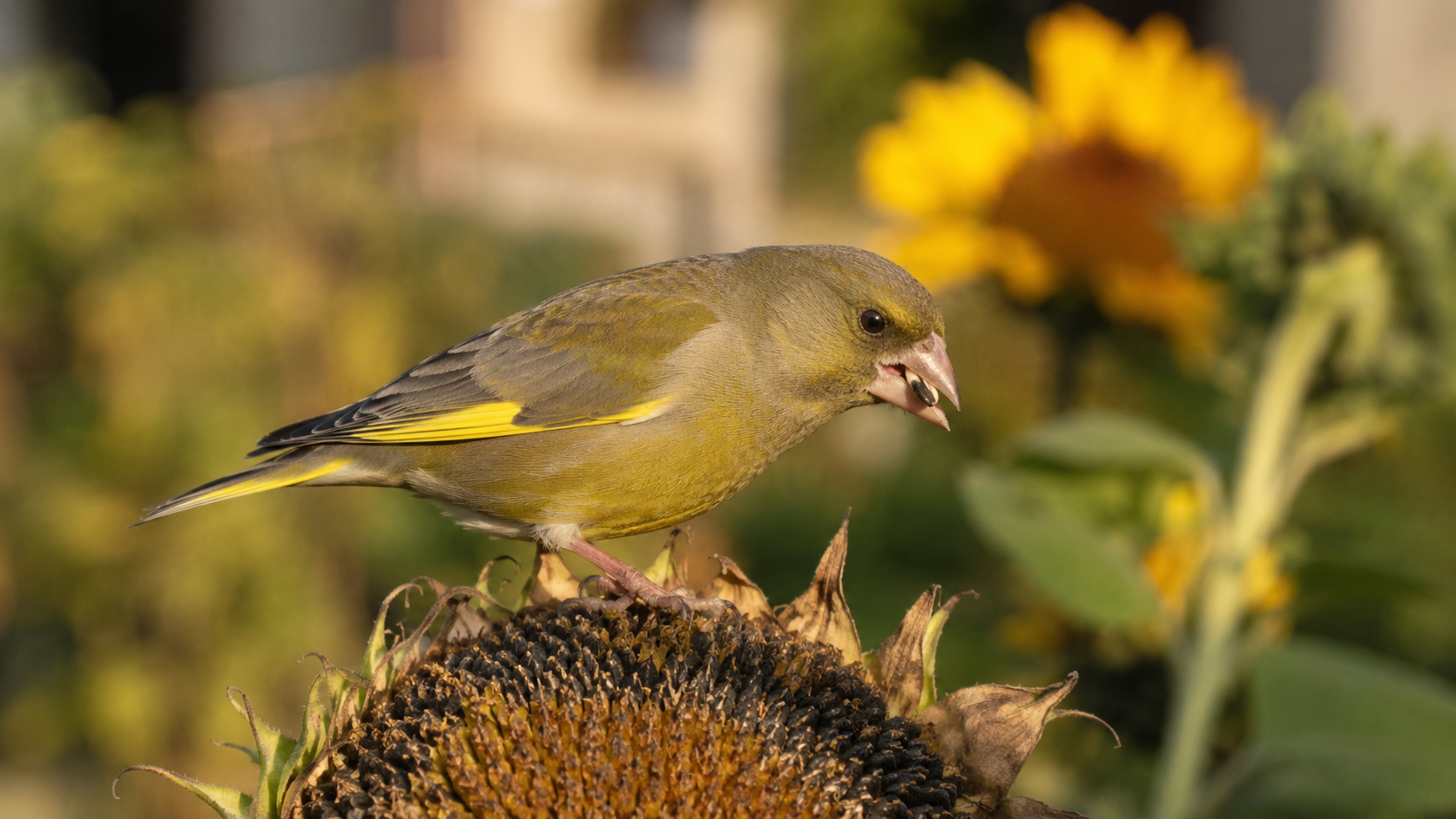
The European greenfinch (Chloris chloris) is a stocky, olive-green finch with flashes of bright yellow in the wings and tail, known for its buzzy, wheezing song and heavy seed-cracking beak.
Key facts
- Latin name
- Chloris chloris
- Family
- Fringillidae (Finches)
- Wingspan
- 24.5–27.5 cm
- Season
- mostly resident; some northern and eastern populations partially migratory October – March
- Diet
- Large seeds, including sunflower, cereal grain, and tree seeds, Berries and soft fruit in late summer and autumn, Buds and young shoots, Insects, mainly fed to nestlings
- Conservation status
- LCLeast Concern
Appearance
The European greenfinch (Chloris chloris) is a stocky, heavily built finch with a wingspan of 24.5 to 27.5 cm and a body length of about 15 cm, weighing between roughly 25 and 36 grams — noticeably chunkier than most other small European finches. The male shows an olive-green body overall, brightest and most saturated on the head and breast, with bright yellow patches flashing along the edge of the folded wing and at the base of the tail, conspicuous both at rest and, especially, in flight.
Females and juveniles are duller and browner overall, with less vivid yellow markings, though both sexes share the species' most distinctive physical feature: a thick, pale, strongly conical beak, considerably heavier than that of most related finches, built for cracking large, hard seeds.
Range and habitat
The European greenfinch is widespread across nearly all of Europe and extends through temperate Russia and parts of Central Asia. Populations in the milder west and south of the range are largely resident, while birds breeding in colder parts of northern and eastern Russia show partial migratory movement, present mainly between October and March further south.
It favors farmland with hedgerows and scattered trees, woodland edges, parks, and gardens, and has adapted particularly well to human-altered landscapes, becoming one of the most familiar garden finches across much of its range, especially where sunflower hearts and other large seeds are offered at feeders.
Behavior and lifestyle
Greenfinches feed mainly on large seeds, including sunflower seeds, cereal grain, and the seeds of various trees and shrubs, cracked open efficiently with the species' heavy conical beak, along with berries, soft fruit, and buds depending on season. Like most finches, the diet shifts toward insects during the breeding season to meet the higher protein demands of growing chicks.
The male's song is distinctive among European finches, combining more typical rapid twittering with a long, nasal, wheezing buzz, often delivered during a slow, exaggerated song-flight with deep, almost bat-like wingbeats that make the display conspicuous even at a distance. Outside the breeding season, greenfinches are gregarious, forming flocks that often mix with chaffinches and other finches at rich winter feeding sites, including garden feeders.
Breeding
The female builds a fairly bulky cup nest of twigs, grass, and moss, typically well concealed in dense shrub or hedge cover, sometimes in loose, informal groups of a few nests relatively close together. The typical clutch is 4 to 6 eggs, incubated mainly by the female for 13 to 14 days. Chicks fledge at around 13 to 16 days old, and pairs frequently raise two, sometimes three, broods across a single extended breeding season.
Interesting facts
- Greenfinches have suffered significant population declines in parts of Western Europe since the early 2000s due to an outbreak of trichomonosis, a parasitic disease that spreads efficiently among birds gathering at crowded garden feeders, making regular feeder cleaning an important practical step for garden bird health.
- The species' heavy, powerful beak allows it to crack seeds too hard for many smaller finches, reducing direct feeding competition with finer-billed relatives such as the goldfinch and siskin despite substantial overlap in habitat.
- The greenfinch's slow, deliberate song-flight display, with deliberately exaggerated wingbeats, is thought to make the singing male more visible to females and rival males alike, functioning as a visual complement to the accompanying buzzy song.