Eurasian Siskin
The Eurasian siskin (Spinus spinus) is a small, acrobatic finch of coniferous forest, often seen hanging upside down from spruce and alder cones while feeding in restless, chattering flocks.
Key facts
- Latin name
- Spinus spinus
- Family
- Fringillidae (Finches)
- Wingspan
- 20–23 cm
- Season
- partially resident; irregular, food-driven movements year-round, with the largest flocks in winter
- Diet
- Seeds of spruce, pine, and other conifers, Seeds of alder and birch, Small insects, mainly in the breeding season, Garden seed feeders, especially nyjer seed
- Conservation status
- LCLeast Concern
Appearance
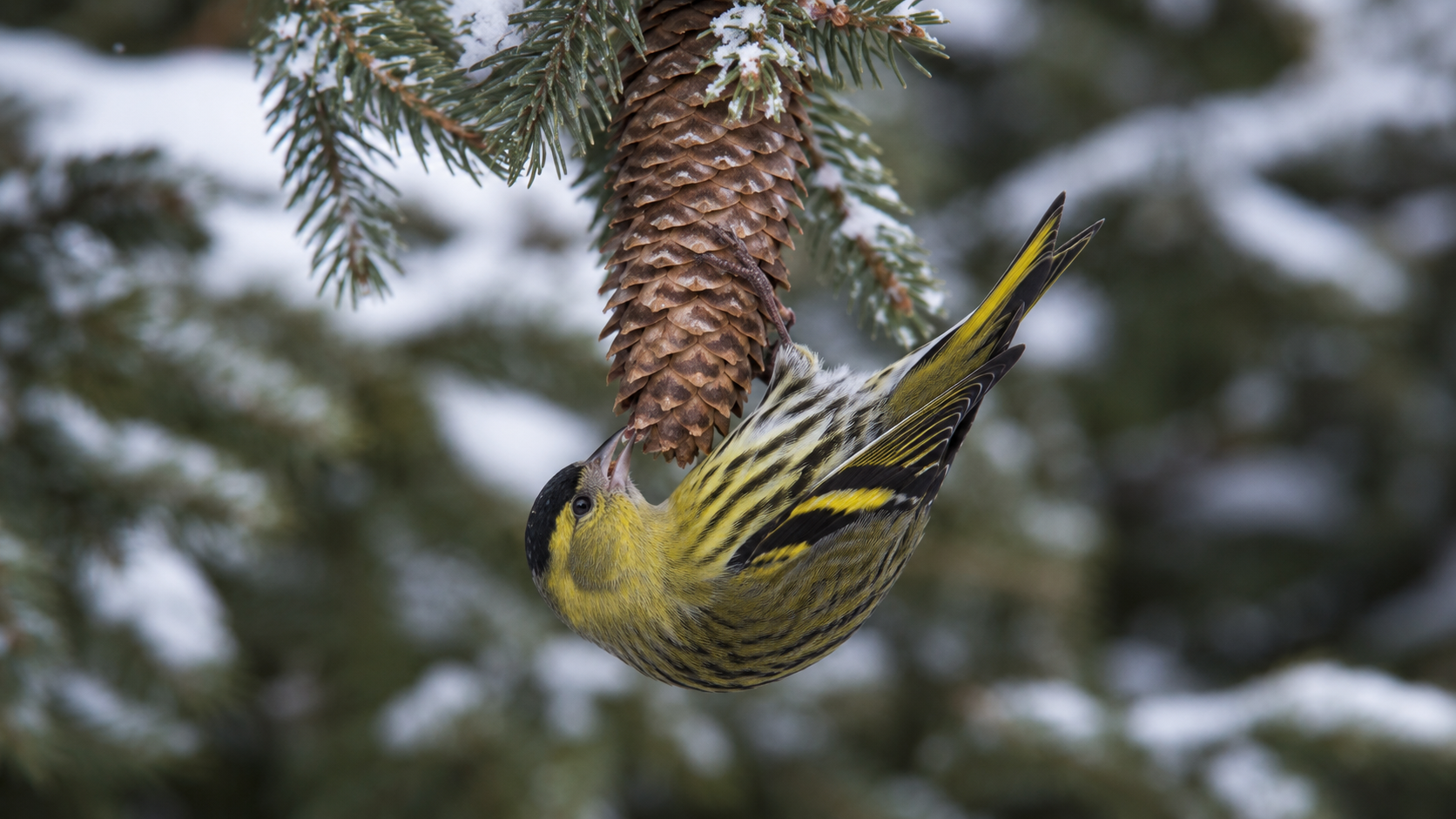
The Eurasian siskin (Spinus spinus) is a small, slender finch with a wingspan of 20 to 23 cm and a body length of about 12 cm, weighing between roughly 12 and 18 grams. The male shows greenish-yellow plumage overall, brightest on the face and rump, with a small but distinctive black cap and chin, dark streaking along the flanks, and bold yellow wing bars crossing otherwise blackish flight feathers — a combination that gives the species a notably crisp, contrasty appearance for such a small bird.
Females and juveniles are considerably duller and greyer-green overall, lacking the male's black cap, with heavier streaking across the underparts, though both sexes share the same bold yellow wing markings visible in flight. The beak is fine and pointed, an adaptation suited to extracting small seeds from tightly packed conifer and alder cones.
Range and habitat
The Eurasian siskin breeds across a broad band of coniferous and mixed forest spanning most of Europe and Russia, from Scandinavia and the Alps through the boreal taiga belt to the Russian Far East. Its movements are best described as irregular and food-driven rather than following a fixed migratory pattern: some populations are largely resident, while others move widely and unpredictably depending on the local cone crop, with the largest and most visible flocks typically appearing in winter.
It is closely tied to coniferous forest, particularly spruce, for breeding, but ranges much more widely outside the breeding season, visiting alder and birch stands, parks, and gardens wherever a reliable seed source is available, including bird feeders stocked with nyjer seed.
Behavior and lifestyle
Siskins feed heavily on the seeds of spruce, pine, and other conifers, supplemented by alder and birch seeds, extracted with remarkable acrobatic agility that frequently includes hanging fully upside down from the tips of thin branches and cones — a feeding style shared with only a few other small finches and closely tied to the hanging orientation of the cones they specialize on. Insects make up a larger share of the diet during the breeding season, when growing chicks need extra protein.
Outside the breeding season, siskins are highly gregarious, forming tight, fast-moving flocks that call almost constantly in flight with light, twittering, wheezy notes, and often associate with flocks of redpolls or other small finches at shared feeding sites. Because their movements track cone crop abundance rather than a fixed calendar, siskin numbers at any given site can swing dramatically between years.
Breeding
The female builds a small, neat cup nest of twigs, moss, and lichen, typically placed high in a conifer and often well concealed near the tip of a branch, making siskin nests notably difficult to locate compared to many other small songbirds. The typical clutch is 3 to 5 eggs, incubated solely by the female for 11 to 12 days. Chicks fledge at around 13 to 15 days old and remain dependent on their parents for continued feeding for a further period after leaving the nest.
Interesting facts
- Large-scale siskin irruptions, driven by cone crop failures in the northern part of the range, can bring unusually high numbers of birds to gardens and feeders across a wide area in a single winter, followed by near-absence the following year once conditions change.
- Siskins are known for a distinctive, wheezy, drawn-out call note interspersed within their more typical light twittering, which experienced birdwatchers often use to detect a flock passing overhead before any birds are visually spotted.
- The species has become an increasingly regular winter garden visitor across parts of its range in recent decades, likely linked to both the wider availability of nyjer seed feeders and shifting patterns in wild conifer seed crops.