European Goldfinch
The European goldfinch (Carduelis carduelis) is one of Europe's most vividly colored songbirds, a thistle-seed specialist with a bold red face and golden-yellow wing flash.
Key facts
- Latin name
- Carduelis carduelis
- Family
- Fringillidae (Finches)
- Wingspan
- 21–25.5 cm
- Season
- mostly resident; northernmost populations partially migratory October – March
- Diet
- Seeds of thistles, teasels, and other composite flowers, Seeds of alder, birch, and other trees in winter, Small insects, especially fed to nestlings, Garden seed feeders, especially nyjer and sunflower hearts
- Conservation status
- LCLeast Concern
Appearance
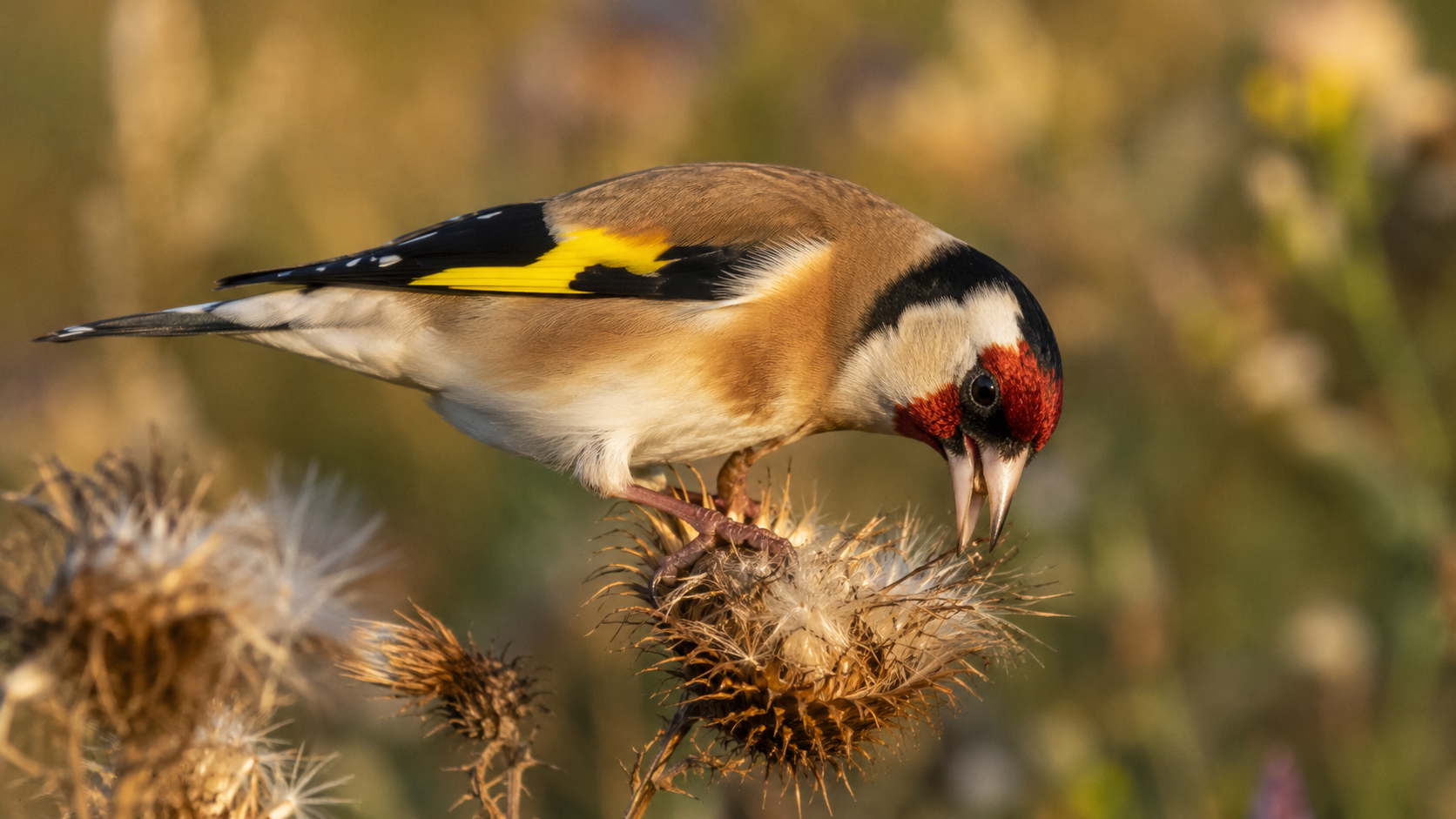
The European goldfinch (Carduelis carduelis) is a small, strikingly patterned finch with a wingspan of 21 to 25.5 cm and a body length of about 12 to 13 cm, weighing between roughly 14 and 19 grams. Its head shows a bold, unmistakable pattern: a bright red face patch surrounding the beak, set within sharply defined black and white areas covering the crown, cheeks, and throat — a combination unlike any other common European songbird.
The body is warm buff-brown above and paler below, but the wings provide the species' most eye-catching feature: a broad, brilliant golden-yellow band crossing otherwise black flight feathers, flashing conspicuously both at rest and, even more strikingly, in the goldfinch's characteristic bounding, undulating flight. The beak is notably fine and pointed compared to most other finches, an adaptation closely tied to its specialized feeding habits.
Range and habitat
The European goldfinch is widespread across nearly all of Europe and extends through temperate Russia and parts of Central Asia. Populations across the milder west and south of the range are largely resident, while birds breeding in the coldest parts of northern and eastern Russia show partial migratory movement, moving south between October and March.
It favors open and semi-open habitats with abundant seed-bearing plants: weedy farmland margins, wasteland, orchards, parks, and gardens, and has adapted particularly well to human-altered landscapes where thistles, teasels, and other seed-rich composite flowers are allowed to grow, whether deliberately in wildlife-friendly gardens or simply as uncontrolled weeds along field edges.
Behavior and lifestyle
The goldfinch's diet centers on the seeds of thistles, teasels, and other composite flowers, extracted with its fine, pointed beak from tightly packed seed heads that thicker-billed finches struggle to exploit as efficiently — a specialization that gives the species its scientific and common name association with thistles across many European languages. In winter, goldfinches also feed heavily on alder and birch seeds, often hanging acrobatically from thin branches and seed catkins.
Outside the breeding season, goldfinches are highly gregarious, forming flocks known traditionally as "charms" that move together between feeding areas, keeping in contact with light, tinkling calls that carry well across open ground. The species has become an increasingly common visitor to garden bird feeders in recent decades, particularly where nyjer seed or sunflower hearts are offered, supplementing its natural diet of wild seeds.
Breeding
The female builds a small, neat cup nest of moss, lichen, and fine plant material, often placed well out on a slender outer branch of a tree, sometimes at surprising height, offering some protection from ground-based predators. The typical clutch is 4 to 6 eggs, incubated solely by the female for 11 to 13 days. Chicks fledge at around 13 to 16 days old, initially fed mainly on regurgitated seeds supplemented with some insects, and remain dependent on their parents for continued feeding for a further couple of weeks.
Interesting facts
- The goldfinch was historically trapped and kept as a cage bird across much of Europe for centuries due to its bright plumage and pleasant song, a practice that significantly reduced wild populations in some regions before legal protection was introduced.
- Goldfinches can extract seeds from thistle heads that are still tightly closed and unripe for most other birds, giving them privileged access to a food source with relatively little competition from other seed-eating species.
- The species has long featured in European art and symbolism, most famously in Carel Fabritius's 1654 painting "The Goldfinch," reflecting a centuries-old cultural fascination with the bird's striking appearance.