Eurasian Bullfinch
The Eurasian bullfinch (Pyrrhula pyrrhula) is a stocky, shy finch whose male's vivid rose-pink underparts make it one of the most striking winter garden visitors across much of Europe and Russia.
Key facts
- Latin name
- Pyrrhula pyrrhula
- Family
- Fringillidae (Finches)
- Wingspan
- 22–29 cm
- Season
- resident year-round; some northern populations move south in the coldest winters
- Diet
- Buds of fruit trees and shrubs, especially in early spring, Seeds of docks, nettles, and other wild plants, Berries and soft fruit, Insects, fed mainly to nestlings
- Conservation status
- LCLeast Concern
Appearance
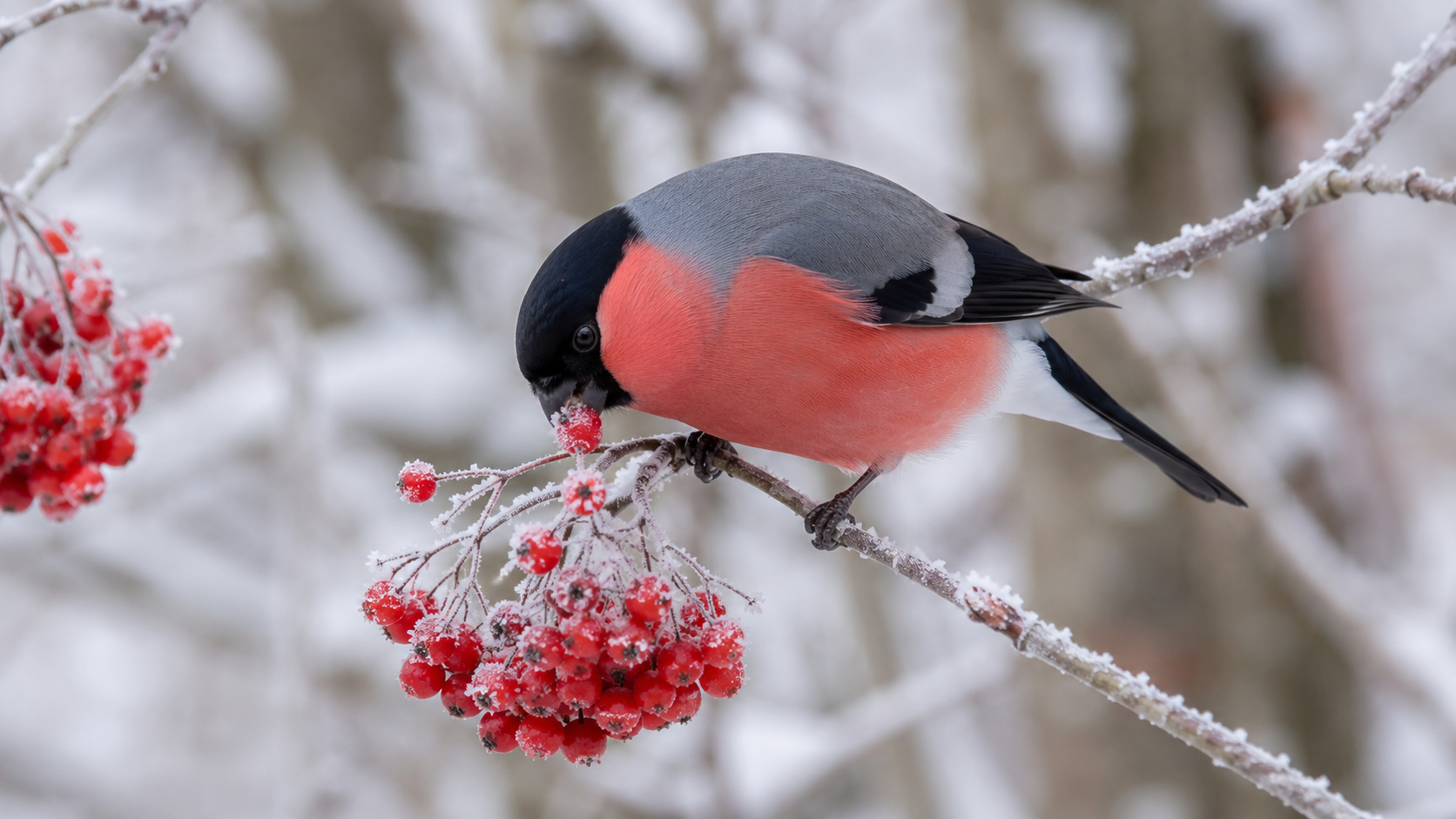
The Eurasian bullfinch (Pyrrhula pyrrhula) is a stocky, short-necked finch with a wingspan of 22 to 29 cm and a body length of about 14.5 to 16.5 cm, weighing between roughly 21 and 27 grams. The male is one of the most vividly colored songbirds in its range, with rich rose-pink cheeks and underparts, a glossy black cap and face mask, a blue-grey back, and black wings marked with a single broad, pale wing bar — a combination that makes him unmistakable in good light.
Females share the male's black cap, black wings, and pale wing bar, but their underparts are a much more subdued greyish-buff or dull pinkish-brown rather than vivid pink. Both sexes show a clean white rump, conspicuous in flight, and a short, stubby, rounded black beak well suited to crushing seeds and stripping buds.
Range and habitat
The Eurasian bullfinch is widespread across most of Europe and extends through forested Russia into parts of Siberia and the Russian Far East. It is largely resident throughout its range, with pairs generally remaining close to their breeding territory year-round, though birds from the coldest northern parts of the range may move short distances south during particularly severe winters.
It favors woodland with dense understory, hedgerows, orchards, and scrubby forest edges, generally preferring more enclosed, well-vegetated habitat than many other common finches, and tends to stay closer to cover, making it a less frequent visitor to open garden lawns than species like the chaffinch or greenfinch.
Behavior and lifestyle
Bullfinches feed on a wide range of plant material through the year, including seeds of docks, nettles, and other wild plants, along with berries and soft fruit, but they are especially well known — and historically controversial in orchard regions — for stripping the flower buds of fruit trees and shrubs in late winter and early spring, when other food is scarce and buds provide a reliable, if costly to growers, source of nutrition.
Pairs are typically monogamous and often remain associated year-round rather than dispersing widely outside the breeding season, a somewhat unusual pattern among small songbirds. Bullfinches are generally shy and unobtrusive, keeping to dense cover and revealing their presence more often through their soft, distinctive piping call than through bold or conspicuous behavior, in clear contrast to the more visible flocking habits of species like the goldfinch or greenfinch.
Breeding
The female builds a fairly flimsy, shallow cup nest of fine twigs and moss, typically well hidden in dense shrub or hedgerow cover. The typical clutch is 4 to 5 eggs, incubated solely by the female for 12 to 14 days. Chicks fledge at around 12 to 18 days old, initially fed by both parents on a diet including insects alongside softened seeds, and pairs may raise two broods in a single season where conditions allow.
Interesting facts
- The bullfinch's habit of bud-stripping in commercial orchards led to it being classified as a pest species in parts of Britain for much of the 20th century, with control measures in place until conservation status changes shifted the balance of protection in the bird's favor.
- Bullfinches have an unusual internal cheek pouch structure that lets them carry and process seeds efficiently, an adaptation that supports their heavily seed- and bud-based winter diet.
- Unlike many finches that form large, loosely structured winter flocks, bullfinches typically remain in pairs or small family groups even outside the breeding season, reflecting the species' comparatively strong and lasting pair bonds.