Birds of China
China's enormous range of climate zones and its position on the East Asian-Australasian Flyway make it one of the most consequential countries in the world for migratory bird conservation.
A critical bottleneck on a major flyway
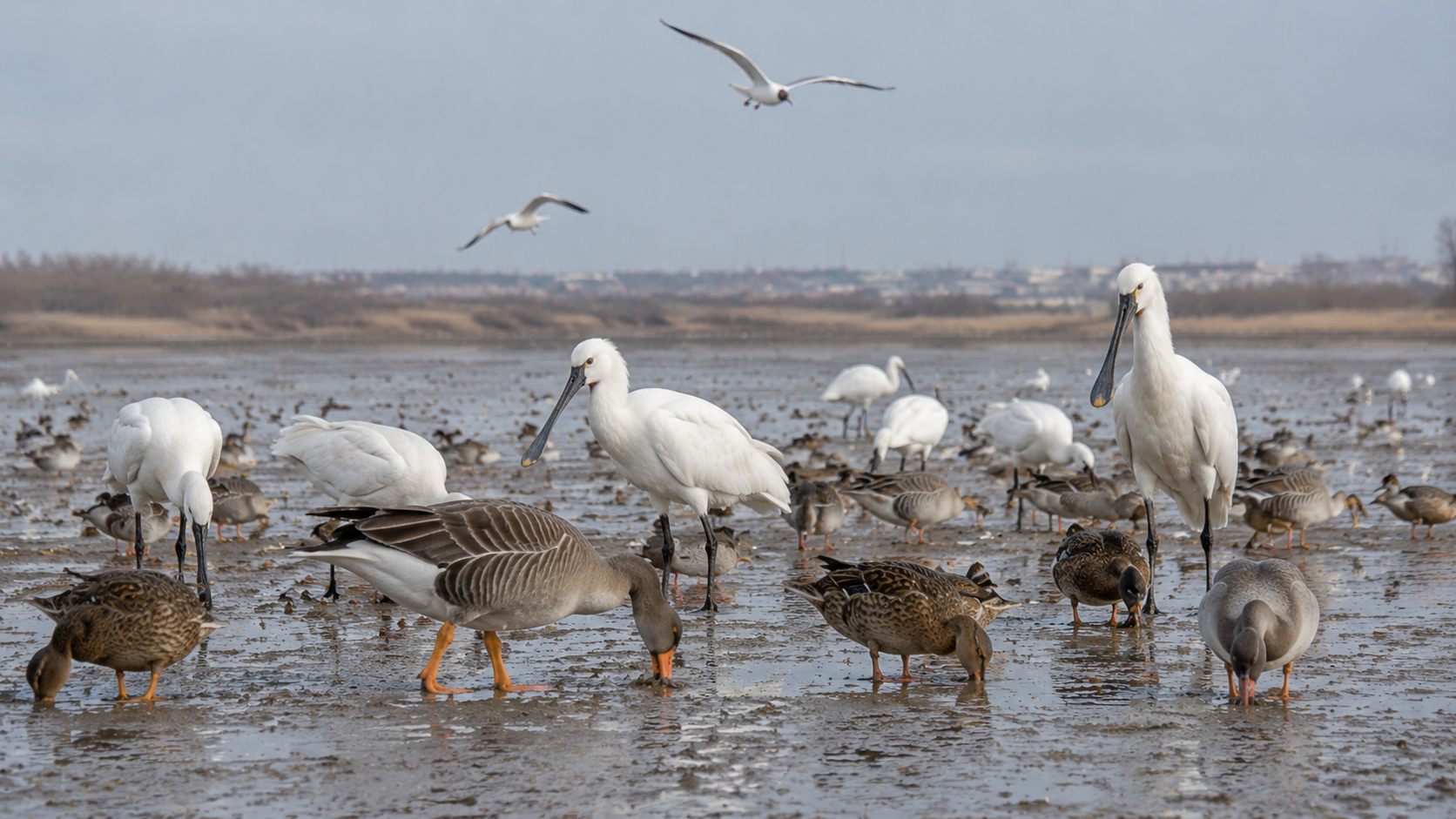
China's sheer geographic scale makes it impossible to summarize in the same terms as smaller countries covered in this atlas, but one feature stands out for its global significance: the coastal mudflats of the Yellow Sea and Bohai Sea, where an extraordinary concentration of migratory shorebirds and waterbirds funnels through a relatively narrow stretch of coastline twice a year while traveling the East Asian-Australasian Flyway between Arctic breeding grounds and wintering areas across Southeast Asia and Australia. Few other stretches of coastline anywhere in the world carry this much migratory traffic through such a constrained area.
Beyond this coastal bottleneck, China's interior spans temperate forest and farmland in the north and east, broadly similar in character to neighboring parts of the Far East, transitioning into increasingly subtropical and mountainous terrain further south and west — a range of habitat this single overview page can only begin to represent.
Typical species relevant to this atlas
A number of species covered throughout this atlas range widely enough across temperate Eurasia to reach northern and eastern China. The common kestrel hunts open country and farmland across much of the country's temperate zone, while the barn swallow is a familiar summer breeder in towns and villages, arriving each spring in a pattern similar to its European range. Wetlands and rivers across northern and eastern China support the mallard and grey heron, both frequently seen on lakes, rice paddies, and slow-moving waterways.
The coastal mudflats along the Yellow Sea, meanwhile, host vastly larger numbers of migratory shorebirds and waterbirds than any single species page in this atlas can represent, reflecting the sheer scale of passage through this stretch of coast during both spring and autumn migration.
Seasonality
Northern and eastern China follows a seasonal pattern with meaningful similarity to neighboring temperate regions of Northeast Asia and Korea: spring migration builds through March and April, with breeding activity through May and June, and a pronounced autumn passage from August through October, when the Yellow Sea coast in particular sees its heaviest shorebird and waterbird traffic as migrants stage on the region's mudflats before continuing their journey south. Winters across the north are cold, with milder conditions further south supporting a larger resident and short-distance migrant bird community.
Conservation notes
Rapid coastal development, land reclamation, and pollution along the Yellow Sea and Bohai Sea coastlines have significantly reduced the area of mudflat habitat available to migratory shorebirds over recent decades, a loss considered one of the more urgent conservation concerns anywhere on the East Asian-Australasian Flyway, since these mudflats function as an essential refueling stop that many migratory species cannot easily bypass. International conservation efforts increasingly focus on protecting the coastline's remaining intact wetland habitat given its outsized importance to the flyway as a whole.