Barn Swallow
The barn swallow (Hirundo rustica) is a sleek, deeply forked-tailed aerial hunter and one of the world's most celebrated long-distance migrants, nesting in barns and outbuildings across nearly the entire Northern Hemisphere.
Key facts
- Latin name
- Hirundo rustica
- Wingspan
- 32–34.5 cm
- Season
- April – September, wintering in sub-Saharan Africa
- Diet
- Flying insects, caught entirely on the wing, Flies, midges, and other small insects concentrated over water or open ground
- Conservation status
- LCLeast Concern
Appearance
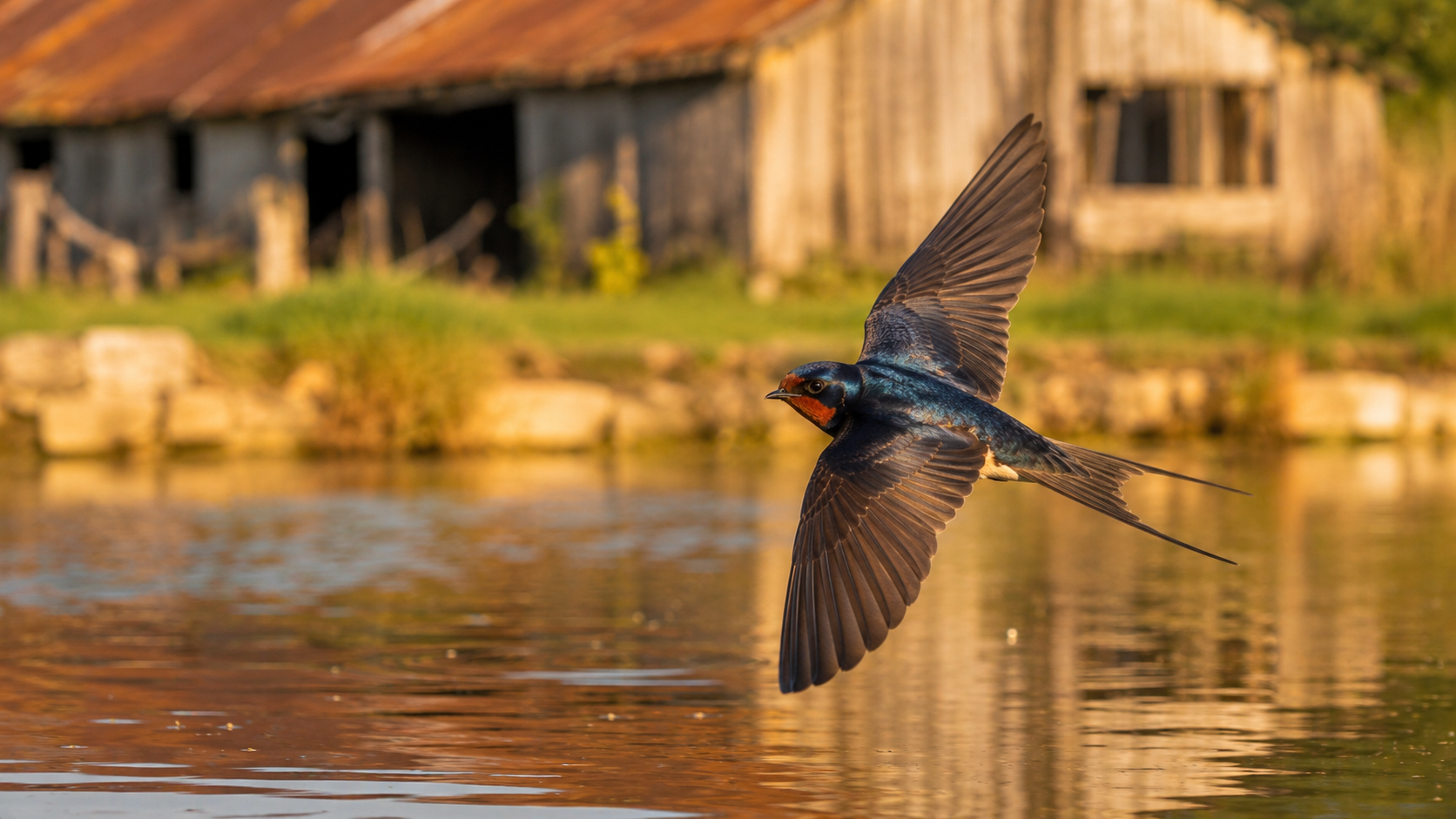
The barn swallow (Hirundo rustica) is a sleek, streamlined songbird with a wingspan of 32 to 34.5 cm and a body length of about 17 to 19 cm including tail streamers, weighing between roughly 16 and 24 grams. Its upperparts are a glossy, iridescent steel-blue, while the forehead and throat show a deep rufous-red, sharply set off from the pale cream underparts — a combination that, together with the species' distinctive silhouette, makes it one of the more easily identified small birds in flight.
The tail is deeply forked into two long, thin streamers, longest in adult males, which appear to play a role in mate choice, with females generally favoring males bearing longer, more symmetrical streamers. In flight, the barn swallow's combination of long, pointed wings, a deeply forked tail, and fast, agile, low-level flight over open ground or water is usually sufficient for confident identification even without a clear view of plumage detail.
Range and habitat
The barn swallow has one of the largest breeding ranges of any songbird, spanning almost the entire Northern Hemisphere across Europe, Asia, and North America. European and Russian populations are entirely migratory, present on the breeding grounds from roughly April to September and undertaking a long journey to winter across sub-Saharan Africa, one of the longest regular migrations of any small songbird covered in this atlas.
It is closely associated with open farmland and, especially, human structures for nesting — barns, stables, sheds, and bridges — foraging low over adjacent open fields, pastures, and water bodies where flying insect prey is concentrated, and is rarely found far from both suitable nesting structures and open hunting ground.
Behavior and lifestyle
Barn swallows feed entirely on flying insects, caught exclusively in flight through fast, agile, low-level aerial pursuit, often just above the surface of water, grass, or bare ground where insect density tends to be highest. This dependence on aerial insects makes the species highly sensitive to weather, since cold or heavy rain can sharply reduce flying insect activity and, in extended poor conditions, threaten breeding success.
The species is often loosely social, particularly around good nesting and foraging sites, sometimes gathering in large pre-migratory flocks on wires and rooftops in late summer before departing on migration. Its cheerful, warbling twittering call is a familiar summer sound around farmyards and open countryside across much of its breeding range.
Breeding
Barn swallows build an open, cup-shaped nest of mud pellets mixed with grass, typically fixed to a beam or ledge under cover inside a barn, shed, or similar structure, often reused and repaired across multiple breeding seasons. The typical clutch is 4 to 5 eggs, incubated mainly by the female for 14 to 19 days. Chicks fledge at around 18 to 23 days old, and pairs commonly raise two or three broods across an extended breeding season, taking advantage of the long, insect-rich summer days at higher latitudes.
Interesting facts
- Long-term ringing studies have shown that individual barn swallows frequently return to the exact same nest site, sometimes even the same barn, year after year, following an annual round-trip migration covering well over 10,000 kilometers each way.
- The length and symmetry of a male barn swallow's tail streamers has been extensively studied as a textbook example of sexual selection, with research showing females generally prefer males displaying longer, more evenly matched streamers.
- Barn swallow numbers in parts of Europe have declined in recent decades, a trend linked partly to changes in farm building design that provide fewer suitable nesting sites, alongside broader concerns about declining flying insect abundance affecting the species' food supply.