Common Kestrel
The common kestrel (Falco tinnunculus) is Europe's most familiar falcon, easily recognized by its habit of hovering motionless in the air while hunting voles over open ground.
Key facts
- Latin name
- Falco tinnunculus
- Family
- Falconidae (Falcons)
- Wingspan
- 65–82 cm
- Season
- April – September
- Diet
- Voles and other small rodents, Large insects (beetles, grasshoppers), Small songbirds and nestlings, Lizards and earthworms
- Conservation status
- LCLeast Concern
Appearance
The common kestrel (Falco tinnunculus) is a small, slender falcon with a wingspan of 65–82 cm and a body length of 32–39 cm, weighing between 136 and 314 grams depending on sex. It is one of the few European raptors with pronounced sexual dimorphism in plumage, making males and females easy to tell apart in good light.
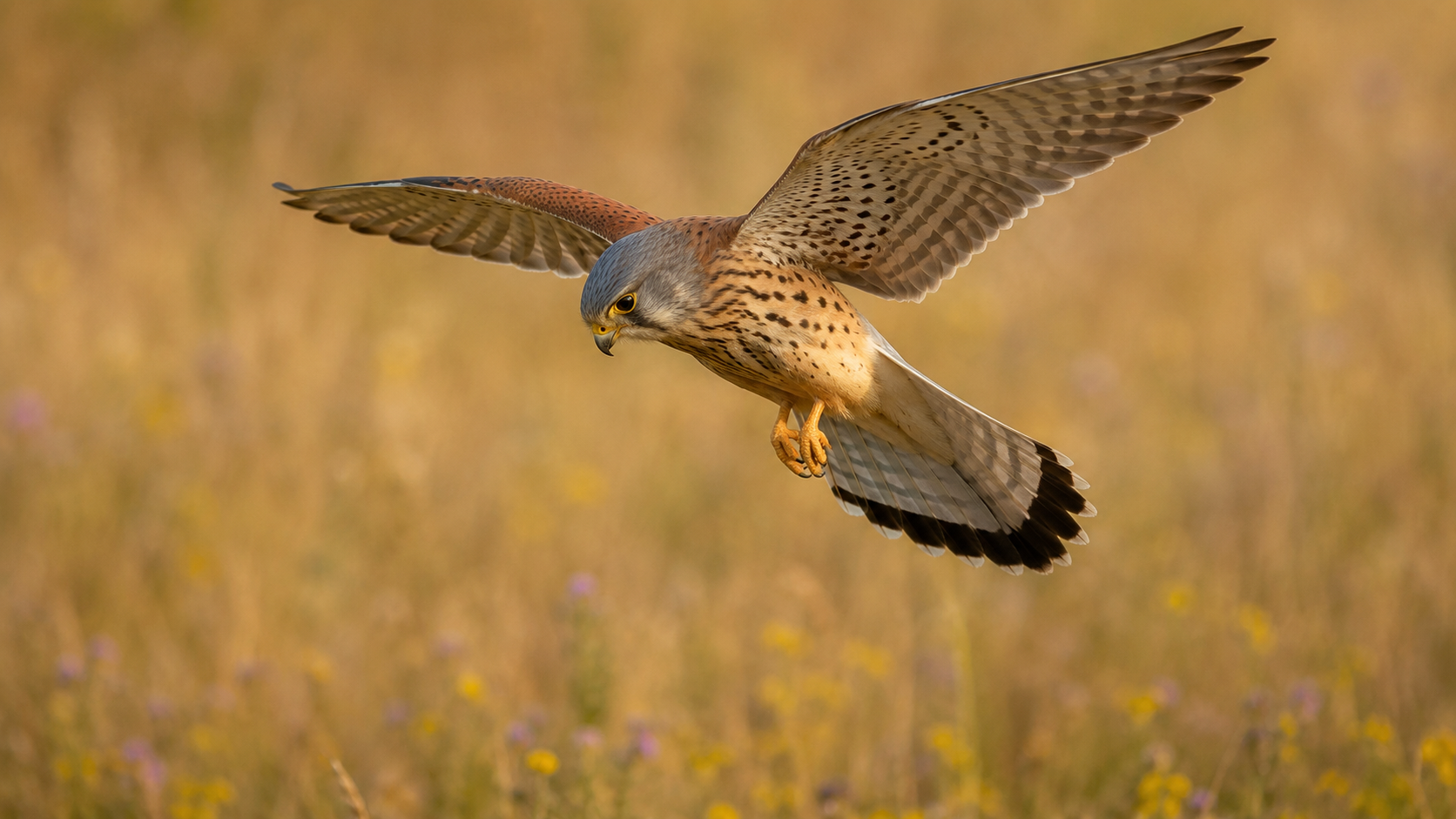
The male has a distinctive blue-grey head and tail, the tail ending in a single broad black band and white tip. His back and upperwings are warm rufous-orange, marked with small dark spots. The female and juveniles are browner overall, lacking the blue-grey head, with a rufous-brown barred tail and heavier dark streaking across the back. Both sexes share pale, buff-cream underparts streaked with dark brown, long pointed wings, and a long tail — proportions that give the kestrel its characteristic silhouette in flight, quite different from the broader-winged buzzards it sometimes shares a field with.
Range and habitat
The common kestrel is one of the most widespread birds of prey in the world, breeding across almost all of Europe, Asia, and Africa. In Russia it occurs from the western border to the Far East, absent only from the high Arctic tundra. Populations in the milder west and south are largely resident, while birds breeding in central and northern Russia are migratory, present from April to September and wintering further south in Europe, the Middle East, or sub-Saharan Africa.
It favors open country: farmland, grassland, steppe, moorland, and forest edges, avoiding dense unbroken forest. The species has adapted remarkably well to human landscapes and is a familiar sight hovering over motorway verges, field margins, and even city parks, where street lighting and ledges on tall buildings can substitute for natural cliffs.
Behavior and lifestyle
The kestrel's signature hunting technique is hovering — flying into the wind, beating its wings rapidly and fanning its tail to hold its head almost motionless in the air while it scans the ground below for movement. This lets it hunt over open ground without a convenient perch, and it is often the easiest falcon to identify at a distance for exactly this reason. Once prey is spotted, the kestrel drops in a short, controlled stoop rather than the high-speed dive used by larger falcons like the peregrine.
Its diet is dominated by voles and other small rodents, which can make up the majority of prey items in good vole years; it also readily takes large insects such as beetles and grasshoppers, small songbirds, lizards, and earthworms. Kestrels can see in the ultraviolet range, allowing them to detect the urine trails that voles leave along their runways — a striking adaptation that effectively lets the falcon "see" where prey has recently passed.
Breeding
Kestrels build no nest of their own. Instead, the female lays her eggs directly into an existing cavity — a disused crow's or magpie's nest, a tree hollow, a cliff ledge, or a nest box provided for the purpose. A typical clutch contains 3 to 6 eggs, most often 4 or 5, incubated mostly by the female for 27 to 29 days. Chicks fledge around 27 to 32 days after hatching and remain dependent on their parents for a further two to four weeks while they learn to hunt. Most pairs raise a single brood per year, though a second clutch is occasionally attempted in the warmer parts of the range.
Interesting facts
- The kestrel's old English name, "windhover," refers directly to its hunting technique and inspired Gerard Manley Hopkins's 1877 poem of the same name.
- Because it readily accepts nest boxes and tolerates human activity, the kestrel is one of the best-studied raptors in Europe, with decades of ringing data tracking its movements and population trends.
- Despite being widespread and classified as Least Concern, kestrel numbers have declined in parts of intensively farmed Western Europe, where hedgerow loss and rodenticide use have reduced both nesting sites and vole populations.