Eurasian Jay
The Eurasian jay (Garrulus glandarius) is a shy, colorful woodland corvid famous for its vivid blue wing patch and its habit of burying thousands of acorns each autumn, helping oak forests spread.
Key facts
- Latin name
- Garrulus glandarius
- Wingspan
- 52–58 cm
- Season
- mostly resident; occasional large-scale irruptive movements in poor acorn years
- Diet
- Acorns and other tree seeds, especially in autumn, Insects and other invertebrates, Eggs and nestlings of small birds, Small mammals and occasionally fruit
- Conservation status
- LCLeast Concern
Appearance
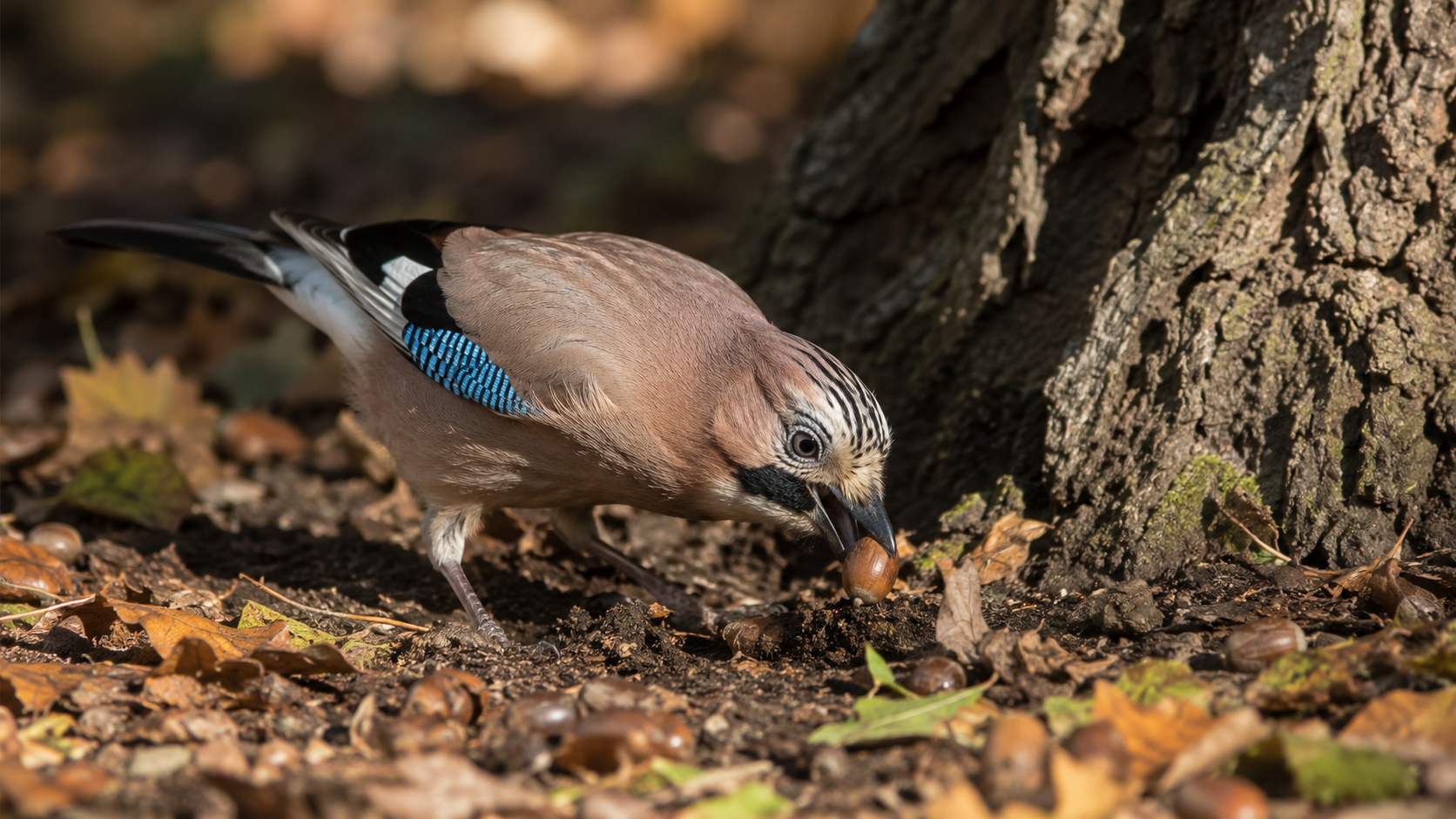
The Eurasian jay (Garrulus glandarius) is a medium-sized, colorful corvid with a wingspan of 52 to 58 cm and a body length of 34 to 35 cm, weighing between roughly 140 and 190 grams. The body is a warm pinkish-brown overall, topped by a pale, black-streaked crown that the bird can raise into a slight crest when alert or excited, with a bold black moustachial stripe running down from the base of the beak.
Its most striking feature is a small but vivid patch of bright blue feathers, finely barred with black and white, on the upper wing coverts — visible both at rest and, even more conspicuously, in flight alongside a bright white rump that flashes clearly as the bird flies away, one of the most reliable field marks for a fleeing jay glimpsed only briefly through trees.
Range and habitat
The Eurasian jay has an extensive range across almost all of Europe, much of temperate Asia, and parts of North Africa, occurring throughout most of forested Russia except the northernmost tundra fringe. Populations are generally resident, though the species is known for occasional large-scale irruptive movements — sudden mass emigrations of birds well beyond their normal range — triggered by poor acorn crops in a given year, when food scarcity pushes many individuals to search for resources elsewhere.
It is closely tied to woodland, particularly oak-dominated deciduous and mixed forest, though it also uses parks, large gardens, and other wooded habitats with mature trees, and is generally shyer and more retiring around humans than its more conspicuous relatives, the magpie and hooded crow.
Behavior and lifestyle
The jay's defining ecological behavior is acorn caching: in autumn, individual jays collect and bury thousands of acorns and other tree seeds across a wide area, often several kilometers from the source tree, to be retrieved later in winter when food is scarce. Because jays reliably fail to recover a substantial fraction of these caches, the species functions as one of the most significant natural dispersers of oak trees across much of Europe and temperate Asia, with individual jays estimated to plant far more oak seedlings over a lifetime than most other agents of dispersal.
Beyond its plant food, the jay is a skilled and often quietly destructive predator of the nests of smaller woodland birds, taking eggs and nestlings opportunistically alongside insects and other invertebrates. It is also an accomplished vocal mimic, capable of imitating the calls of other birds, including convincing renditions of raptor calls such as the common buzzard, and its own harsh, screeching alarm call is often the first sign of a predator moving through the woods, alerting other birds in the area.
Breeding
Jays build a fairly simple stick nest in the fork of a tree or dense shrub, typically well concealed within woodland cover. The typical clutch is 3 to 6 eggs, incubated mainly by the female for 16 to 19 days while the male brings her food. Chicks fledge at around 19 to 20 days old but remain dependent on their parents for continued feeding for several weeks after leaving the nest, gradually becoming independent by late summer.
Interesting facts
- A single jay's memory for the locations of its own acorn caches, drawing on spatial recall abilities comparable to some of the most cognitively studied corvids, allows it to relocate a meaningful proportion of buried seeds months later, even under snow cover.
- Genetic studies of oak forest regeneration patterns in parts of Europe have directly linked jay caching behavior to the pace and direction of postglacial oak recolonization thousands of years ago, underscoring the species' long-term ecological importance.
- Despite its role as an active nest predator of other songbirds, the jay itself is highly wary and secretive around potential threats, usually detected first by its harsh alarm call rather than direct sighting, especially during the breeding season.