Western Jackdaw
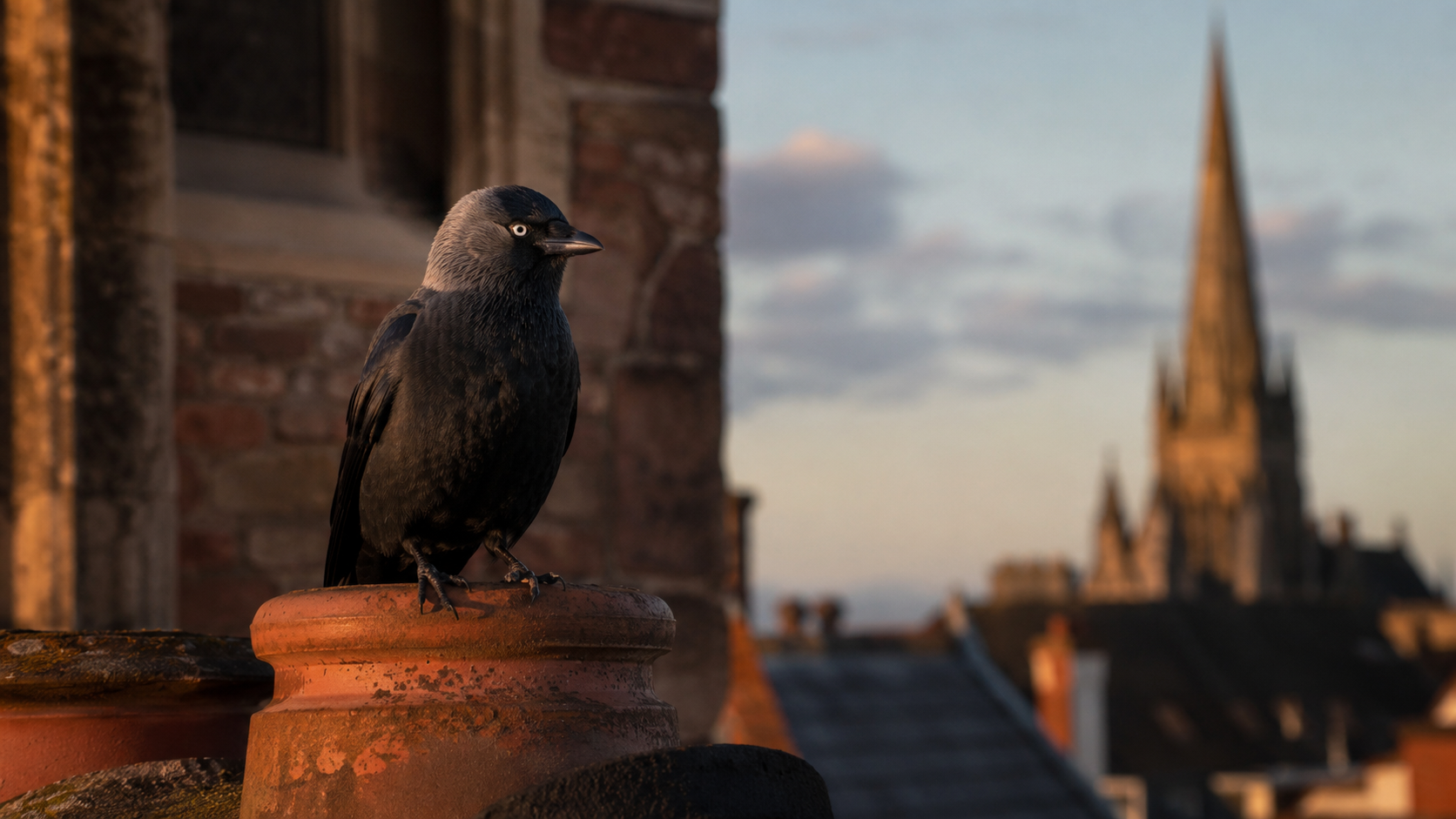
The western jackdaw (Coloeus monedula) is the smallest common European corvid, a sociable, cavity-nesting bird easily recognized by its pale silvery-grey eye and steel-grey nape.
Key facts
- Latin name
- Coloeus monedula
- Wingspan
- 64–73 cm
- Season
- mostly resident; northern and eastern populations partially migratory October – March
- Diet
- Insects and other invertebrates, Seeds, grain, and fruit, Eggs and nestlings of other birds, Human food waste near settlements
- Conservation status
- LCLeast Concern
Appearance
The western jackdaw (Coloeus monedula) is the smallest and most compact of the common European corvids, with a wingspan of 64 to 73 cm, a body length of around 34 cm, and a weight of roughly 220 to 270 grams — noticeably smaller than a rook or crow. Its plumage is glossy black overall, but the nape and sides of the head are a distinct, pale steel-grey, giving the bird a two-toned head pattern that is one of its most reliable field marks.
The most striking single feature, however, is the eye: adult jackdaws have a strikingly pale, almost silvery-white iris that contrasts sharply against the dark plumage and gives the bird an unusually sharp, attentive expression, quite different from the uniformly dark eyes of most other corvids. Juveniles have duller, browner eyes that lighten gradually as they mature.
Range and habitat
The western jackdaw is widespread across almost all of Europe and extends through temperate Russia into parts of western Siberia, generally absent only from the far north and the highest mountain ranges. Populations across the milder west and south of the range are largely resident, while birds from the colder parts of northern and eastern Russia show partial migratory movement, moving south between October and March.
As an obligate cavity nester, its distribution closely tracks the availability of suitable nest holes: mature trees with natural hollows, cliff crevices, and — especially in farmland and urban areas — old buildings, church towers, and chimneys, which the species has adapted to use extensively, making it one of the most familiar corvids in towns and villages across its range.
Behavior and lifestyle
Jackdaws are highly social throughout the year, feeding, roosting, and traveling in large, often noisy flocks that frequently mix with rooks on farmland, where the two species can be seen foraging together across open fields. Diet is broadly omnivorous, including insects and other invertebrates, seeds, grain, and fruit, along with the eggs and nestlings of smaller birds and food scavenged near human activity, reflecting the same dietary flexibility seen across most corvids.
A defining behavioral trait of the species is its strong, typically lifelong pair bond: mated jackdaws remain in close physical proximity even within large flocks, frequently perching in contact with one another, a level of visible pair fidelity that has made the species a valuable model for scientific research into monogamy and cooperative behavior in birds. Jackdaws are also notably vocal, with their sharp, clipped "tchack" call — the likely origin of the bird's English name — a familiar sound around rooftops and farmland alike.
Breeding
Because jackdaws require an enclosed cavity to nest, pairs compete for a limited supply of suitable holes in trees, cliffs, or buildings, sometimes nesting loosely colonially where several cavities exist close together, such as in a large chimney stack or old tower. The typical clutch is 4 to 6 eggs, incubated mainly by the female for 17 to 18 days while the male provides food. Chicks fledge at around 30 to 35 days old and, like young rooks, typically integrate into the wider social flock soon after gaining independence.
Interesting facts
- Research on captive and semi-wild jackdaws has shown the species can follow human gaze and pointing gestures to locate hidden food, a form of social cognition previously documented mainly in domestic dogs and closely studied primates.
- The pale iris of adult jackdaws is thought to play a role in social signaling between individuals, potentially helping birds assess the age, and possibly the intentions, of others within a flock at a glance.
- Large jackdaw roosts, sometimes shared with rooks and numbering in the thousands, can be spectacular to observe at dusk in autumn and winter, as birds converge from surrounding farmland toward a shared communal roosting site.