Cuckoos (Cuculidae)
The cuckoo family: slender, long-tailed birds best known for the common cuckoo's remarkable brood-parasitic lifestyle, tricking other species into raising its young.
What makes Cuculidae a family
Cuculidae, the cuckoo family, comprises around 150 species found across most of the world, sharing a generally slender body, a long, often graduated tail, and zygodactyl feet, with two toes pointing forward and two backward, an arrangement also found in woodpeckers that provides a particularly secure grip on branches and vegetation. Despite the strong popular association between the family name and brood parasitism, this remarkable breeding strategy — laying eggs in the nests of other species and leaving them to raise the resulting chick — is actually found in only a portion of the family worldwide, with many other cuckoo species building conventional nests and raising their own young directly.
The common cuckoo, the sole species covered so far in this atlas, represents one of the most thoroughly studied and evolutionarily specialized examples of the parasitic strategy found within the family, involving a coordinated set of adaptations spanning egg mimicry, precisely timed laying behavior, and instinctive chick behavior aimed at eliminating any competition for parental care immediately after hatching.
Distinctive traits across the family
Brood parasitism within Cuculidae, where it occurs, represents one of the more dramatic examples of an evolutionary arms race documented in birds: host species that suffer repeated parasitism have, in several well-studied cases, evolved improved abilities to recognize and reject foreign eggs, prompting parasitic cuckoo lineages to evolve correspondingly closer egg mimicry in response, an ongoing evolutionary back-and-forth that continues to be an active area of behavioral and evolutionary research.
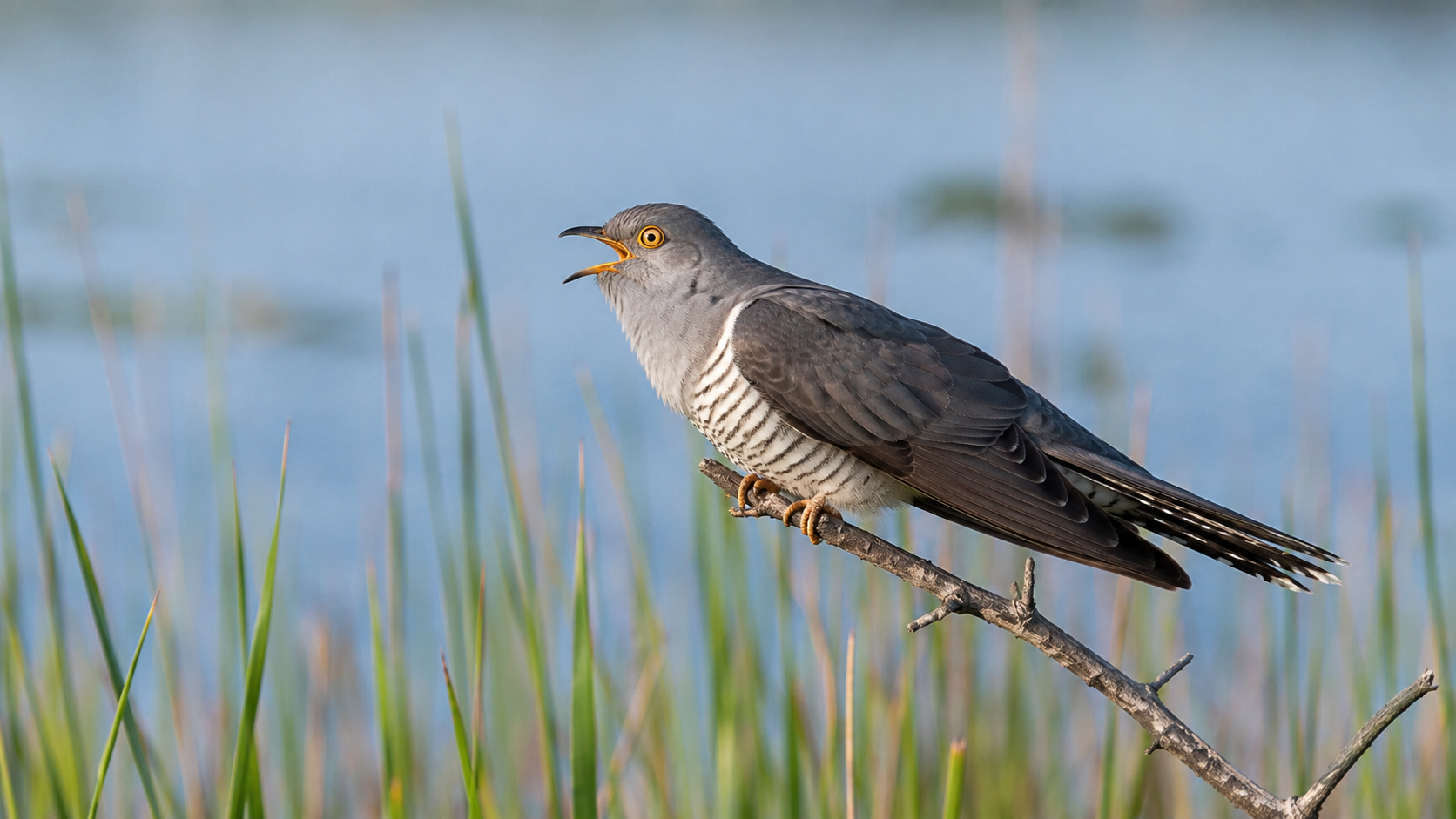
Vocal behavior also varies meaningfully across the family, though the common cuckoo's simple, widely recognized two-note call stands as one of the most culturally familiar bird sounds in Europe, closely associated in folklore and tradition with the arrival of spring across much of the cuckoo's breeding range.
Species in this family
This atlas currently covers one member of Cuculidae: the common cuckoo (Cuculus canorus), a hawk-like migrant famous both for its instantly recognizable call and for its remarkable, specialized brood-parasitic breeding strategy. Further Cuculidae species native to the atlas's covered regions will be added to the catalogue over time.
Where and when to watch this family
Wetland reed beds, farmland hedgerows, moorland, and woodland edges — habitat shared broadly with several of the common cuckoo's preferred host species — offer the best chance of encountering this family, and because the common cuckoo is a long-distance migrant, it is present in Europe and Russia only from spring through mid-summer, with the male's distinctive call typically at its most frequent and easiest to hear during the peak of the breeding season in late spring.