Birds of the United States
From Alaskan tundra to Florida wetland, the United States spans an enormous range of bird habitats connected by well-defined migratory flyways used by hundreds of species each year.

A continent-scale range of habitat within one country
The United States spans an unusually wide range of bird habitat for a single country: Arctic-influenced tundra and boreal forest across much of Alaska, temperate forest and farmland through the eastern and midwestern states, arid desert and scrub across much of the southwest, and subtropical wetland dominating much of Florida. Bird movement across this landscape is organized largely around four major flyways — Pacific, Central, Mississippi, and Atlantic — broad north-south corridors that concentrate migratory traffic along consistent coastlines, river systems, and mountain ranges, giving birdwatchers a reliable framework for predicting which species are likely to appear in a given region at a given time of year.
Florida stands out within this range as a particularly distinctive habitat zone, its warm, low-lying wetlands, including the Everglades, supporting a wading bird and waterfowl community shaped by conditions unlike almost anywhere else in the continental United States.
Species shared with the rest of this atlas
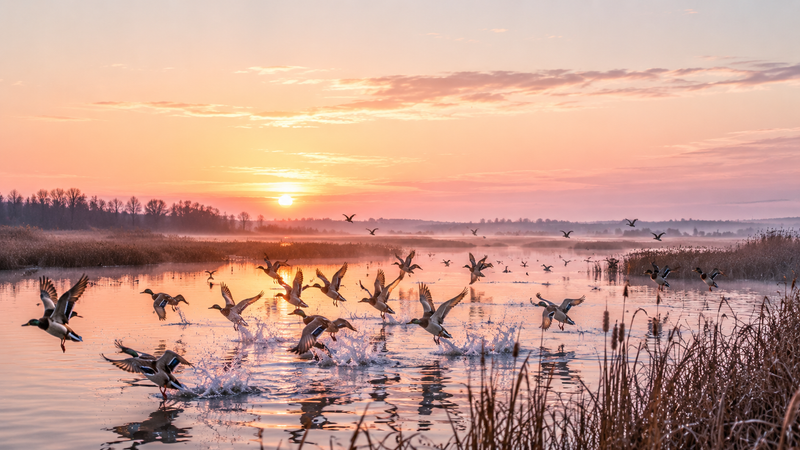
The mallard is one of the most familiar ducks across the United States, following an ecology closely comparable to its Eurasian range: broadly resident across milder regions, with more northern populations shifting south for winter when home waters freeze. The rock dove, introduced from its native Old World range, is now firmly established in virtually every American city, as familiar a sight on U.S. streets and building ledges as it is across Eurasian urban centers.
Beyond these direct overlaps, the country's vast native songbird, raptor, and waterfowl diversity belongs largely to families and species distinct from this atlas's core Eurasian coverage, better explored through dedicated North American field guides than summarized on a single country page here.
Seasonality
Spring migration along the major flyways builds from March through May, with the Mississippi Flyway in particular channeling an enormous volume of songbird and waterfowl traffic north through the continent's interior each spring. Breeding activity peaks through May and June across most temperate latitudes, and autumn migration reverses the flow from roughly August through October, as birds head south again — many toward Florida, the Gulf Coast, and points further into Central and South America for the winter. Alaska's brief but intense summer breeding season, compressed into just a few months around the northern solstice, contrasts sharply with Florida's much milder, longer active season further south.
Conservation notes
Wetland loss along major flyway corridors, particularly historical drainage of prairie pothole wetlands important to breeding waterfowl and coastal wetland loss in Florida and along the Gulf Coast, remains an ongoing concern for species that depend on these habitats during breeding, migration, or winter. Coordinated flyway-level conservation planning, tracking bird populations across the full length of each migratory corridor rather than state by state, has become an increasingly central approach to addressing these pressures across the country.