Rock Dove
The rock dove (Columba livia) is the wild ancestor of every domestic and feral pigeon, a cliff-nesting species whose descendants now thrive as one of the most familiar birds of cities worldwide.
Key facts
- Latin name
- Columba livia
- Wingspan
- 62–72 cm
- Season
- resident year-round
- Diet
- Seeds and grain, the dominant natural food source, Waste food and bread scraps in urban settings, Green shoots and plant matter, Occasional small invertebrates
- Conservation status
- LCLeast Concern
Appearance
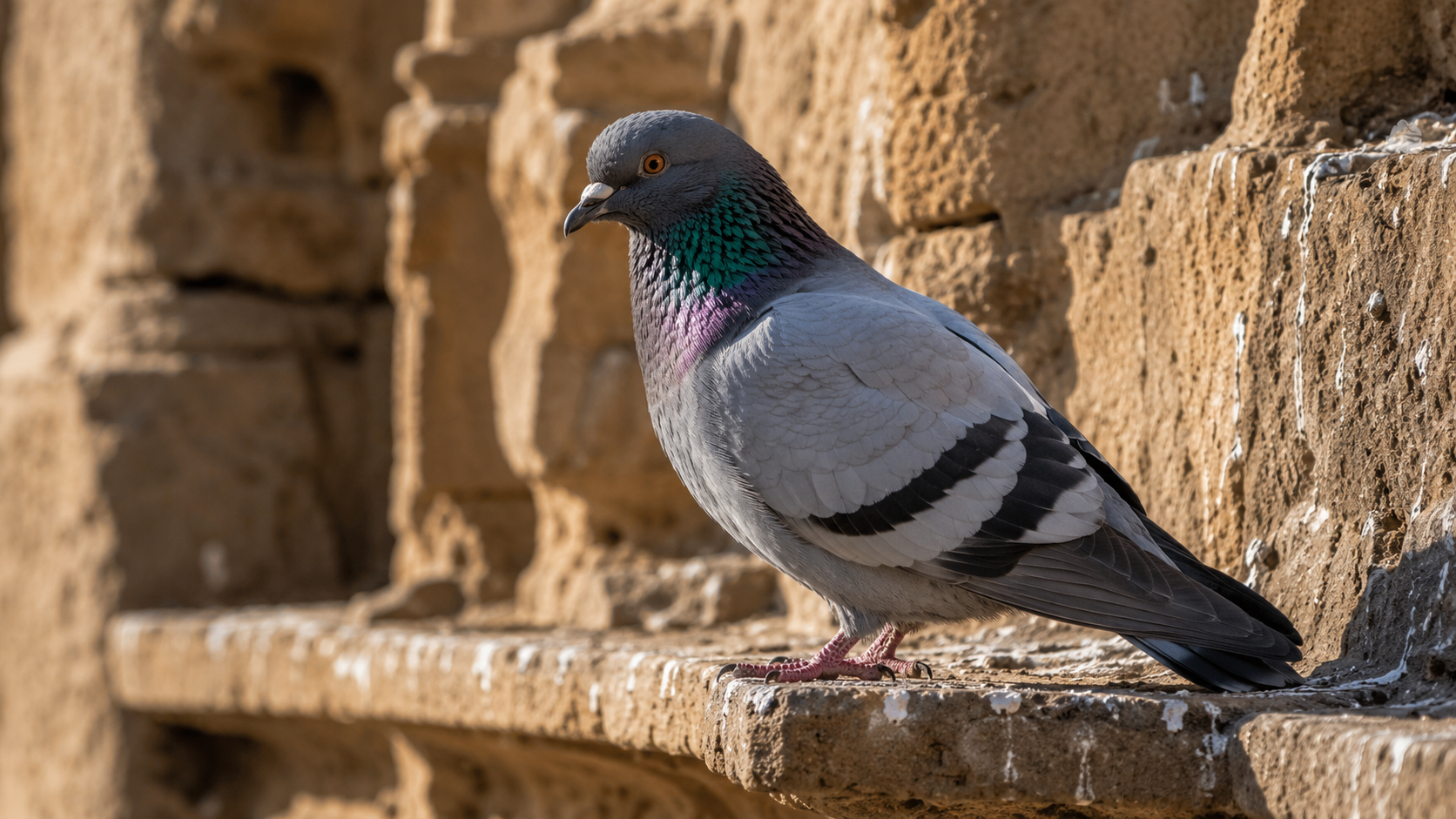
The rock dove (Columba livia) is a medium-sized pigeon with a wingspan of 62–72 cm and a body length of 29–37 cm, weighing between roughly 240 and 400 grams. In its classic wild plumage, it shows a bluish-grey body, a glossy patch of iridescent green and purple on the neck and upper breast, and two bold black bars crossing each folded wing, a combination that remains the standard reference plumage even though feral urban populations often show far greater variation.
Because feral pigeons descended from domesticated stock have interbred extensively and been shaped by selective breeding over centuries, city-dwelling birds frequently show plumage ranging from near-white to solid black, heavily pied patterns, or rusty-brown tones, in sharp contrast to the more uniform blue-grey coloring typical of genuinely wild, cliff-nesting rock dove populations.
Range and habitat
The rock dove is native to rocky coastlines, sea cliffs, and inland cliff faces across parts of Europe, North Africa, and Asia, nesting naturally in caves, crevices, and sheltered ledges on vertical rock. Long domestication and subsequent feralization, however, have made its descendants among the most widely distributed birds on Earth, established as feral urban populations on every continent except Antarctica, thriving especially in city centers, town squares, and industrial areas offering ledges and structures resembling natural cliffs.
The species is entirely resident wherever established, showing no seasonal migration and instead remaining year-round in the same general area, sustained in urban settings by a consistent year-round food supply from human sources that removes much of the pressure driving seasonal movement in many other bird species.
Behavior and lifestyle
Rock doves and their feral descendants feed mainly on seeds and grain where naturally available, but readily shift to bread, discarded food, and other human-provided scraps in cities, a dietary flexibility central to the species' extraordinary success in urban environments. Feeding typically happens on the ground in flocks, with birds walking steadily while pecking rather than foraging on the wing.
Highly social throughout the year, rock doves form large flocks, particularly around reliable feeding sites such as public squares, markets, and areas where people regularly feed them, and roost communally on ledges, rooftops, and other elevated structures that mimic the sheltered cliff ledges used by wild populations. The species is also notable for a strong homing instinct, the same trait long exploited in the breeding of racing and messenger pigeons.
Breeding
Rock doves nest on ledges, in crevices, or, in urban settings, on window sills, building ledges, and beneath bridges, building a fairly simple, often flimsy stick platform compared with the more elaborate nests of many other bird families. A typical clutch contains 1 to 2 eggs, incubated by both parents for 17 to 19 days.
Because the species lacks a strict seasonal breeding trigger and urban food supplies remain abundant year-round, feral rock doves can breed at almost any time of year, sometimes producing several broods annually, contributing significantly to the species' persistently high urban population densities. Chicks are fed initially on crop milk, a nutrient-rich secretion produced by both parents, before gradually transitioning to solid food.
Interesting facts
- The rock dove holds the distinction of being one of the earliest domesticated birds, with evidence of its domestication for food, message-carrying, and companionship stretching back several thousand years.
- Homing pigeons, bred from this species, were used to carry messages across considerable distances well into the 20th century, including significant use during both World Wars for military communication.
- Despite being classified as Least Concern and enormously abundant in feral urban form, genuinely wild, unmixed rock dove populations on natural cliff habitat have declined in parts of their native range due to extensive interbreeding with feral and domestic birds.