Mute Swan
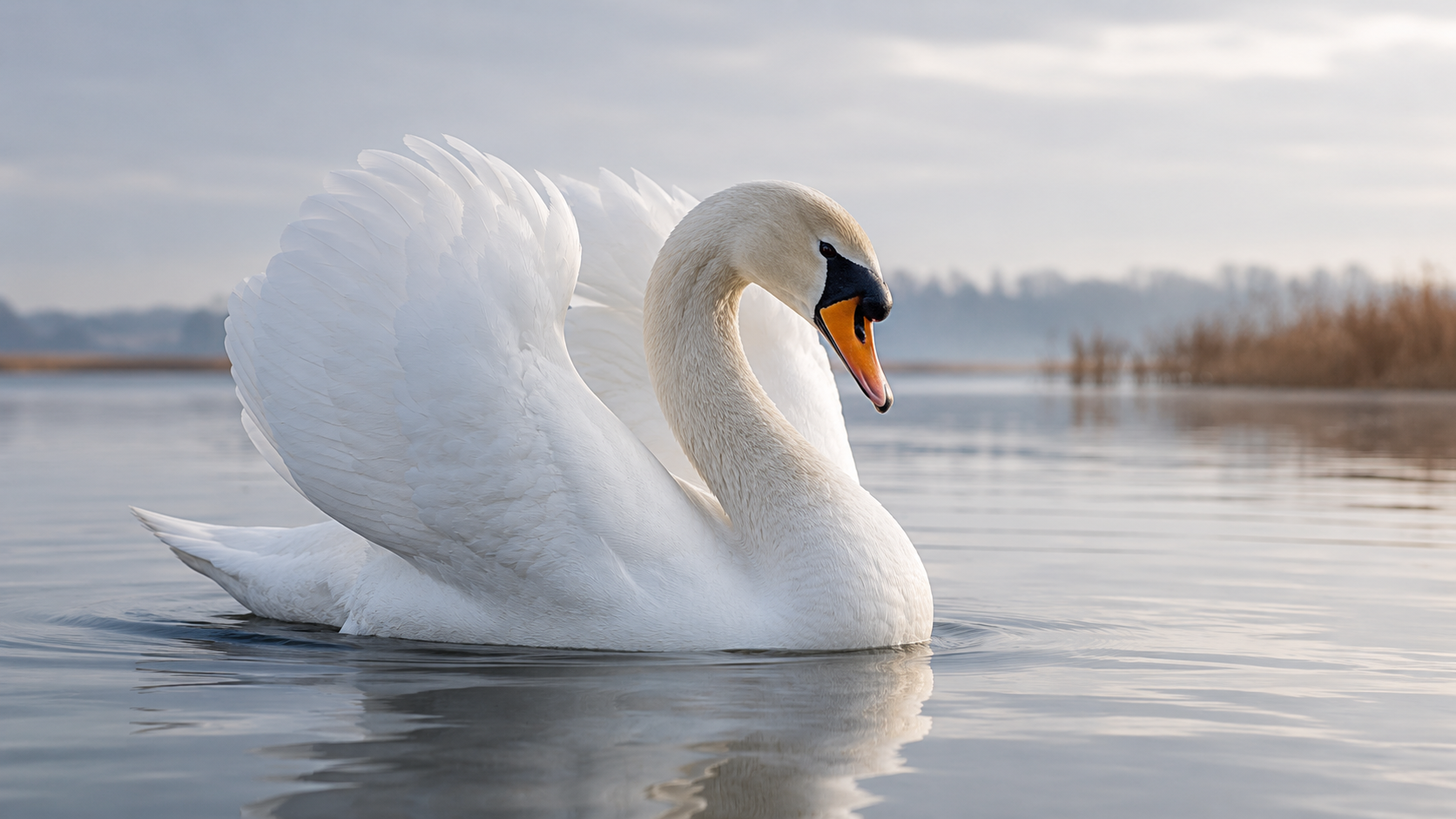
The mute swan (Cygnus olor) is one of the world's largest flying birds, instantly recognized by its pure white plumage, gracefully curved neck, and orange bill with a black basal knob.
Key facts
- Latin name
- Cygnus olor
- Family
- Anatidae (Waterfowl)
- Wingspan
- 200–240 cm
- Season
- resident year-round in most of the range, with some northern and eastern populations moving short distances south in severe winters
- Diet
- Submerged aquatic plants, pulled up with the long neck, Waterside grasses and shoots, Small aquatic invertebrates, taken incidentally while feeding on plants, Waste grain and food scraps in urban settings
- Conservation status
- LCLeast Concern
Appearance
The mute swan (Cygnus olor) is a massive waterbird with a wingspan of 200–240 cm and a body length of 125–160 cm, weighing between roughly 6.5 and 15 kilograms, making it among the heaviest flying birds in the world. Adults are entirely pure white, with a long, flexible neck typically held in a graceful curved S-shape rather than straight, a habit that immediately distinguishes it at a distance from the more upright-necked whooper and Bewick's swans.
Its bill is bright orange with a prominent black basal knob, larger and more pronounced in males, sitting above black facial skin extending from the base of the bill to the eye. Juveniles, sometimes called cygnets through their first year, show dull greyish-brown plumage and a dark grey bill lacking the knob, gradually acquiring full white adult plumage over one to two years.
Range and habitat
The mute swan breeds across much of temperate Europe and central Asia, including a large native range through Russia and Ukraine, and has additionally been widely introduced as an ornamental bird to North America, Australia, and other regions where feral populations are now established. It favors slow-flowing rivers, lakes, ponds, marshes, and sheltered coastal lagoons, generally avoiding fast-moving water and requiring open stretches long enough for its heavy, labored takeoff run.
Most populations across its milder range are essentially resident, remaining on the same waters year-round, while birds breeding in the coldest continental and northern parts of Russia may move short distances to find open water when their home lakes freeze over completely.
Behavior and lifestyle
Mute swans feed primarily by upending in shallow water, submerging the head and neck to pull up aquatic vegetation from the bottom with their long reach, supplemented by grazing on waterside grasses and shoots and by incidentally consuming small invertebrates while feeding on plants. Their size and reach allow them to access submerged plant beds unavailable to most ducks, giving them an important role in shaping aquatic vegetation on the waters they inhabit.
Outside the breeding season mute swans can be loosely social, sometimes forming non-breeding flocks, but breeding pairs become strongly territorial, with the well-known arched-wing "busking" threat display — wings raised over the back while swimming rapidly and directly at an intruder — used to warn off rivals, other waterfowl, and occasionally people who venture too close to a nest or cygnets.
Breeding
Mute swans build a very large nest, often over a meter across, constructed from reeds, grasses, and other waterside vegetation, typically sited on a small island, riverbank, or dense reed bed close to water for both easy access and predator protection. A typical clutch contains 5 to 7 eggs, incubated mainly by the female for 35 to 41 days, with the male standing close guard throughout and often taking a share of the incubation.
Cygnets are precocial, able to swim within a day of hatching, and are frequently seen riding on a parent's back during their first weeks, a behavior that helps protect them from cold water, exhaustion, and predators. They remain with both parents for around 4 to 5 months until fledging, and family groups sometimes stay loosely associated well into the following winter.
Interesting facts
- Historically in England, mute swans on open water were considered property of the Crown, and this legal tradition survives today in a largely ceremonial annual census known as "Swan Upping" on the River Thames.
- Mute swans are capable of surprisingly powerful and fast flight despite their bulk, with recorded flight speeds well over 50 km/h, though their heavy weight requires a long running takeoff across open water to become airborne.
- Despite being widespread and classified as Least Concern, introduced feral populations in parts of North America have raised local ecological concerns over competition with native waterfowl and damage to submerged aquatic vegetation.