Bird of Prey (Raptor)
A bird of prey, or raptor, hunts live vertebrate prey using strong grasping feet and a hooked bill — a functional grouping spanning several unrelated families, including falcons, hawks, and owls.

What defines a raptor
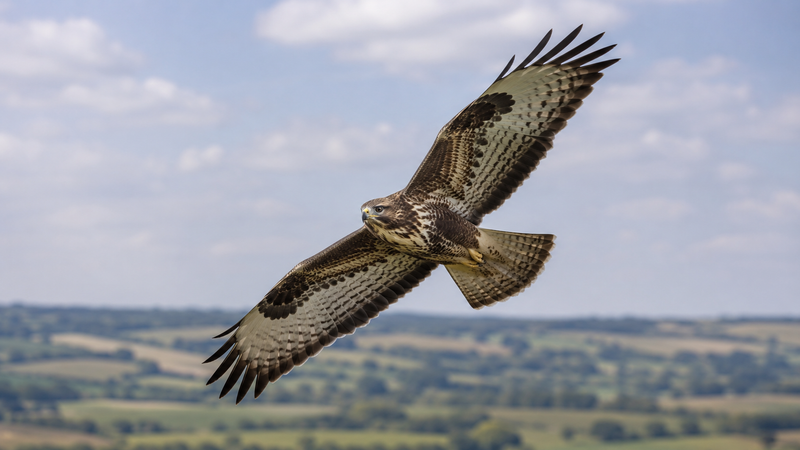
Bird of prey (or raptor) is a functional term for birds that hunt and kill live vertebrate prey using a combination of strong, sharp-clawed feet — talons — and a hooked bill for tearing flesh. It is not a single taxonomic group: falcons like the common kestrel, hawks and eagles like the common buzzard and white-tailed eagle, and owls like the tawny owl all count as raptors despite belonging to separate, only distantly related taxonomic orders.
What unites them is convergent evolution toward the same solution for the same problem — killing and processing live prey. Diurnal raptors (hawks, eagles, falcons) rely heavily on exceptional daytime vision, some of the sharpest in the animal kingdom, to spot prey from great distances or high altitude. Owls, hunting mainly at night, instead rely on extraordinarily sensitive hearing — aided in many species by an asymmetrical skull structure that helps pinpoint a sound's exact location — alongside large eyes adapted for low light.
Ecological role and conservation
Raptors typically sit near the top of local food webs as predators of smaller birds, mammals, and other vertebrates, which makes them sensitive indicators of wider ecosystem health: a decline in raptor numbers often signals a problem further down the food chain, whether prey scarcity, habitat loss, or — historically — the buildup of pesticides like DDT, which caused catastrophic eggshell-thinning declines across many raptor species in the mid-20th century before being banned in most countries.
Because raptors need relatively large hunting territories and often reproduce slowly, raising few young per year, several species carry elevated conservation status despite occupying wide geographic ranges — a pattern seen in species like the white-tailed eagle, listed as Near Threatened despite a recovering population across much of its Eurasian range.