Tawny Owl
The tawny owl (Strix aluco) is the most familiar owl across much of Europe and western Russia, a stocky, big-headed woodland hunter best known for its haunting hooting call after dark.
Key facts
- Latin name
- Strix aluco
- Family
- Strigidae (Typical Owls)
- Wingspan
- 94–104 cm
- Season
- resident year-round
- Diet
- Voles, mice, and other small rodents, Small birds, taken mostly while roosting at night, Earthworms and large insects, Amphibians and occasionally fish
- Conservation status
- LCLeast Concern
Appearance
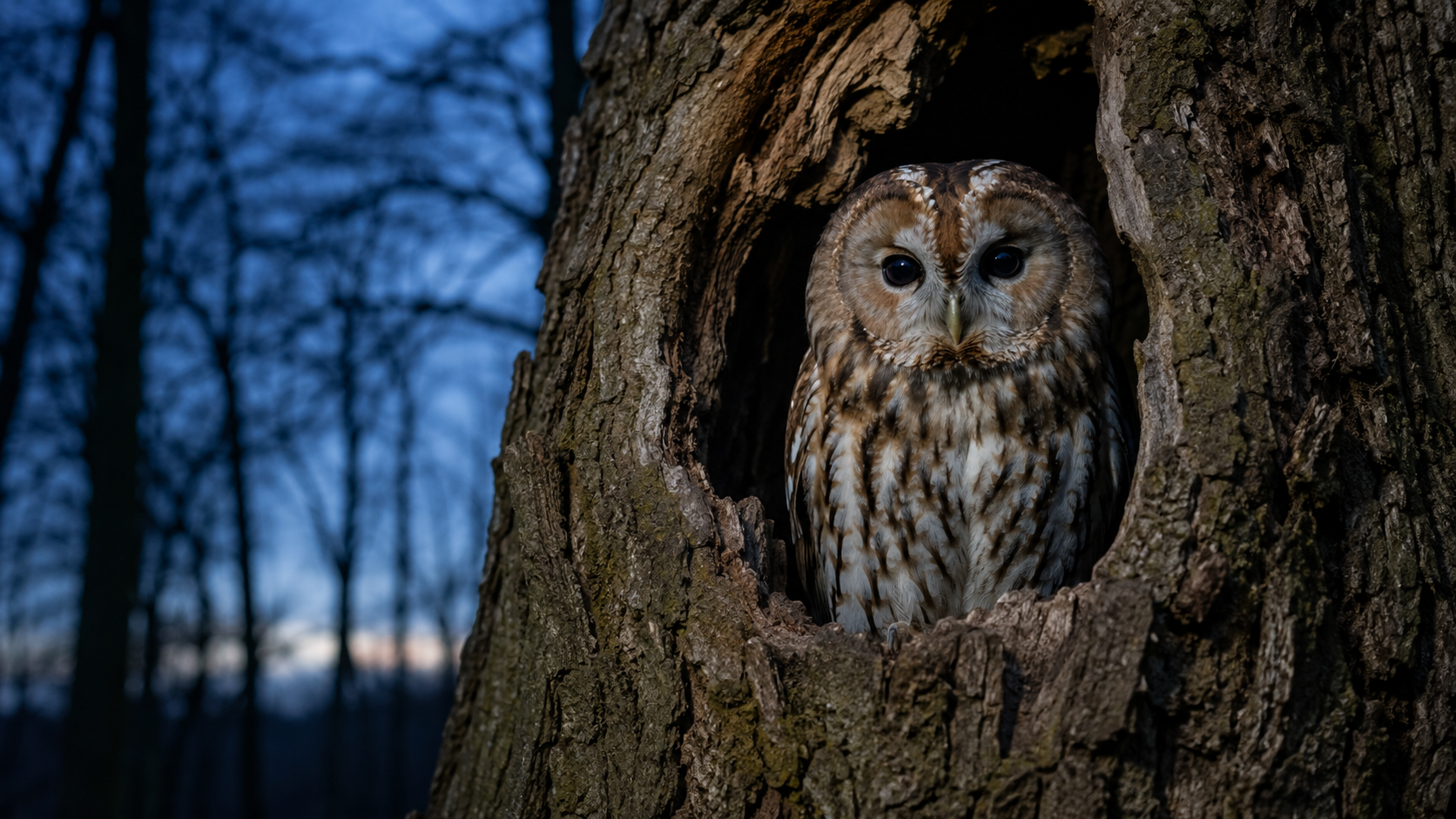
The tawny owl (Strix aluco) is a stocky, medium-large owl with a wingspan of 94 to 104 cm and a body length of 37 to 43 cm, weighing between roughly 385 and 800 grams. It has a large, rounded head with no ear tufts, a facial disc of concentric feather rings that funnels sound toward its ears, and enormous, dark liquid-black eyes adapted for gathering the faintest available light.
Plumage occurs in two main color forms — a warmer rufous-brown morph and a greyer morph — both marked with heavy dark streaking and mottling across the back, wings, and underparts that gives excellent camouflage against tree bark when the bird roosts motionless during the day. Unlike the long-eared owl, the tawny owl shows no visible ear tufts at all, and its overall silhouette is noticeably rounder and more compact.
Range and habitat
The tawny owl is widespread across most of Europe and extends through temperate western Russia into parts of western Siberia, generally absent from Ireland, northern Scandinavia, and the far north of European Russia. It is strongly resident throughout its range, with individuals typically remaining within the same territory for their entire adult lives rather than migrating or wandering widely.
It favors mature deciduous and mixed woodland with old trees offering natural nesting cavities, but has adapted successfully to parks, large gardens, and other wooded urban and suburban green spaces, making it one of the few owls a city resident is likely to hear regularly after dark, even without visiting true wilderness.
Behavior and lifestyle
Tawny owls are almost entirely nocturnal, spending daylight hours roosting motionless against a tree trunk or in dense cover, relying on camouflage rather than flight to avoid detection — a roosting bird disturbed by day is often quickly discovered and mobbed by small birds. At night they hunt primarily from a perch, dropping silently onto prey detected by sight or sound, their flight feathers specially structured with soft, comb-like edges that eliminate the whooshing noise typical of most birds and allow a near-silent approach.
Diet centers on voles, mice, and other small rodents, supplemented by small birds taken mainly while roosting, along with earthworms, large insects, and amphibians depending on local availability and season. Tawny owls are strongly territorial year-round, and pairs defend the same patch of woodland against intruders using loud hooting duets, particularly in autumn and again in early spring around the start of the breeding season.
Breeding
Tawny owls nest in tree cavities, old nests built by other birds, or nest boxes, laying a typical clutch of 2 to 3 eggs, occasionally up to 5 in years with abundant prey, incubated solely by the female for 28 to 30 days while the male provides food. Chicks leave the nest cavity at around 32 to 37 days old, often before they can fly properly — a stage known as "branching," during which fluffy young owls clamber around nearby branches and are still fed and defended vigorously by their parents.
Adult tawny owls are famously aggressive in defense of their young, and there are well-documented cases of birds striking humans, including researchers and even ornithologists, who approach too closely to an active nest.
Interesting facts
- The tawny owl's night vision is roughly 100 times more sensitive than a human's, but contrary to popular belief its hearing, not its eyesight alone, is the primary tool it relies on to detect prey moving under snow or leaf litter in complete darkness.
- Individual tawny owls can live over 20 years in the wild, considerably longer than most similarly sized birds, in large part because a stable, defended territory reduces many of the risks associated with dispersal and competition.
- The species' evocative hooting call has made it one of the most culturally recognizable owl sounds in Europe, frequently used as a generic "owl call" in films and recordings even when the scene is set somewhere the tawny owl doesn't actually occur.