Northern Goshawk
The northern goshawk (Accipiter gentilis) is a powerful, secretive forest hawk built for explosive short bursts of speed through dense woodland in pursuit of birds and mammals.
Key facts
- Latin name
- Accipiter gentilis
- Wingspan
- 89–127 cm
- Season
- resident year-round across most of its range
- Diet
- Medium-sized birds (pigeons, crows, grouse), Squirrels and other tree-dwelling mammals, Rabbits and hares, Occasionally reptiles and large insects
- Conservation status
- LCLeast Concern
Appearance
The northern goshawk (Accipiter gentilis) is a large, powerfully built hawk with short, broad, rounded wings and a long, rounded tail — proportions built for speed and tight turns through dense forest rather than sustained soaring. Wingspan ranges from 89 to 127 cm, with pronounced sexual size dimorphism: females can weigh up to 2.2 kilograms, nearly twice the weight of the smallest males, making the goshawk one of the raptors where male and female are most obviously mismatched in size.
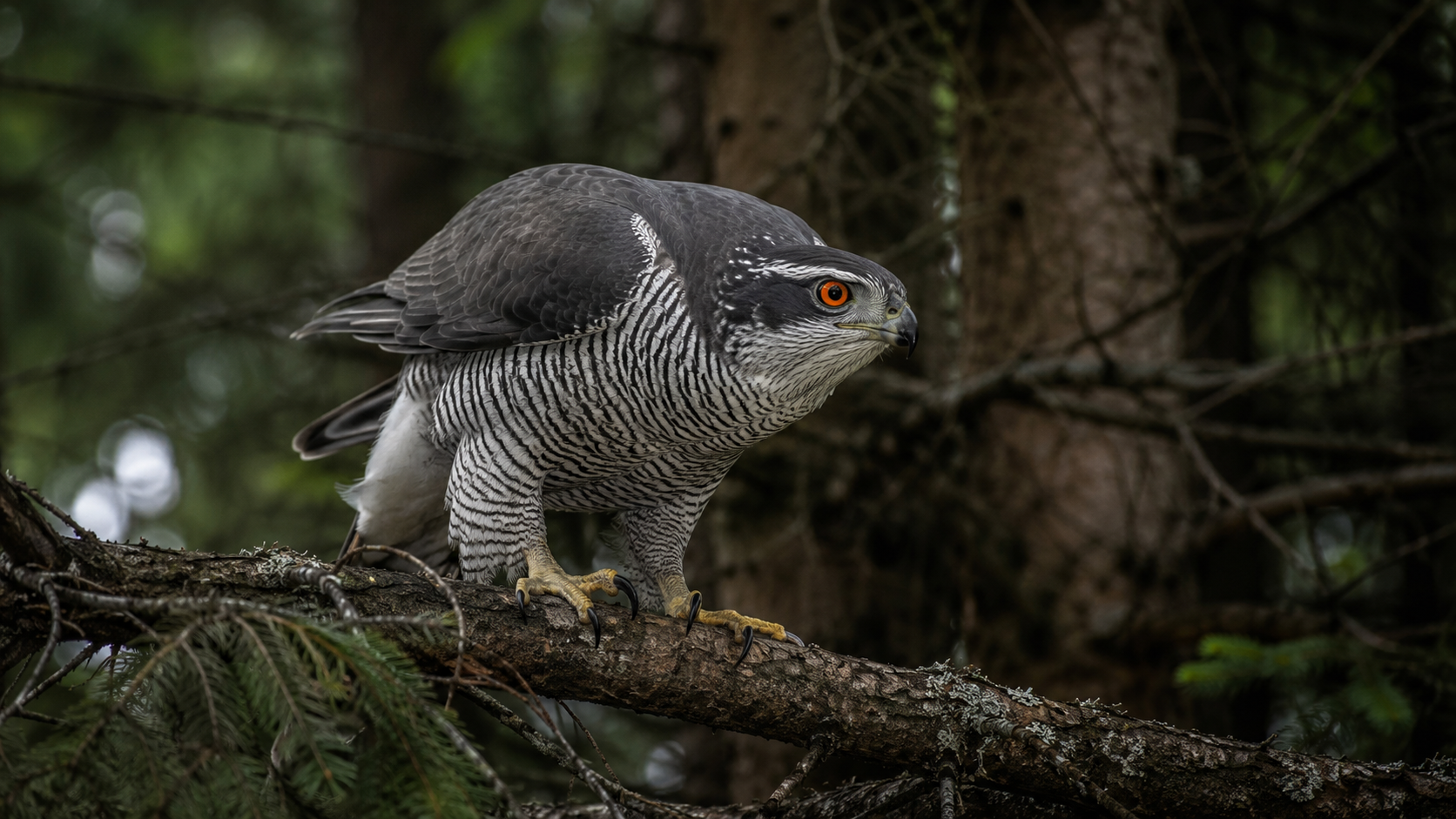
Adults show slate-grey to blue-grey upperparts and finely barred pale grey underparts, with a piercing orange-red to deep red eye and a bold pale eyebrow stripe that gives the bird its characteristically fierce expression. Juveniles are browner overall, with coarse dark streaking on a buff breast rather than the fine barring of adults, and paler yellow eyes that darken with age. Its heavier build, thicker legs, and more prominent eyebrow distinguish it from the smaller, more delicate Eurasian sparrowhawk, with which it is most often confused.
Range and habitat
The northern goshawk breeds across a vast swathe of the Northern Hemisphere's forested regions, from Western Europe through Russia to the Pacific coast of Siberia, and separately across much of North America. Across nearly all of this range it is resident year-round, defending the same territory across seasons rather than migrating, though birds from the harshest northern parts of Siberia may move short distances south in severe winters when prey becomes scarce.
It is a true forest specialist, strongly favoring large tracts of mature woodland — both coniferous taiga and deciduous or mixed forest — with enough canopy cover and open flight lanes between trunks to support its fast, maneuverable hunting style. Unlike many raptors, it has adapted only patchily to fragmented or urban landscapes, though goshawks nesting in large city parks have been recorded in parts of its European range.
Behavior and lifestyle
The goshawk's hunting style is built around explosive acceleration and extreme maneuverability rather than the sustained speed of a stooping falcon: it typically watches from a concealed perch or flies low and fast through the trees, using cover to approach prey unseen before a sudden, powerful burst of speed and a chase that can involve tight turns, obstacle-dodging, and even brief pursuit on foot through undergrowth. Its diet centers on medium-sized birds such as pigeons, crows, and grouse, along with squirrels and other tree-dwelling mammals, and it is powerful enough to take prey as large as hares.
Away from the nest, goshawks are notoriously secretive and difficult to observe, spending most of the day perched motionless in dense cover. The clearest window into their presence is the breeding display flight in early spring, when pairs soar conspicuously above the forest canopy calling loudly — often the only time of year the species is reliably seen in open sky.
Breeding
Goshawks build a large stick nest high in a mature tree, frequently reusing and enlarging the same nest across multiple years, sometimes maintaining more than one alternate nest within a territory. The typical clutch is 2 to 4 eggs, incubated mainly by the female for around 35 to 38 days while the male provisions her with food. Chicks fledge at roughly 35 to 46 days old and remain dependent on their parents, particularly for food, for several weeks to months after leaving the nest — a longer dependency period than many other raptors of similar size.
Goshawks are famously aggressive in defense of the nest, and adults will strike or even draw blood from humans, dogs, or other animals that approach too closely, a trait well known to foresters and researchers who work in goshawk territory during the breeding season.
Interesting facts
- The name "goshawk" derives from Old English words meaning "goose hawk," reflecting a long history of use in falconry to hunt geese and other large birds.
- The northern goshawk was historically persecuted heavily as a threat to game birds and poultry, leading to local extinctions in parts of Western Europe during the 19th and 20th centuries; many populations have since recovered through legal protection and natural recolonization, including reintroductions aided partly by escaped falconry birds.
- Despite its formidable hunting reputation, the goshawk itself can fall prey to the Eurasian eagle-owl, one of the few predators large and powerful enough to threaten an adult bird.