Black Kite
The black kite (Milvus migrans) is one of the most abundant birds of prey on Earth, an adaptable scavenger easily recognized by its shallow forked tail and buoyant, twisting flight.
Key facts
- Latin name
- Milvus migrans
- Wingspan
- 135–155 cm
- Season
- April – September in most of Russia and Europe
- Diet
- Carrion and roadkill, Fish and other food scavenged near water, Small mammals, birds, and reptiles, Large insects, especially around grass fires, Refuse scavenged at rubbish dumps and near human settlements
- Conservation status
- LCLeast Concern
Appearance
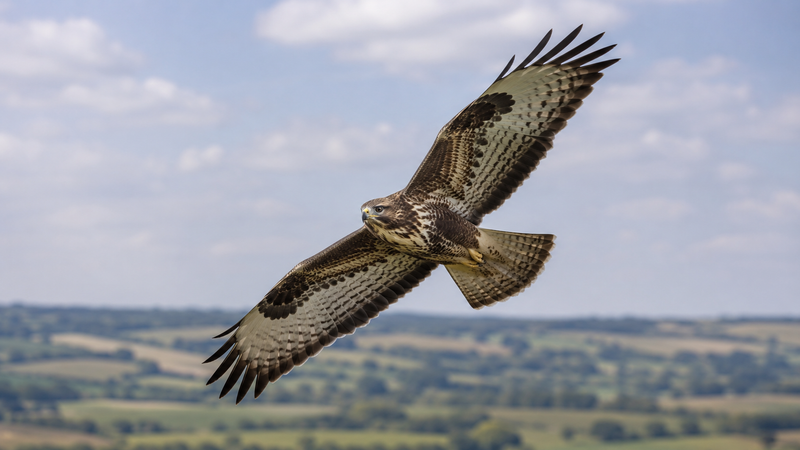
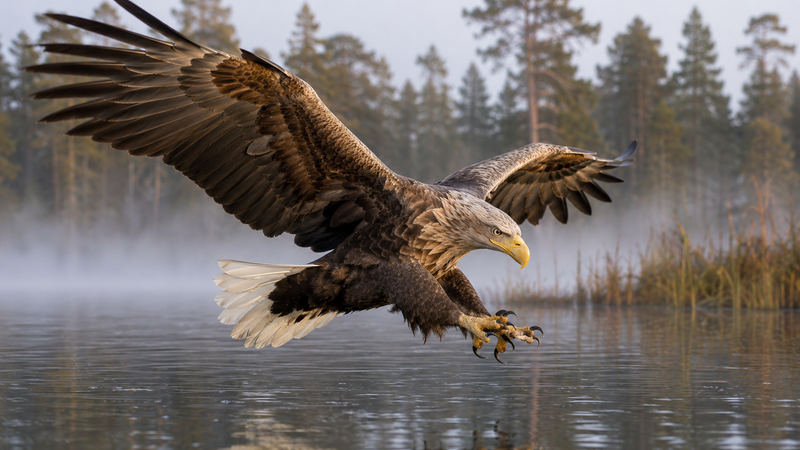
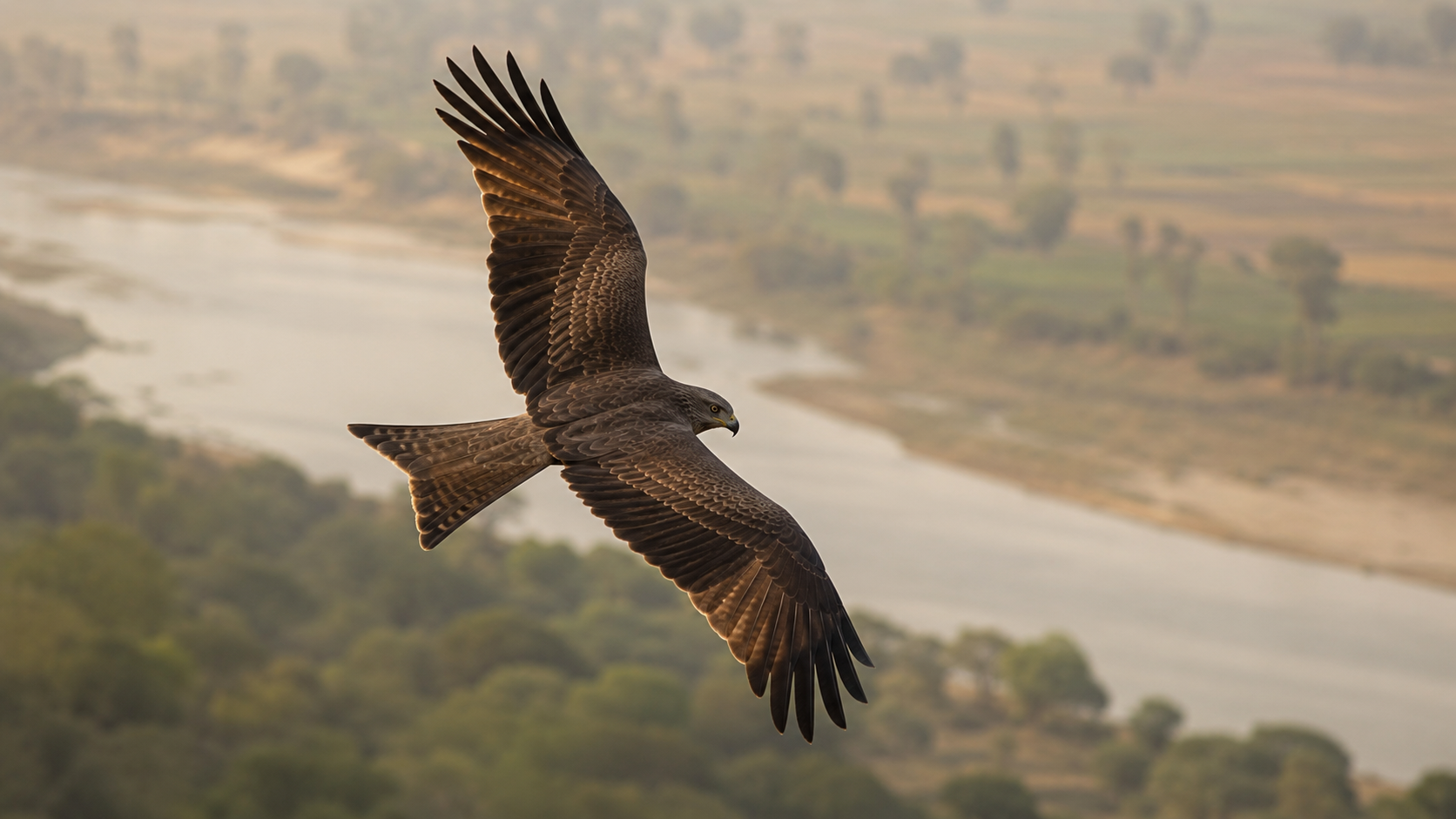
The black kite (Milvus migrans) is a medium-sized raptor with long, angled wings and a wingspan of 135 to 155 cm, weighing between roughly 560 grams and 1.2 kilograms. Its most distinctive feature is a shallow forked tail, which the bird continuously twists and tilts in flight to steer — a habit that, combined with a light, almost tern-like buoyancy in the air, makes it identifiable at a distance even before plumage details are visible.
Plumage is a fairly uniform sooty to dark brown across the body, with somewhat paler, warmer brown flight feathers and a pale patch near the base of the outer primaries that shows clearly from below in flight. The head is slightly paler grey-brown than the body, and the beak is smaller and less heavily hooked than in the true eagles or buzzards, reflecting its more scavenging, less pure-predator lifestyle.
Range and habitat
The black kite has one of the largest breeding ranges of any bird of prey in the world, spanning Europe, most of Asia, and Africa, with several recognized subspecies across this vast area. In Russia and most of Europe it is a summer migrant, present from April to September and wintering mainly in sub-Saharan Africa or southern Asia, while populations in parts of Africa and southern Asia are resident year-round.
It favors open and semi-open country near water — river valleys, lake shores, wetland edges, and farmland — but shows an exceptional tolerance for human-altered and urban environments compared to most raptors, regularly nesting and foraging in towns, around rubbish dumps, fishing harbors, and even city centers across large parts of its Asian and African range.
Behavior and lifestyle
The black kite is an opportunistic generalist above all else, feeding on carrion, scavenged fish and refuse, and live prey including small mammals, birds, reptiles, and large insects, which it will snatch directly from the ground or water surface in a low, agile pass without landing. It readily follows agricultural machinery, grass fires, and even other predators to catch prey flushed into the open, and is well known for scavenging at rubbish dumps and fishing harbors wherever these provide a reliable food source.
Outside the breeding season, black kites are highly gregarious, often roosting and migrating in large flocks that can number in the hundreds or even thousands at major migration bottlenecks, a striking contrast to the largely solitary habits of most other diurnal raptors covered in this atlas.
Breeding
Black kites build an untidy stick nest in a tree, often incorporating unusual material such as plastic, cloth, or paper scavenged from nearby settlements — a habit noted in numerous populations across its range. The typical clutch is 2 to 3 eggs, incubated mainly by the female for around 30 to 34 days. Chicks fledge at roughly 42 to 50 days old and remain near the nest, dependent on their parents, for a further few weeks. In areas with abundant food, black kites sometimes nest in loose colonies rather than strictly defended individual territories, an unusual trait among diurnal birds of prey.
Interesting facts
- Black kites are among the relatively few birds of prey documented using tools: individuals in parts of Australia and Africa have been observed picking up smoldering sticks from grass fires and dropping them in unburned vegetation, apparently to flush out prey — a behavior researchers describe as intentional fire-spreading.
- Large migratory gatherings of black kites at narrow sea crossings, such as the Strait of Gibraltar and the Bosphorus, can number in the tens of thousands of birds over the course of a single migration season.
- Despite being one of the most numerous raptors on Earth overall, some regional populations — particularly in parts of Western Europe — have declined due to habitat change and collisions with power lines, showing that a healthy global population can still mask local pressure.