Black-headed Gull
The black-headed gull (Chroicocephalus ridibundus) is Europe's most familiar small gull, easily identified by its chocolate-brown breeding hood and readily seen far from the coast on inland lakes and city parks.
Key facts
- Latin name
- Chroicocephalus ridibundus
- Family
- Laridae (Gulls)
- Wingspan
- 94–110 cm
- Season
- March – September, with many birds wintering locally where water stays open
- Diet
- Aquatic and terrestrial insects, caught in flight or picked from the ground, Small fish and aquatic invertebrates, Earthworms, taken from freshly ploughed or wet fields, Food scraps and waste in urban and harbor settings
- Conservation status
- LCLeast Concern
Appearance
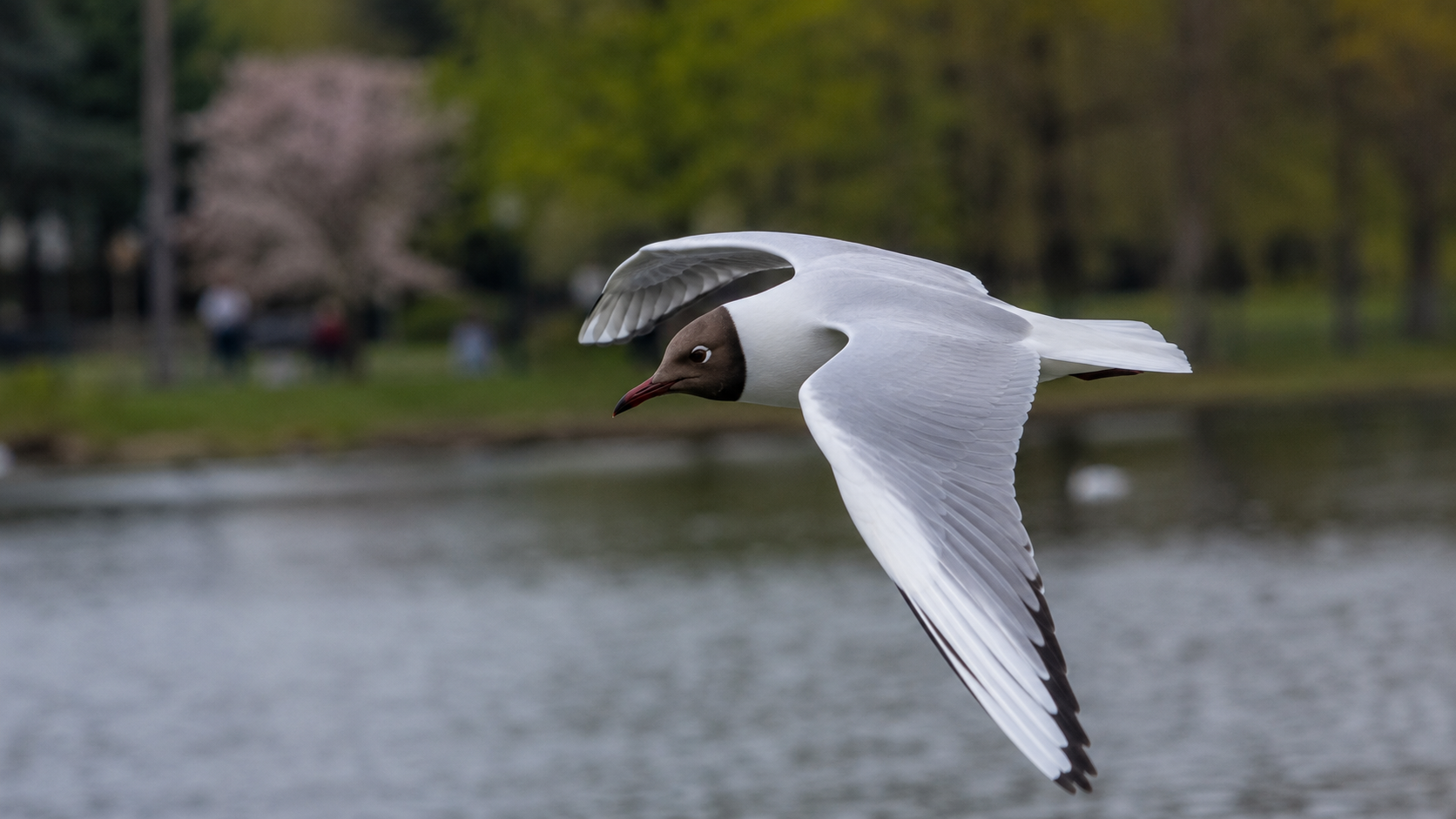
The black-headed gull (Chroicocephalus ridibundus) is a small, slender gull with a wingspan of 94–110 cm and a body length of 35–39 cm, weighing between roughly 200 and 400 grams. In breeding plumage, adults show a distinctive dark chocolate-brown hood covering the head, sharply set off against a white body, pale grey back, and slim red bill with a dark tip — a look retained only from roughly late winter through summer.
Outside the breeding season, the hood is lost almost entirely, replaced by a mostly white head marked with a small dark spot behind the eye, making the species notably plainer-headed for much of the year. In flight at any season, the black-headed gull is readily identified by a bold white wedge along the leading edge of the outer wing, contrasting with darker grey and black wingtips, a pattern visible at considerable distance even on a fast-moving bird.
Range and habitat
The black-headed gull breeds across an enormous range spanning most of Europe and temperate Asia, including nearly all of Russia south of the Arctic tundra, and is notably flexible in habitat compared with many gull species, breeding not only on coasts but extensively inland on lakes, reservoirs, marshes, and river systems far from the sea. It is one of the most familiar gulls across much of its range precisely because of this inland adaptability.
Russian and continental European breeding populations are largely migratory, present on breeding waters from March to September, though many individuals winter well within the milder parts of the same general range wherever water remains sufficiently open, and the species is a very common sight on city park lakes and rivers even in winter across much of western and central Europe.
Behavior and lifestyle
Black-headed gulls are opportunistic and highly adaptable foragers, taking aquatic and terrestrial insects both in flight and picked directly from open ground, along with small fish, aquatic invertebrates, and earthworms exposed by ploughing or heavy rain. This dietary flexibility, combined with a strong tolerance of human activity, has made the species a familiar scavenger around harbors, waste sites, and urban parks, where it readily takes food scraps.
Highly social throughout the year, black-headed gulls breed in dense, noisy colonies that can number from a few dozen to many thousands of pairs, and gather in large mixed flocks outside the breeding season, often following farm machinery to feed on invertebrates disturbed by ploughing or joining other gull species at rich feeding sites such as rubbish tips and fishing harbors.
Breeding
Black-headed gulls nest colonially, typically on the ground among marsh vegetation, a low island, or occasionally floating vegetation offering some protection from ground predators, with nests often placed close enough together that neighboring pairs can see and hear one another constantly. A typical clutch contains 2 to 3 eggs, incubated by both parents for 22 to 26 days.
Chicks are semi-precocial, able to walk and leave the nest scrape within a few days of hatching but remaining dependent on both parents for food and protection within the colony for several weeks, fledging at around 32 to 35 days. The dense colony provides some collective defense against predators, with birds mobbing intruders noisily and persistently as a group.
Interesting facts
- Despite its name and gull-typical appearance, the black-headed gull is not closely tied to marine habitats at all, and many populations across Europe and Russia spend their entire lives without ever visiting open coastline.
- The species' dark breeding hood is lost through a partial head moult after the breeding season, one of the more visually striking seasonal plumage changes among common European birds.
- Black-headed gull colonies are frequently used as informal indicators of wetland health by naturalists, since the species is sensitive to disturbance and water-level changes at traditional breeding sites, even though the species itself remains classified as Least Concern and widespread overall.