Eurasian Blackcap
The Eurasian blackcap (Sylvia atricapilla) is a plain grey-brown warbler with a neat black or chestnut cap, prized for a rich, fluting song and famous for rapidly evolving a brand-new migration route within living memory.
Key facts
- Latin name
- Sylvia atricapilla
- Wingspan
- 20–24 cm
- Season
- mostly April – October, migrating to Africa and the Mediterranean; a growing minority now winters in northwestern Europe
- Diet
- Insects and spiders, especially during the breeding season, Berries and soft fruit, especially in autumn and winter, Garden feeder food, including fruit and suet, in wintering birds
- Conservation status
- LCLeast Concern
Appearance
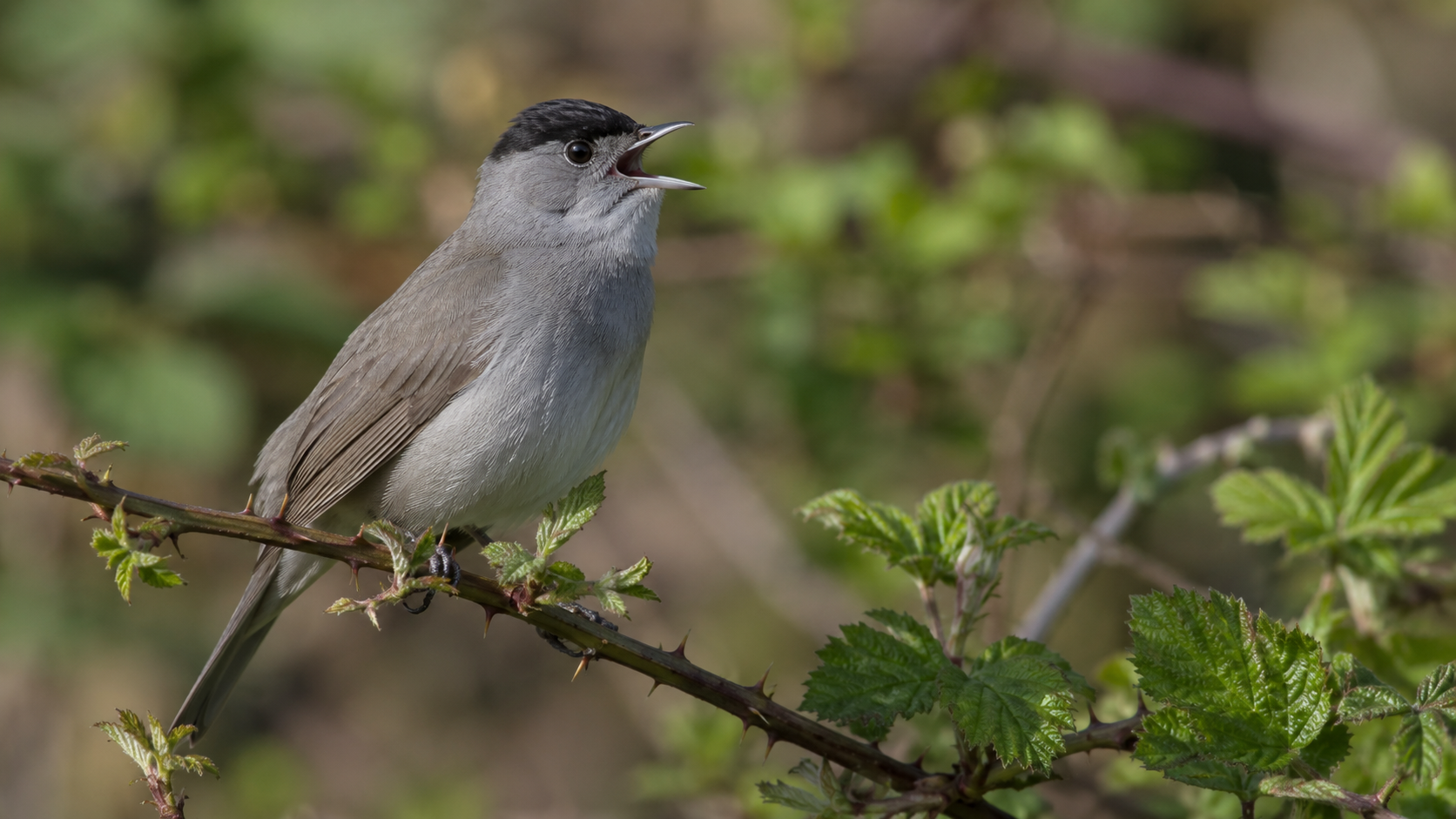
The Eurasian blackcap (Sylvia atricapilla) is a small, slender warbler with a wingspan of 20 to 24 cm and a body length of about 13 to 15 cm, weighing between roughly 16 and 25 grams. Its plumage is otherwise plain — grey-brown above, paler grey below — but the head carries the species' defining field mark: a neat, sharply defined cap that is glossy black in the male and warm chestnut-brown in the female, a clean sexual difference that makes the species one of the easier warblers to sex confidently in the field.
Beyond the cap, blackcaps show few other strong markings, relying on their generally plain, unstreaked grey-brown plumage and slim build to distinguish them from other small warblers, most reliably confirmed by the combination of overall shape, the distinctive cap, and, especially, the species' rich, distinctive song.
Range and habitat
The Eurasian blackcap breeds across nearly all of Europe and extends into western Russia and parts of the Middle East and North Africa. Most of the population is migratory, present on the breeding grounds from roughly April to October and wintering traditionally in the Mediterranean basin and sub-Saharan Africa, though a growing number of birds, primarily from central European breeding populations, now winter instead in Britain, Ireland, and other parts of northwestern Europe — a genuinely new migratory pattern that has emerged within recent decades.
It favors woodland with a dense shrub layer, scrubby forest edges, overgrown hedgerows, and increasingly large gardens with sufficient cover, generally preferring somewhat denser vegetation than more open-country warblers.
Behavior and lifestyle
Blackcaps feed mainly on insects and spiders during the breeding season, an important protein source for raising chicks, shifting substantially toward berries and soft fruit in autumn and winter, a dietary flexibility that has made the small but growing population of birds wintering in northwestern Europe increasingly reliant on garden fruit and, notably, garden bird feeders rather than the more insect-rich diet available on traditional African wintering grounds.
The male's song — a rich, fluting warble that typically builds from a quieter, more subdued introductory section into a loud, clear, musical climax — is one of the most highly regarded among common European warblers, sometimes drawing direct comparison to the nightingale despite belonging to an entirely different genus. Blackcaps are generally more visible than some skulking warblers, often singing from a moderately exposed perch within cover rather than staying fully hidden.
Breeding
The female builds a fairly loose, sometimes flimsy cup nest low in dense shrub or bramble cover, occasionally supplemented by a rougher "cock's nest" built earlier by the male as part of courtship display, of which the female typically chooses only one to actually use for eggs. The typical clutch is 3 to 6 eggs, most often 4 or 5, incubated by both parents for 11 to 12 days. Chicks fledge at around 10 to 14 days old, and pairs may raise two broods where the season allows.
Interesting facts
- The blackcap's evolving new migration route to Britain and Ireland, first documented scientifically in the late 20th century, is one of the most frequently cited real-world examples of rapid, observable evolutionary change in a wild bird population, driven by a combination of genetic predisposition, climate change, and the modern availability of garden bird feeders.
- Genetic studies tracking this migratory shift have shown that blackcaps wintering in Britain and those wintering in the traditional Mediterranean and African range now differ measurably in migratory direction, a divergence that researchers continue to monitor as a live case study in evolution in action.
- Despite its modest, unassuming grey-brown plumage, the blackcap's song has led to it being nicknamed the "northern nightingale" in parts of its range, a testament to how much vocal quality alone can shape a bird's cultural reputation.