Thrush Nightingale
The thrush nightingale (Luscinia luscinia) is a plain, skulking songbird of dense riverside thickets, famous far beyond its unassuming looks for one of the richest, loudest night songs of any European bird.
Key facts
- Latin name
- Luscinia luscinia
- Wingspan
- 25–26 cm
- Season
- May – September, wintering in East Africa
- Diet
- Insects and other invertebrates, Earthworms and small snails, Berries and soft fruit before autumn migration
- Conservation status
- LCLeast Concern
Appearance
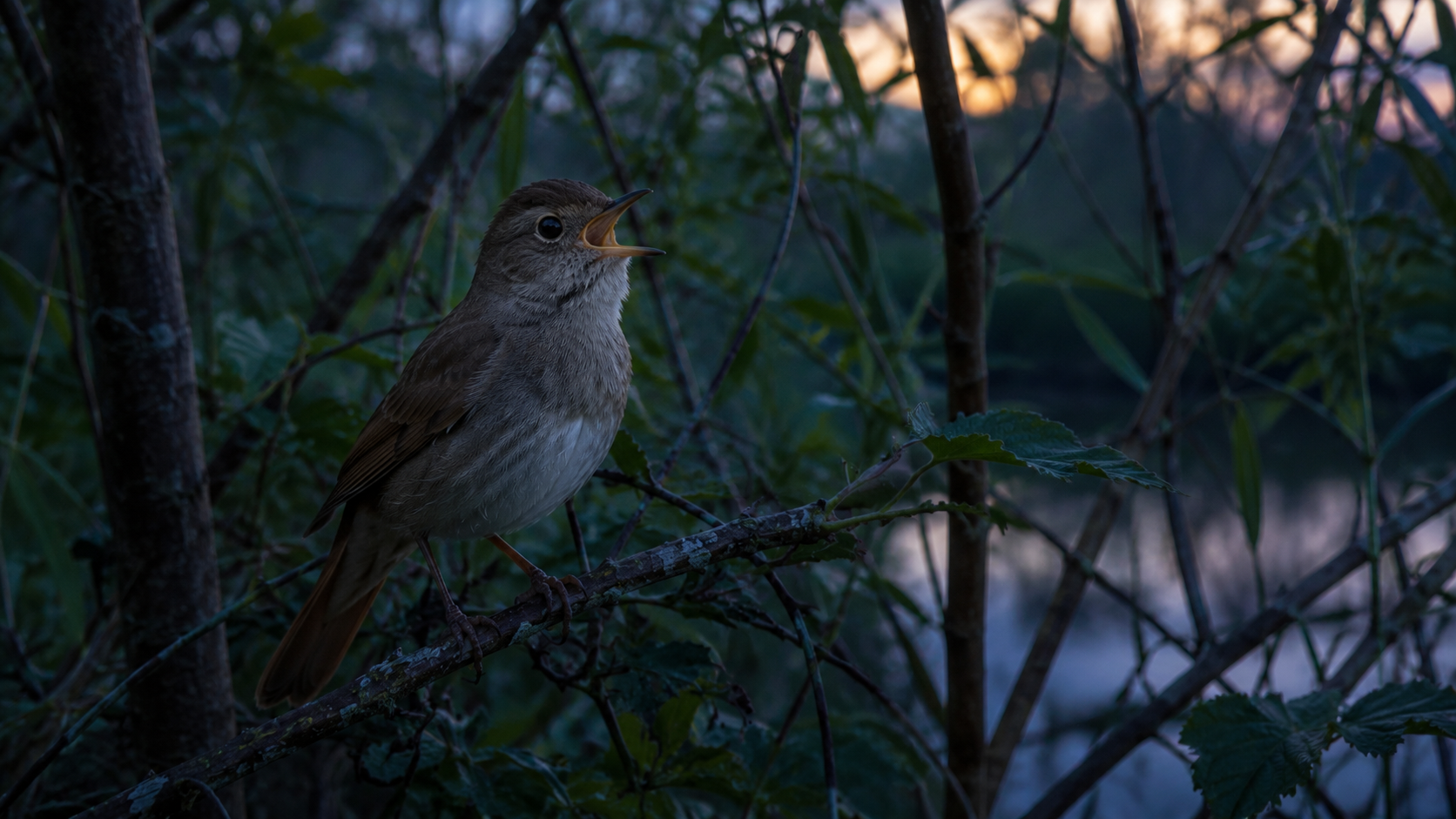
The thrush nightingale (Luscinia luscinia) is a fairly large, plainly plumaged songbird within its family, with a wingspan of 25 to 26 cm and a body length of about 16 to 17 cm, weighing between roughly 20 and 28 grams. Its upperparts are a uniform warm brown, deepening to a slightly more russet tone on the tail, while the underparts are pale greyish-white with faint, diffuse mottling across the breast — subtle, unremarkable plumage that gives almost no hint of the species' outsized vocal reputation.
The plainness of the nightingale's appearance is, in a sense, functional: spending nearly all of its time deep within dense, tangled vegetation, the species relies far more on cryptic coloring for concealment than on visual display, in sharp contrast to more brightly patterned relatives that spend more time in open view.
Range and habitat
The thrush nightingale breeds across a broad band of Eastern and Northern Europe and Russia, extending from roughly the Baltic states and Scandinavia eastward across much of European Russia, a range set somewhat further east and north than the closely related common nightingale, with which it overlaps and occasionally hybridizes in parts of Central and Eastern Europe. It is a long-distance migrant, present on the breeding grounds from roughly May to September and wintering in East Africa.
It favors dense, tangled vegetation, particularly damp thickets along rivers and lake margins, overgrown scrub, and dense hedgerow undergrowth, generally avoiding open or sparsely vegetated habitat and remaining deeply hidden within cover for most of its time on the breeding grounds.
Behavior and lifestyle
Thrush nightingales feed on insects and other invertebrates, foraging mainly on or near the ground within dense cover, supplemented by earthworms, small snails, and, before autumn migration, berries and soft fruit that help build fat reserves for the long journey south. The species is notoriously difficult to observe directly, spending the vast majority of its time skulking within thick vegetation rather than perching in the open.
Its defining behavior, and the source of its fame, is its song: an exceptionally loud, rich, and structurally complex sequence of fluting whistles, harsh churring notes, and a distinctive rising crescendo passage, delivered mainly after dark when background noise and competing bird song are minimal, letting the song carry unusually far through otherwise quiet nighttime air.
Breeding
The female builds a well-concealed cup nest low in dense vegetation or occasionally directly on the ground within thick cover, reflecting the species' overall preference for staying hidden. The typical clutch is 4 to 5 eggs, incubated solely by the female for around 13 days. Chicks leave the nest at around 11 to 12 days old, before they can fly well, remaining hidden and dependent within dense cover as they continue to develop, a pattern broadly similar to the "branching" stage seen in some other ground- and shrub-nesting songbirds.
Interesting facts
- The nightingale's song has inspired centuries of poetry, music, and folklore across numerous European cultures, frequently used as a symbol of romantic longing or beauty despite the singer itself rarely being seen by the same audiences who celebrate its voice.
- Sound recordings of nightingale song have documented individual birds capable of producing well over a hundred distinct song phrase types, among the largest documented repertoires of any European songbird.
- Because the thrush nightingale and common nightingale are so difficult to separate by plumage alone, birdwatchers in the zone where their ranges overlap typically rely on subtle differences in song structure to confidently identify which species they are hearing.